

Accurate Hot Selling 156-215.82 Exam Dumps 2026 Newly Released
Get 100% Authentic CheckPoint 156-215.82 Dumps with Correct Answers
NEW QUESTION # 44
What is the purpose of the Clean-up Rule?
- A. To eliminate duplicate log entries in the Security Gateway
- B. To clean up policies found inconsistent with the compliance blade reports
- C. To log all traffic that is not explicitly allowed or denied in the Rule Base
- D. To remove all rules that could have a conflict with other rules in the database
Answer: C
Explanation:
The purpose of the Clean-up Rule is to log all traffic that is not explicitly allowed or denied in the Rule Base78.The Clean-up Rule is the last rule in the rulebase and is used to drop and log explicitly unmatched traffic97.To improve the rulebase performance, noise traffic that is logged in the Clean-up rule should be included in the Noise rule so it is matched and dropped higher up in the rulebase8. The other options are not valid purposes of the Clean-up Rule.
NEW QUESTION # 45
Your internal networks 10.1.1.0/24, 10.2.2.0/24 and 192.168.0.0/16 are behind the Internet Security Gateway. Considering that Layer 2 and Layer 3 setup is correct, what are the steps you will need to do in SmartConsole in order to get the connection working?
- A. 1. Define an accept rule in Security Policy.2. Define automatic NAT for each network to NAT the networks behind a public IP.3. Publish the policy.
- B. 1. Define an accept rule in Security Policy.2. Define automatic NAT for each network to NAT the networks behind a public IP.3. Publish and install the policy.
- C. 1. Define an accept rule in Security Policy.2. Define Security Gateway to hide all internal networks behind the gateway's external IP.3. Publish and install the policy.
- D. 1. Define an accept rule in Security Policy.2. Define Security Gateway to hide all internal networks behind the gateway's external IP.3. Publish the policy.
Answer: B
Explanation:
The steps you will need to do in SmartConsole in order to get the connection working behind the Internet Security Gateway are:
Define an accept rule in Security Policy. This rule allows the traffic from your internal networks to pass through the Security Gateway.
Define automatic NAT for each network to NAT the networks behind a public IP. This option translates the private IP addresses of your internal networks to a public IP address assigned by your ISP router. This way, your internal networks can communicate with the Internet using a valid IP address.
Publish and install the policy. This step applies the changes you made to the Security Gateway and activates the security and NAT rules.
NEW QUESTION # 46
When installing a dedicated R80 SmartEvent server, what is the recommended size of the root partition?
- A. Less than 20GB
- B. More than 10GB and less than 20 GB
- C. Any size
- D. At least 20GB
Answer: D
Explanation:
The correct answer is D because the recommended size of the root partition for a dedicated R80 SmartEvent server is at least 20GB2. Any size, less than 20GB, or more than 10GB and less than 20GB are not sufficient for the SmartEvent server. Check Point R80.40 Installation and Upgrade Guide
NEW QUESTION # 47
Which configuration element determines which traffic should be encrypted into a VPN tunnel vs. sent in the clear?
- A. The firewall topologies
- B. The Rule Base
- C. NAT Rules
- D. The VPN Domains
Answer: D
Explanation:
The VPN Domains configuration element determines which traffic should be encrypted into a VPN tunnel vs. sent in the clear.The VPN Domain is the set of hosts and networks that are allowed to communicate securely with the gateway12. The firewall topologies, NAT rules, and the rule base do not directly affect the VPN encryption decision. Check Point R81 Security Gateway Technical Administration Guide,CCSA/CCSE Exam Tips & Content - R80.X vs. R81.X - Check Point CheckMates
NEW QUESTION # 48
What is the most recommended installation method for Check Point appliances?
- A. DVD media created with Check Point ISOMorphic
- B. USB media created with Check Point ISOMorphic
- C. SmartUpdate installation
- D. Cloud based installation
Answer: B
Explanation:
USB media created with Check Point ISOMorphic is the most recommended installation method for Check Point appliances, as it provides a fast and easy way to install the Gaia operating system and the latest software version4.SmartUpdate installation requires an existing Gaia installation and does not support fresh installations4.DVD media created with Check Point ISOMorphic is less convenient than USB media, as it requires burning the image to a DVD and inserting it into the appliance4.Cloud based installation is not applicable for Check Point appliances, as it is intended for cloud environments such as AWS or Azure4.
NEW QUESTION # 49
Which two Identity Awareness commands are used to support identity sharing?
- A. Policy Enforcement Point (PEP) and Policy Manipulation Point (PMP)
- B. Policy Decision Point (PDP) and Policy Enforcement Point (PEP)
- C. Policy Activation Point (PAP) and Policy Decision Point (PDP)
- D. Policy Manipulation Point (PMP) and Policy Activation Point (PAP)
Answer: B
Explanation:
The answer is A because Identity Awareness commands are used to support identity sharing between Security Gateways. Policy Decision Point (PDP) is the Security Gateway that collects identities from various sources and shares them with other gateways.Policy Enforcement Point (PEP) is the Security Gateway that enforces the policy based on the identities received from the PDP12Check Point R81 Identity Awareness Administration Guide,Check Point R81 Security Management Administration Guide
NEW QUESTION # 50
Which of the following is NOT a policy type available for each policy package?
- A. Threat Emulation
- B. Access Control
- C. Desktop Security
- D. Threat Prevention
Answer: A
NEW QUESTION # 51
True or False: More than one administrator can log into the Security Management Server with SmartConsole with write permission at the same time.
- A. False, this feature has to be enabled in the Global Properties.
- B. True, every administrator works in a session that is independent of the other administrators
- C. True, every administrator works on a different database that Is independent of the other administrators
- D. False, only one administrator can login with write permission
Answer: B
Explanation:
SmartConsole is a unified graphical user interface that allows administrators to manage multiple Check Point security products from a single console. More than one administrator can log into the Security Management Server with SmartConsole with write permission at the same time. Every administrator works in a session that is independent of the other administrators.The changes made by one administrator are not visible to others until they are published2. Check Point R81 SmartConsole R81 User Guide
NEW QUESTION # 52
Which of the following cannot be configured in an Access Role Object?
- A. Networks
- B. Time
- C. Machines
- D. Users
Answer: B
Explanation:
The following cannot be configured in an Access Role Object:Time4.An Access Role Object is a way to define a group of users based on four criteria: Networks, Users, Machines, and Locations5. Networks are IP addresses or network objects that represent the source or destination of the traffic. Users are user accounts or user groups from an identity source such as LDAP or RADIUS. Machines are endpoints that are identified by MAC addresses or certificates. Locations are geographical regions based on IP addresses. Check Point R81 Firewall Administration Guide,Check Point R81 Identity Awareness Administration Guide
NEW QUESTION # 53
The competition between stateful inspection and proxies was based on performance, protocol support, and security. Considering stateful Inspections and Proxies, which statement is correct?
- A. Proxies offer far more security because of being able to give visibility of the payload (the data).
- B. Stateful Inspection is limited to Layer 3 visibility, with no Layer 4 to Layer 7 visibility capabilities.
- C. When it comes to performance, stateful inspection was significantly faster than proxies.
- D. When it comes to performance, proxies were significantly faster than stateful inspection firewalls.
Answer: C
Explanation:
Stateful Inspection and Proxies are two different technologies for implementing firewall security. Stateful Inspection is a technique that inspects packets at the network layer and maintains a state table that tracks the status of each connection. Proxies are applications that act as intermediaries between clients and servers, and inspect packets at the application layer. The competition between stateful inspection and proxies was based on performance, protocol support, and security.When it comes to performance, stateful inspection was significantly faster than proxies, because it did not have to process the payload of each packet and could handle more concurrent connections1. Check Point R81 Security Gateway Technical Administration Guide
NEW QUESTION # 54
Fill in the blanks: A ____ license requires an administrator to designate a gateway for attachment whereas a _____ license is automatically attached to a Security Gateway.
- A. Formal; corporate
- B. Central; local
- C. Local; central
- D. Local; formal
Answer: B
Explanation:
A central license is automatically attached to a Security Gateway when it is installed.A local license requires an administrator to designate a gateway for attachment1, p. 8. Check Point CCSA - R81: Practice Test & Explanation
NEW QUESTION # 55
The Online Activation method is available for Check Point manufactured appliances. How does the administrator use the Online Activation method?
- A. Using the Gaia First Time Configuration Wizard, the appliance connects to the Check Point User Center and downloads all necessary licenses and contracts.
- B. The SmartLicensing GUI tool must be launched from the SmartConsole for the Online Activation tool to start automatically.
- C. No action is required if the firewall has internet access and a DNS server to resolve domain names.
- D. The cpinfo command must be run on the firewall with the switch -online-license-activation.
Answer: A
Explanation:
The Online Activation method is available for Check Point manufactured appliances. The administrator uses the Online Activation method by using the Gaia First Time Configuration Wizard, the appliance connects to the Check Point User Center and downloads all necessary licenses and contracts. This method requires internet access and a valid User Center account. [Check Point Licensing and Contract Operations User Guide], [Check Point R81 Gaia Installation and Upgrade Guide]
NEW QUESTION # 56
Which of the following describes how Threat Extraction functions?
- A. Delivers file with original content
- B. Delivers PDF versions of original files with active content removed
- C. Proactively detects threats
- D. Detect threats and provides a detailed report of discovered threats
Answer: B
Explanation:
Threat Extraction delivers PDF versions of original files with active content removed, such as macros, embedded objects, and scripts.This ensures that users receive clean and safe files in seconds12. Check Point SandBlast Zero-Day Protection,Check Point Threat Extraction
NEW QUESTION # 57
You want to verify if there are unsaved changes in GAiA that will be lost with a reboot. What command can be used?
- A. show unsaved
- B. show configuration diff
- C. show config-state
- D. show save-state
Answer: C
Explanation:
The commandshow cnfig-statecan beused to verify if there are unsaved changes in GAiA that will be lost with a reboot . The other commands are not valid in GAiA. [Check Point GAiA Administration Guide], [Check Point CCSA - R81: Practice Test & Explanation]
NEW QUESTION # 58
From SecureXL perspective, what are the tree paths of traffic flow:
- A. Layer Path; Blade Path; Rule Path
- B. Firewall Path; Accelerated Path; Medium Path
- C. Firewall Path; Accept Path; Drop Path
- D. Initial Path; Medium Path; Accelerated Path
Answer: B
Explanation:
The correct answer is D because from SecureXL perspective, the three paths of traffic flow are Firewall Path, Accelerated Path, and Medium Path3.The Fiewall Path is used when SecureXL is disabled or traffic is not eligible for acceleration3.The Acelerated Path is used when SecureXL handles the entire connection and bypasses the Firewall kernel3.The Meium Path is used when SecureXL handles part of the connection and forwards packets to the Firewall kernel for further inspection3.The oter options are not valid paths of traffic flow from SecureXL perspective3. Check Point R81 Performance Tuning Administration Guide
NEW QUESTION # 59
Most Check Point deployments use Gaia but which product deployment utilizes special Check Point code (with unification in R81.10)?
- A. Small Business and Branch Office Appliances
- B. Enterprise Network Security Appliances
- C. Scalable Platforms
- D. Rugged Appliances
Answer: C
Explanation:
Most Check Point deployments use Gaia, which is a unified operating system for all Check Point appliances, open servers, and virtualized gateways. However, some product deployments utilize special Check Point code, such as Scalable Platforms (formerly known as Maestro), which are high-performance security gateways that can scale up to 1.5 Tbps of firewall throughput.Scalable Platforms use a special version of Gaia OS called Gaia Embedded, which is planned to be unified with Gaia OS in R81.102. Check Point R81 Release Notes
NEW QUESTION # 60
What does it mean if Deyra sees the gateway status: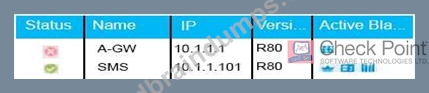
Choose the BEST answer.
- A. There is a blade reporting a problem
- B. Security Gateway's MGNT NIC card is disconnected.
- C. VPN software blade is reporting a malfunction
- D. SmartCenter Server cannot reach this Security Gateway
Answer: A
Explanation:
If Deyra sees the gateway status as shown in the image, it means thatthere is a blade reporting a problem. The red "X" in the status column indicates that one or more blades on the Security Gateway have a problem that requires attention. The other options are not correct, as they do not match the status shown in the image. If the SmartCenter Server cannot reach this Security Gateway, the status column would show a yellow triangle with an exclamation mark. If the VPN software blade is reporting a malfunction, the blades column would show a red "X" on the VPN icon. If the Security Gateway's MGNT NIC card is disconnected, the IP column would show "N/A" instead of the IP address.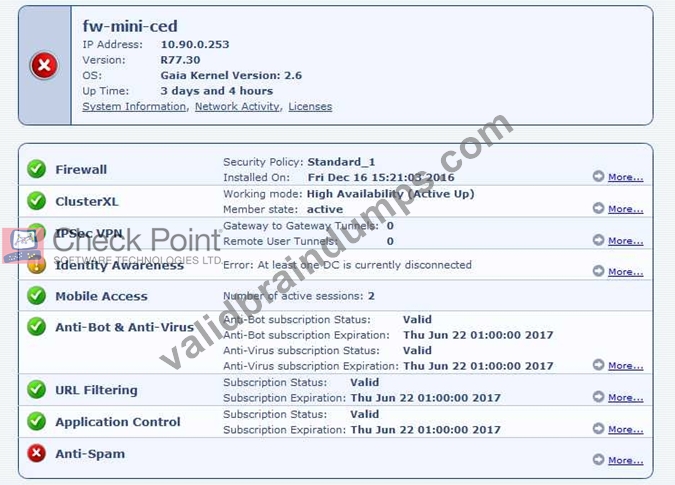
NEW QUESTION # 61
Which command shows the installed licenses?
- A. cplic print
- B. show licenses
- C. fwlic print
- D. print cplic
Answer: A
Explanation:
The command that shows the installed licenses iscplic print. This command displays the license information on a Check Point server or Security Gateway. It shows the license type, expiration date, attached blades, etc. The other options are incorrect.print cplicis not a valid command.fwlic printis not a valid command.show licensesis not a valid command. [How to check license status on SecurePlatform / Gaia from CLI]
NEW QUESTION # 62
What is the main difference between Threat Extraction and Threat Emulation?
- A. Threat Emulation never delivers a file that takes less than a second to complete
- B. Threat Extraction never delivers a file and takes more than 3 minutes to complete
- C. Threat Extraction always delivers a file and takes less than a second to complete
- D. Threat Emulation never delivers a file and takes more than 3 minutes to complete
Answer: C
Explanation:
The correct answer is B because Threat Extraction always delivers a file and takes less than a second to complete2.hreat Extraction removes exploitable content from files and delivers a clean and safe file to the user2.Treat Emulation analyzes files in a sandbox environment and delivers a verdict of malicious or benign2.Theat Emulation can take more than 3 minutes to complete depending on the file size and complexity2. Check Point R81 Threat Prevention Administration Guide
NEW QUESTION # 63
Under which file is the proxy arp configuration stored?
- A. $FWDIR/conf/local.arp on the gateway
- B. $FWDIR/state/_tmp/proxy.arp on the security gateway
- C. $FWDIR/conf/local.arp on the management server
- D. $FWDIR/state/proxy_arp.conf on the management server
Answer: A
Explanation:
The file that stores the proxy arp configuration is$FWDIR/conf/local.arpon the gateway3. The other files are not related to proxy arp configuration. How to configure Proxy ARP for Manual NAT on Security Gateway, [Check Point CCSA - R81: Practice Test & Explanation]
NEW QUESTION # 64
When should you generate new licenses?
- A. Before installing contract files.
- B. When the existing license expires, license is upgraded or the IP-address where the license is tied changes.
- C. After an RMA procedure when the MAC address or serial number of the appliance changes.
- D. Only when the license is upgraded.
Answer: B
Explanation:
You should generate new licenses when the existing license expires, license is upgraded or the IP-address where the license is tied changes13.These scenarios require a new license to be generated and activated on the Security Gateway or Management Server13. Therefore, the correct answer is C.When the existing license expires, license is upgraded or the IP-address where the license is tied changes
NEW QUESTION # 65
Where is the "Hit Count" feature enabled or disabled in SmartConsole?
- A. On the Policy Package
- B. On the Policy layer
- C. In Global Properties for the Security Management Server
- D. On each Security Gateway
Answer: B
Explanation:
The "Hit Count" feature is enabled or disabled on the Policy layer in SmartConsole1. To enable or disable the "Hit Count" feature, right-click on the Policy layer and select "Edit Layer".Then, check or uncheck the "Enable Hit Count" option1. Solved: Hit Count in R80.x
NEW QUESTION # 66
To view the policy installation history for each gateway, which tool would an administrator use?
- A. Gateway installations
- B. Installation history
- C. Revisions
- D. Gateway history
Answer: B
Explanation:
To view the policy installation history for each gateway, an administrator would use the Installation history tool1, p. 22.The Installation history tool shows the date and time of each policy installation, the name of the administrator who installed it, and the status of the installation3. Revisions, Gateway installations, and Gateway history are not valid tools in SmartConsole. Check Point CCSA - R81: Practice Test & Explanation,Check Point SmartConsole R81 Help
NEW QUESTION # 67
You have successfully backed up your Check Point configurations without the OS information. What command would you use to restore this backup?
- A. import backup
- B. migrate import
- C. cp_merge
- D. restore_backup
Answer: D
Explanation:
The command to restore a backup of Check Point configurations without the OS information isrestore_backup4. This command restores the Gaia OS configuration and the firewall database from a compressed file. The other commands are not valid for this purpose.import backupis not a valid command.cp_mergeis a command to merge policies or objects from different databases.migrate importis a command to import a previously exported database usingmigrate export. System Backup and Restore feature in Gaia, [cp_merge], [migrate import]
NEW QUESTION # 68
......
Dumps of 156-215.82 Cover all the requirements of the Real Exam: https://www.validbraindumps.com/156-215.82-exam-prep.html