

[Dec-2025] VMware 2V0-12.24 DUMPS WITH REAL EXAM QUESTIONS
2025 New ValidBraindumps 2V0-12.24 PDF Recently Updated Questions
NEW QUESTION # 43
A company plans to enhance its DevOps practices by implementing Kubernetes as part of VMware Cloud Foundation environment.
Which three steps should an administrator complete to achieve this integration? (Choose three.)
- A. Deploy HCX to migrate existing VMs to Kubernetes.
- B. Configure vSAN to provide storage for Kubernetes workloads.
- C. Configure Aria Automation to automate the deployment of Kubernetes clusters.
- D. Enable IaaS Control Plane on existing vSphere clusters.
- E. Deploy NSX to manage the networking for Kubernetes clusters.
Answer: B,C,E
Explanation:
Aria Automation (formerly vRealize Automation) can be configured to automate the deployment of Kubernetes clusters, which aligns with DevOps practices by enabling the self-service and automation of Kubernetes infrastructure.
NSX is used to manage networking for Kubernetes clusters, providing features such as network segmentation and micro-segmentation, which are essential for secure and scalable Kubernetes deployments.
vSAN provides the storage infrastructure for Kubernetes workloads, offering distributed and scalable storage that integrates with Kubernetes.
NEW QUESTION # 44
A disk failure has occurred in a vSAN cluster.
What four steps should be taken to recover from this disk failure? (Choose four.)
- A. Use the vSohere Client to check the vSAN Health Service
- B. Perform a full resync of the vSAN objects
- C. Replace the failed disk with a new one
- D. Ensure the new disk is claimed by the vSAN cluster
- E. Rebuild the affected disk group
- F. Disable disk group encryption
Answer: A,C,D,E
Explanation:
Checking the vSAN Health Service in the vSphere Client is the first step in diagnosing the issue and verifying the status of the vSAN components after the disk failure.
Rebuilding the affected disk group is necessary to ensure that data is re-optimized and replicated in accordance with the vSAN policy.
Replacing the failed disk with a new one ensures that the storage capacity is restored.
Ensuring that the new disk is claimed by the vSAN cluster is important to ensure that it is recognized and integrated into the vSAN disk group.
NEW QUESTION # 45
An administrator needs to ensure that their VMware Cloud Foundation-based private cloud solution can support multi-tenancy for different departments within their organization.
What two configurations and components are necessary to achieve this? (Choose two.)
- A. Deploy Aria Automation to enable self-service provisioning for tenants.
- B. Use vSphere Resource Pools to allocate resources to different departments.
- C. Configure vSAN storage policies for each department.
- D. Use NSX to create isolated network segments for each tenant.
Answer: B,D
Explanation:
vSphere Resource Pools allow for the allocation of CPU, memory, and storage resources to different departments (tenants) within the VMware Cloud Foundation environment. This ensures that each department has its own dedicated resources, preventing resource contention between them.
NSX can be used to create isolated network segments (logical networks) for each tenant, ensuring network security and segmentation between departments. Each department can have its own isolated network environment.
NEW QUESTION # 46
An administrator needs to configure and manage storage resources and policies to optimize performance of a VCF environment configured with vSAN.
What two steps should the administrator take? (Choose two.)
- A. Disable vSAN health alerts to reduce administrative overhead.
- B. Analyze the current vSAN storage policies and adjust them as needed.
- C. Enable vSphere HA to ensure high availability and resource distribution.
- D. Decrease the number of disk groups per host to improve performance.
- E. Monitor the vSAN performance service for insights into the performance issues.
Answer: B,E
Explanation:
The vSAN performance service provides valuable insights into the storage performance, helping identify potential bottlenecks or areas for improvement.
Analyzing and adjusting vSAN storage policies is crucial for ensuring optimal performance. Policies such as RAID levels, storage encryption, and other settings can be tweaked to better match the environment's performance requirements.
NEW QUESTION # 47
An administrator is tasked with migrating a set of virtual machines between data centers using HCX.
To minimize downtime and ensure data consistency, which two HCX migration options should be considered? (Choose two.)
- A. HCX Bulk Migration
- B. HCX Cold Migration
- C. HCX Network Extension
- D. HCX Replication Assisted vMotion (RAV)
- E. HCX vMotion
Answer: C
Explanation:
VM storage policies in a VMware vSphere environment are used to define and enforce specific storage requirements for virtual machines, such as performance (e.g., IOPS), availability (e.g., RAID levels), and redundancy. These policies ensure that VMs are placed on storage that meets their particular needs and that storage resources are utilized effectively.
NEW QUESTION # 48
An administrator needs to add a new cluster to an existing VI workload domain. The existing cluster in the domain is using NFS as its principal storage.
Which principal storage options are available for the new cluster?
- A. vSAN, NFS, VMFS on Fibre Channel, or vVols
- B. vSAN, NFS, or VMFS on Fibre Channel
- C. NFS or vSAN
- D. NFS only
Answer: C
Explanation:
In a VMware Cloud Foundation (VCF) environment, when adding a new cluster to an existing VI workload domain, the new cluster must use the same principal storage as the existing cluster. Since the existing cluster is using NFS, the available storage options for the new cluster would be NFS or vSAN, depending on the configuration.
NEW QUESTION # 49
What is the recommended method for managing IP address allocation for VMware ESXi hosts in a VMware Cloud Foundation environment?
- A. Static IP addresses assigned manually
- B. Dynamic IP addresses assigned via DHCP and without any reservations
- C. Dynamic IP addresses assigned via DHCP with reservations
- D. Static IP address assigned using VMware NSX IP Pools
Answer: D
Explanation:
In a VMware Cloud Foundation environment, it is recommended to use static IP addresses that are managed via VMware NSX IP Pools. This method ensures consistency, scalability, and centralized management of IP addresses, which is essential for large environments. NSX IP Pools allow for efficient IP address allocation and management.
NEW QUESTION # 50
An Administrator is configuring the network within their VCF management domain in preparation to deploy VMware Aria Suite Lifecycle.
What are the two types of virtual networks that the Administrator could configure to support the deployment? (Choose two.)
- A. VLAN-backed Port Groups
- B. VLAN-backed NSX Segments
- C. VXLAN-backed Network Pools
- D. Overlay-backed NSX Segments
Answer: A,D
Explanation:
VLAN-backed Port Groups are used in traditional network environments where VLANs are configured on the physical switches. These port groups can be configured in the management domain to support network connectivity.
Overlay-backed NSX Segments use NSX to create virtual networks overlaid on existing physical networks, which is essential for network virtualization and communication between virtual machines, especially in a VMware Cloud Foundation environment.
NEW QUESTION # 51
Arrange the steps in the correct order to resolve host connectivity issues.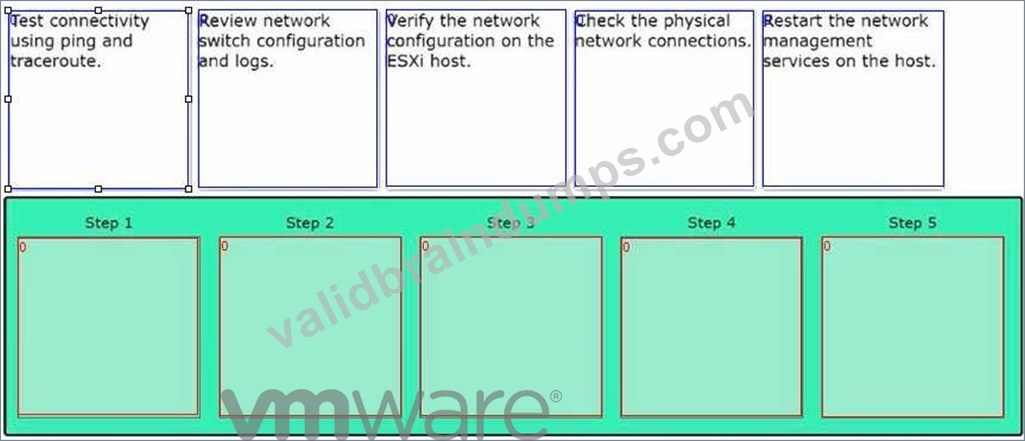
Answer:
Explanation: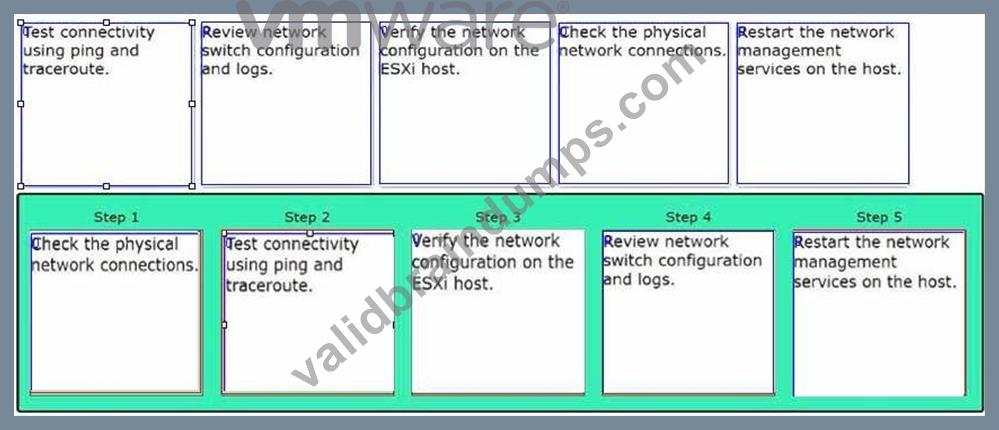
NEW QUESTION # 52
A newly added ESXi host is not able to communicate with the vCenter Server.
What three steps should an administrator take to diagnose and resolve this issue? (Choose three.)
- A. Use the vSphere Client to review the host's network settings
- B. Verify the network configuration on the ESXi host
- C. Ensure that the management network is correctly configured and reachable
- D. Restart the manaqement aqents on the ESXi host
- E. Check the license on the ESXi host
Answer: B,C,D
Explanation:
Verifying the network configuration on the ESXi host ensures that the host is correctly configured for network communication with the vCenter Server.
The management network must be properly configured and reachable from the ESXi host to communicate with the vCenter Server.
Restarting the management agents on the ESXi host can resolve issues related to communication between the ESXi host and vCenter Server, as sometimes the agents might become unresponsive.
NEW QUESTION # 53
An organization is integrating VMware vCenter with Active Directory (AD) to streamline user authentication. As part of this process, the administrator needs to add AD as an identity source in vCenter.
Which three steps must be performed to successfully add AD as an identity source? (Choose three.)
- A. Enter the Domain Name and the credentials of an AD user with domain join privileges
- B. Reboot the vCenter Server to apply the identity source settings.
- C. Configure DNS settings on all ESXi hosts to point to the AD DNS servers.
- D. Select 'Add Identity Source' and choose 'Active Directory (Integrated Windows Authentication)'.
- E. Navigate to the vCenter Single Sign-On configuration in the vSphere Client.
Answer: A,D,E
Explanation:
When adding AD as an identity source, you need to enter the Domain Name and provide the credentials of an AD user with domain join privileges to authenticate and add the domain.
In the vSphere Client, you need to select 'Add Identity Source' and choose the appropriate method for AD integration, which is typically 'Active Directory (Integrated Windows Authentication)'.
The process to add AD as an identity source is performed under the vCenter Single Sign-On (SSO) configuration in the vSphere Client.
NEW QUESTION # 54
An administrator is tasked with enabling Workload Management (vSphere IaaS control plane) on a VMware Cloud Foundation workload domain.
Which three of the following are prerequisites for enabling Workload Management? (Choose three.)
- A. Ensure that the cluster has at least three ESXi hosts.
- B. Configure NTP and DNS settings for all management components.
- C. Install the vSphere Client on all ESXi hosts.
- D. Verify that all ESXi hosts are running vSphere 7.0 or later.
Answer: A,B,D
Explanation:
For Workload Management in VMware Cloud Foundation, a minimum of three ESXi hosts is required to create a robust, highly available vSphere cluster.
Proper NTP and DNS configuration is essential to ensure time synchronization and proper resolution of network names, which are critical for Workload Management.
The hosts must be running vSphere 7.0 or later to be compatible with the latest features and requirements for Workload Management.
NEW QUESTION # 55
Which vSphere component is essential for providing persistent storage to Kubernetes workloads deployed on IaaS Control Plane?
- A. Container Image Virtual Disks
- B. Pod Service
- C. Control Plane Storage Policy
Answer: B
Explanation:
The vSphere Pod Service is essential for providing persistent storage to Kubernetes workloads deployed on IaaS Control Plane (formerly vSphere with Tanzu). It enables the integration of Kubernetes with vSphere, allowing the creation of persistent volumes and the management of storage resources for Kubernetes workloads, ensuring that they can utilize vSphere's storage capabilities like vSAN.
NEW QUESTION # 56
An administrator needs to create a custom role in vCenter Server that is part of VMware Cloud Foundation environment to grant specific privileges to a group of users.
Which two actions should be taken to create this custom role? (Choose two.)
- A. Assign permissions to the custom role before adding privileges.
- B. Navigate to the Roles section in the vSphere Client.
- C. Apply the custom role to the root of the vCenter Server inventor/.
- D. Choose the privileges required for the custom role.
- E. Clone an existing role in SDDC Manager to create the custom role.
Answer: B,D
Explanation:
When creating a custom role, it is essential to choose the appropriate privileges that the role will require. These privileges define what actions the users in the role can perform.
To create and manage roles, you need to navigate to the "Roles" section in the vSphere Client. This is where roles are defined and assigned within the vCenter Server.
NEW QUESTION # 57
Put the following steps in the correct order to optimize resource allocation using Aria Operations.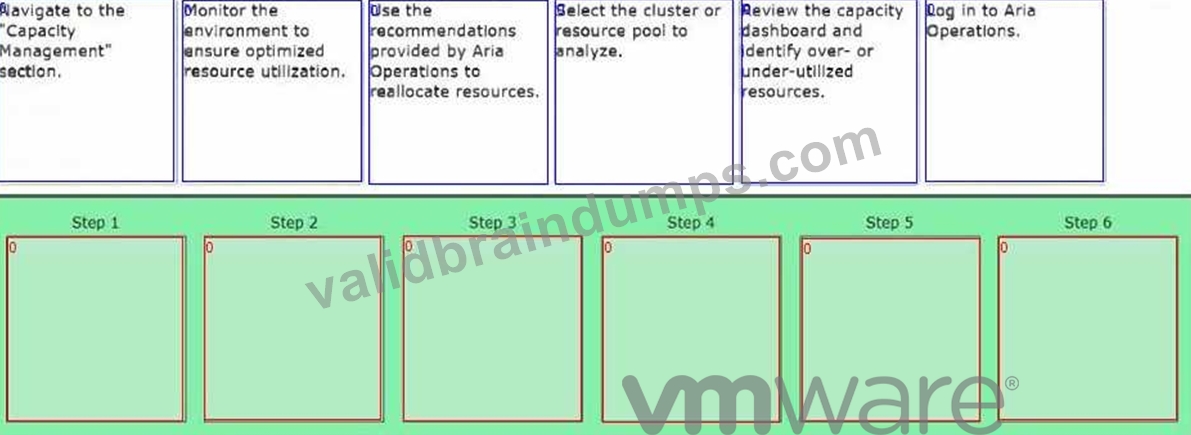
Answer:
Explanation: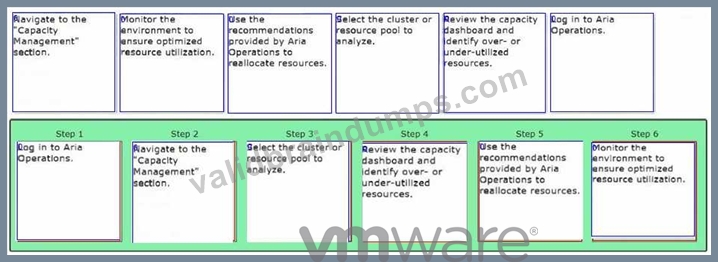
NEW QUESTION # 58
An alert in SDDC Manager indicates that the health status of the vSAN cluster is degraded.
Which tool within VMware Cloud Foundation should be used to gather detailed logs and perform in-depth troubleshooting for the vSAN issues?
- A. Aria Operations for Networks
- B. vCenter Server
- C. Aria Operations for Logs
- D. SDDC Manager
Answer: C
Explanation:
Aria Operations for Logs (formerly known as vRealize Log Insight) is used to collect, analyze, and troubleshoot logs from various components within VMware Cloud Foundation, including the vSAN cluster. It provides detailed insights into the logs, allowing administrators to perform in-depth troubleshooting of issues like degraded health statuses.
NEW QUESTION # 59
......
Latest 2V0-12.24 Pass Guaranteed Exam Dumps Certification Sample Questions: https://www.validbraindumps.com/2V0-12.24-exam-prep.html
2V0-12.24 Exam with Guarantee Updated 109 Questions: https://drive.google.com/open?id=1dscCBr02IqqtDFyBlnHF5fTv4bYuXv3m