

Download NVIDIA NCA-GENM Exam Dumps to Pass Exam Easily in 2026
Get 100% Real Free NVIDIA-Certified Associate NCA-GENM Sample Questions
NEW QUESTION # 109
Consider a multimodal generative A1 model that produces images based on textual prompts. The model is prone to generating images that are similar to those in the training data, resulting in a lack of novelty. Which hyperparameter adjustment would be MOST effective in increasing the diversity of the generated images?
- A. Increase the weight decay during training.
- B. Decrease the number of layers in the decoder network.
- C. Increase the temperature parameter in the decoding process.
- D. Decrease the batch size during inference.
- E. Reduce the learning rate during fine-tuning.
Answer: C
Explanation:
Increasing the temperature parameter during decoding introduces more randomness into the sampling process, leading to a wider range of possible outputs and thus increasing the diversity of generated images. Decreasing batch size doesn't directly affect diversity. Reducing the learning rate affects training, not the diversity of generated images after training. Decreasing layers might reduce model capacity but not necessarily increase diversity. Increasing weight decay can prevent overfitting but doesn't directly address the lack of novelty in generated images.
NEW QUESTION # 110
You've trained a large multimodal model that takes text and images as input and generates creative stories. While the model produces high-quality stories in general, it occasionally generates outputs that are factually incorrect or nonsensical. Which of the following techniques would be MOST effective in improving the model's factual accuracy and coherence?
- A. Increasing the model size by adding more layers.
- B. Implementing a retrieval-augmented generation (RAG) approach.
- C. Training the model on a smaller dataset.
- D. Reducing the temperature parameter during generation.
- E. Removing dropout layers.
Answer: B
Explanation:
Retrieval-augmented generation (RAG) involves retrieving relevant information from an external knowledge source (e.g., a database or a collection of documents) and incorporating it into the model's generation process. This can help the model generate more factually accurate and coherent outputs by grounding its responses in external knowledge. Increasing the model size might improve performance, but doesn't guarantee factual accuracy. Reducing temperature makes the output more predictable but doesn't address factual correctness. Smaller datasets and removing dropout would likely worsen performance.
NEW QUESTION # 111
You are experimenting with different multimodal transformer architectures for a video understanding task. You are using a large pre- trained model and fine-tuning it on your specific dataset. You observe that the model is overfitting and struggling to generalize to unseen videos. Which of the following techniques would be most effective in mitigating overfitting in this scenario? (Choose two)
- A. Reduce the number of transformer layers in the model.
- B. Implement weight decay and dropout regularization.
- C. Use a smaller pre-trained model.
- D. Employ data augmentation techniques specifically designed for video data (e.g., temporal jittering, random cropping).
- E. Increase the batch size significantly.
Answer: B,D
Explanation:
Weight decay and dropout are standard regularization techniques that help prevent overfitting. Data augmentation increases the diversity of the training data, improving the model's ability to generalize. Reducing the number of layers is a potentially viable option, but requires experimentation to achieve optimum performance.
NEW QUESTION # 112
You are building a multimodal model to translate spoken language into sign language animations. You have audio recordings of spoken words and corresponding sign language video sequences. Which architecture would be most suitable for this task?
- A. A recurrent neural network (RNN) or Transformer network with attention mechanisms to capture the temporal dependencies in both the audio and video sequences, and a connectionist temporal classification (CTC) loss function for alignment.
- B. A support vector machine (SVM) to classify audio and video features.
- C. A simple feedforward neural network.
- D. A convolutional neural network (CNN) for audio and another CNN for video, followed by a fully connected layer.
- E. A generative adversarial network (GAN) to generate realistic sign language animations.
Answer: A
Explanation:
RNNs or Transformer networks with attention mechanisms are best suited for sequence-to-sequence tasks like translation, as they can capture temporal dependencies. CTC loss helps align the audio and video sequences, even if they are not perfectly synchronized. CNNs are good for feature extraction but don't handle sequential data as well as RNNs/Transformers.
NEW QUESTION # 113
You're using Stable Diffusion with a custom prompt to generate images of landscapes. You notice that the generated images consistently lack detail and appear blurry, despite increasing the number of inference steps. Which of the following prompt engineering techniques, combined with appropriate parameter tuning, is MOST likely to address this issue and improve the image's sharpness and detail?
- A. Adding keywords like 'photorealistic', 'high resolution', '8k', 'detailed', and adjusting the 'clip_skip' parameter.
- B. Using a very short and general prompt to allow the model more freedom.
- C. Specifying 'oil painting' or another artistic style to mask the lack of detail.
- D. Using completely unrelated keywords to encourage the model to create something unique.
- E. Decreasing the 'guidance_scale' to allow for more creative freedom.
Answer: A
Explanation:
Adding keywords specifically related to image quality ('photorealistic', 'high resolution', '8k', 'detailed') helps guide the model towards generating sharper and more detailed images. 'clip_skip' influences the model to incorporate more details into the output images. Adjusting 'clip_skip' along with quality prompt keywords will enhance the image quality.
NEW QUESTION # 114
You are building a multimodal emotion recognition system that uses facial expressions (images) and speech (audio). You want to use transfer learning to leverage pre-trained models for both modalities. You have access to a large pre-trained facial recognition model (trained on millions of faces) and a large pre-trained speech recognition model (trained on thousands of hours of speech). How do you design a multimodal transfer learning strategy to efficiently train the entire system on a smaller dataset of peoples face and audio samples?
- A. Train the Audio model first, then train the Face model to recognize emotions based on the results of the audio expression emotions.
- B. Extract features separately using each of the pre-trained face and speech models and then train a separate classifier model, combining those features to recognize emotion.
- C. Fine-tune each of the pre-trained models for the emotion recognition task using a joint loss function that combines the outputs of face emotion and speech emotion to create an overall expression.
- D. Use the features of the face data as an attention mechanism to pay attention to the audio, in an end-to-end learning model.
- E. Train the face model first, then train the audio model to recognize emotions based on the results of the facial expression emotions.
Answer: C,D
Explanation:
Fine-tuning the pre-trained models using a joint loss function helps the model to adapt to a combined face and speech emotion recognition task. In addition, using the features of one modality as an attention mechanism for the other modality can help guide an end-to-end training model. Feature extraction is more of a traditional method and does not fully allow pre-trained models to fully transfer. Training in series might not result in the best model performance since multimodal emotion recognition is about using all facets of information to predict.
NEW QUESTION # 115
Which of the following statements accurately describes the purpose and functionality of 'LoRA' (Low-Rank Adaptation) in the context of fine-tuning large language models?
- A. LoRA is a fine-tuning technique that freezes the original weights of a pre-trained model and trains a small set of low-rank matrices to adapt the model to a specific task.
- B. LoRA is a method for compressing the weights of a pre-trained language model to reduce its memory footprint.
- C. LoRA is a type of attention mechanism used in transformer models.
- D. LoRA is a regularization technique used to prevent overfitting during fine-tuning.
- E. LoRA is a data augmentation technique used to increase the size of the training dataset.
Answer: A
Explanation:
LoRA (Low-Rank Adaptation) is a parameter-efficient fine-tuning technique that freezes the original pre-trained model weights and introduces a small number of trainable low-rank matrices. This allows for efficient adaptation to downstream tasks with significantly fewer trainable parameters compared to full fine-tuning. The goal is faster, and less expensive, and prevent catastrophic forgetting.
NEW QUESTION # 116
You are developing a text-to-image generative model and want to evaluate the quality and diversity of the generated images. Which metric is MOST appropriate for assessing the diversity of generated images, considering computational efficiency is also important?
- A. Multi-Scale Structural Similarity Index (MS-SSIM)
- B. Inception Score (IS)
- C. Number of unique images in the generated set.
- D. Frechet Inception Distance (FID)
- E. Learned Perceptual Image Patch Similarity (LPIPS)
Answer: D
Explanation:
FID is a commonly used metric for evaluating the quality and diversity of generated images, and it's more robust than IS. While LPIPS and MS-SSIM are useful for measuring perceptual similarity between images, they don't directly quantify diversity across a large set of generated images. Simply counting unique images doesn't capture the semantic diversity of the generated content. FID calculates the distance between the feature representations of real and generated images, capturing both quality and diversity.
NEW QUESTION # 117
You are fine-tuning a pre-trained Generative A1 model for a specific downstream task with limited dat a. The model starts to exhibit catastrophic forgetting of the original pre-trained knowledge. Which technique could mitigate this issue effectively?
- A. Increasing the learning rate significantly
- B. Elastic Weight Consolidation (EWC)
- C. Freezing the weights of earlier layers in the network
- D. Using a smaller batch size
- E. Adding more data augmentation
Answer: B,C
NEW QUESTION # 118
You're working with a Text-to-Image generation model and want to improve its explainability by visualizing which words in the text prompt are most influential in generating specific regions of the output image. What technique would be most suitable for achieving this?
- A. SHAP values applied to the text encoder.
- B. Attention maps from the cross-attention layers between the text encoder and the image decoder.
- C. Gradient-weighted Class Activation Mapping (Grad-CAM) on the image encoder.
- D. Analyzing the frequency of words in the generated image captions.
- E. Visualizing the latent space embeddings of the generated images.
Answer: B
Explanation:
Attention maps from the cross-attention layers directly indicate which words in the text prompt the image decoder attends to when generating different regions of the image. This provides a visual explanation of the relationship between text and image generation. Grad-CAM is more suited for explaining image classification models. SHAP values can explain the importance of words in the text, but not their spatial influence in the generated image.
NEW QUESTION # 119
You are building a multimodal generative A1 model that combines text, images, and audio. You notice that the model performs well on text and images but struggles with audio, particularly in noisy environments. Which of the following strategies would be MOST effective in improving the model's performance with audio data?
- A. Reduce the dimensionality of the audio features to simplify the learning task.
- B. Increase the learning rate for the audio modality during training.
- C. Apply data augmentation techniques specifically designed for audio, such as adding noise or varying the speed and pitch.
- D. Use transfer learning by pre-training the audio component of the model on a large audio dataset.
- E. Decrease the weight of the audio modality in the loss function.
Answer: C,D
Explanation:
Data augmentation (C) increases the robustness of the model to variations in audio, including noise. Transfer learning (E) allows the model to leverage knowledge from a large, pre-existing audio dataset, improving its initial performance.
NEW QUESTION # 120
You're developing a multimodal model that takes both image and audio inputs to predict a relevant text description. You observe that the model is heavily biased towards the image data, effectively ignoring the audio input. Which of the following techniques could you employ to address this modality imbalance and ensure the model effectively utilizes both input modalities?
- A. Increase the batch size for each epoch.
- B. Oversample the audio data during training.
- C. Increase the learning rate for the audio modality pathway during training.
- D. Reduce the dimensionality of the image features before fusion.
- E. Apply modality-specific dropout to the image pathway.
Answer: B,C,D,E
Explanation:
Increasing the learning rate for the audio pathway allows it to update its weights more aggressively, potentially counteracting the image bias. Applying modality-specific dropout to the image pathway forces the model to rely less on image features and more on audio. Oversampling the audio data ensures that the model sees more examples from the audio modality during training. Reducing the dimensionality of the image features can prevent them from dominating the fusion process. Increasing batch size is not specific to each modality and does not directly deal with modality imbalance, but can influence training dynamics.
NEW QUESTION # 121
You are building a multimodal application that needs to understand both image and text dat a. You want to use a pre-trained model but fine-tune it for your specific task. Which of the following strategies is MOST effective for fine-tuning a large pre-trained multimodal model?
- A. Fine-tune only the text encoder layers, keeping the image encoder layers frozen.
- B. Train a new classification head from scratch on top of the frozen pre-trained model.
- C. Fine-tune the attention mechanism between the text and image encoders, while keeping the encoder weights frozen.
- D. Fine-tune the entire model, including both text and image encoder layers, using a small learning rate.
- E. Fine-tune only the image encoder layers, keeping the text encoder layers frozen.
Answer: D
Explanation:
Fine-tuning the entire model with a small learning rate allows the model to adapt to the specific nuances of the new task while leveraging the knowledge already learned during pre-training. Freezing layers can limit adaptability. Training only a new head might not fully utilize the pre-trained features.
NEW QUESTION # 122
You're training a conditional GAN to generate images of birds based on text descriptions. The GAN generates images, but they lack fine- grained details and often have artifacts. Which of the following techniques are MOST likely to improve the quality and realism of the generated images? (Select TWO)
- A. Using a simple Multi-Layer Perceptron (MLP) as the generator.
- B. Reducing the size of the input noise vector to the generator.
- C. Using a more powerful discriminator architecture (e.g., with attention mechanisms).
- D. Implementing spectral normalization in both the generator and discriminator.
- E. Using a deeper and wider generator network (e.g., with more layers and channels).
Answer: D,E
Explanation:
Spectral normalization helps stabilize training by limiting the Lipschitz constant of the discriminator and generator, preventing exploding gradients and improving image quality. A deeper and wider generator network can capture more complex image features and generate more detailed images. A simple MLP wouldn't be suitable for generating high-resolution images. Reducing the input noise vector size might limit the diversity of generated images. A more powerful discriminator helps in better distinguishing between real and fake images, which guides the generator to produce more realistic outputs. However, spectral normalization directly addresses stability issues that cause artifacts.
NEW QUESTION # 123
Consider the following PyTorch code snippet intended for training a variational autoencoder (VAE):
What potential issue(s) exist(s) in this code, and how would you address them?
- A. The KLD calculation is incorrect; it should be 0.5 torch.sum(mu.pow(2) + logvar - 1 - logvar.exp()).
- B. The Kullback-Leibler divergence (KLD) term isn't scaled appropriately for the batch size; divide it by the batch size to get a mean KLD loss.
- C. All of the above.
- D. The binary cross-entropy (BCE) loss doesn't account for pixel values outside the range [0, 1]; normalize the input images to this range.
- E. The BCE loss is summed across all pixels; average it by dividing by the total number of pixels in the input.
Answer: C
Explanation:
All the mentioned issues exist. Firstly, BCE requires inputs between 0 and 1 . Secondly, KLD loss needs to be scaled according to batch size for proper gradients during training. Thirdly, simply summing the BCE isn't ideal, average is better. Finally, the KLD calculation is indeed reverse of what it should be.
NEW QUESTION # 124
You are building a real-time multimodal application that requires processing both audio and video streams simultaneously. You need to minimize the latency of the system while maximizing throughput. Which of the following hardware and software optimizations would be most effective?
- A. Using a CPU-based implementation for both audio and video processing.
- B. Using separate GPUs for audio and video processing and employing asynchronous data transfer techniques.
- C. Using a high-latency, high-bandwidth network connection.
- D. Offloading both audio and video processing to a single high-end GPIJ.
- E. Compressing the audio and video streams aggressively to reduce the amount of data that needs to be processed.
Answer: B
Explanation:
Using separate GPUs allows for parallel processing of audio and video streams. Asynchronous data transfer techniques minimize latency by allowing the CPU to continue processing other tasks while data is being transferred to the GPUs. While a single high-end GPU could handle both tasks, using separate GPUs maximizes parallelism. CPU-based implementations are generally slower than GPU-based implementations for multimedia processing. Aggressive compression can reduce data size but may also introduce artifacts and reduce the quality of the output. High-latency networks are detrimental to real-time applications.
NEW QUESTION # 125
You're using NVIDIA Triton to serve a multimodal model: a CLIP text encoder and a StyleGAN image generator. You need to ensure high throughput and minimal latency. Which Triton backend configuration is most suitable for this scenario, assuming both models are optimized for NVIDIA GPUs?
- A. Two separate model repositories, one for CLIP (as ONNX) and one for StyleGAN (as TensorRT), served by two Triton instances on different GPUs.
- B. Using just the Python backend with the models on CPU.
- C. A single model repository with two model instances (CLIP as ONNX, StyleGAN as TensorRT) served by a single Triton instance, leveraging concurrent execution.
- D. A Python backend where both models are loaded into memory and inference is performed sequentially.
- E. A single model repository containing both models as TorchScript, served by a single Triton instance using the PyTorch backend.
Answer: C
Explanation:
Option C is the most efficient. Serving both models within a single Triton instance and using optimized formats (ONNX and TensorRT) allows Triton to manage resources effectively and potentially overlap computation (concurrent execution) if the models allow for it, leading to higher throughput and lower latency. Using the python backend only is less efficient than the dedicated backends. Running on different GPUs increases cost unnecessarily. TorchScript might work but depends on the models.
NEW QUESTION # 126
You are building an A1 model that takes video and corresponding subtitles as input to generate short summaries of video content. Which of the following strategies are most important to reduce the chance of your model generating biased summaries? (Select all that apply)
- A. Randomly shuffle data during training.
- B. Ensure the training dataset contains diverse representation of all demographic groups and viewpoints.
- C. Use a pre-trained language model that has been debiased.
- D. Evaluate the model's summaries on different demographic groups to identify and mitigate any disparities in performance.
- E. Increase the number of training epochs.
Answer: B,C,D
Explanation:
Debiasing pre-trained models helps remove existing biases. A diverse training dataset is important to reduce the influence of any single biased viewpoint. Evaluating model performance on different demographic groups allows you to find and rectify performance disparities. Random data shuffling (D) and increasing training epochs (E) do not directly address bias. Note this is a very tough question as all choices seem viable but only options, A, B and C are the correct choice.
NEW QUESTION # 127
You are working with a multimodal dataset that contains images and corresponding captions. You want to use contrastive learning to learn joint embeddings for images and text. Which of the following loss functions is the most suitable for this task?
- A. Binary Cross-entropy loss
- B. Mean Squared Error (MSE) loss
- C. Cross-entropy loss
- D. Negative Log Likelihood (NLL) loss
- E. Triplet loss
Answer: E
Explanation:
Triplet loss is specifically designed for contrastive learning, where the goal is to learn embeddings such that similar pairs are closer in the embedding space than dissimilar pairs- Cross-entropy and binary cross-entropy are classification losses. MSE loss is a regression loss- NLL loss is often used with sequence models but doesn't directly address contrastive learning goals.
NEW QUESTION # 128
You are designing a IJ-Net architecture for semantic segmentation of medical images. Your input images are 512x512 with 3 channels.
You want to ensure the final output segmentation map is also 512x512. Which of the following design choices are crucial for achieving this resolution, considering the downsampling and upsampling stages?
- A. Using max pooling with a kernel size of 3x3 and stride of 2 for downsampling, and nearest neighbor interpolation for upsampling.
- B. Using a batch size of 1 during training to simplify memory management.
- C. Employing only IXI convolutions in the bottleneck of the U-Net architecture to reduce computational complexity.
- D. Ensuring that the number of downsampling and upsampling blocks are equal, and employing skip connections from corresponding encoder layers to decoder layers.
- E. Using only strided convolutions for downsampling and transposed convolutions for upsampling without skip connections.
Answer: D
Explanation:
Maintaining the same resolution in IJ-Net requires symmetric downsampling and upsampling and the crucial use of skip connections. These connections pass feature maps from the downsampling (encoder) path to the corresponding layers in the upsampling (decoder) path, allowing the decoder to recover spatial information lost during downsampling. Option A omits skip connections. Option C's nearest neighbor interpolation can lead to blocky artifacts. Option D describes a bottleneck optimization unrelated to output resolution. Option E is about training parameters.
NEW QUESTION # 129
Consider the following Python code snippet used for processing image and text data for a multimodal model: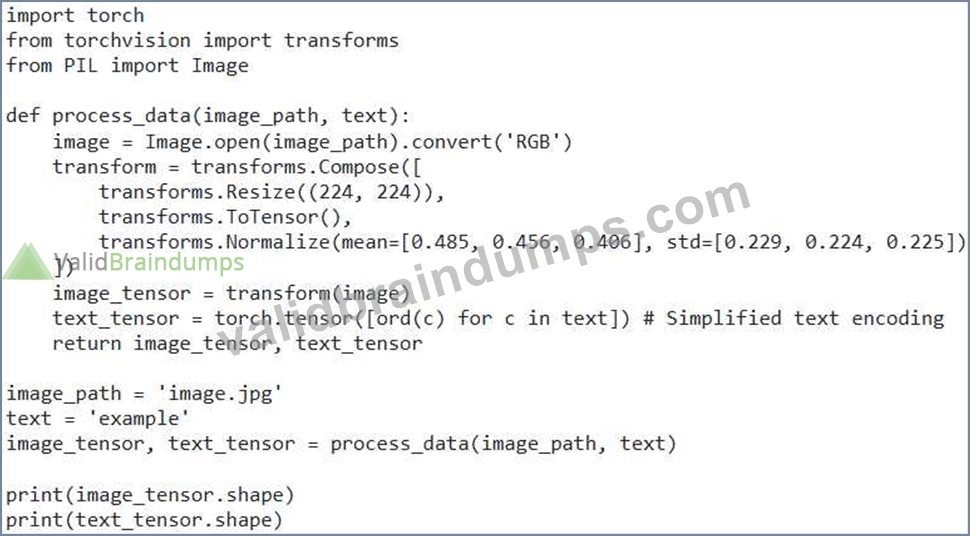
What is the primary limitation of the text encoding method used in this code, and how could it be improved for use in a real-world multimodal model?
- A. It adequately addresses the complexities inherent in natural language, making it suitable for a variety of multimodal models.
- B. The text encoding is overly complex and should be simplified to reduce computational overhead.
- C. The text encoding is suitable for small datasets but will not scale to larger datasets.
- D. The text encoding is efficient but incompatible with common deep learning architectures.
- E. The text encoding only supports ASCII characters and does not account for word embeddings or sequence length variations. Use a tokenizer like BERT or SentencePiece to generate embeddings and pad sequences to a fixed length
Answer: E
Explanation:
The code simply converts each character to its ASCII value, which loses semantic meaning and doesn't handle variable-length sequences or word relationships. Real-world models use tokenizers and embeddings to capture the nuances of language. BERT and SentencePiece are common tools for this. Option B accurately describes this limitation and suggests a practical solution.
NEW QUESTION # 130
You are evaluating a Generative A1 model for image captioning. Which of the following metrics is MOST appropriate for assessing the semantic similarity between the generated captions and the ground truth captions?
- A. BLEU score
- B. Perplexity
- C. CIDEr score
- D. Inception Score
- E. ROUGE score
Answer: C
Explanation:
CIDEr (Consensus-based Image Description Evaluation) is specifically designed for image captioning and is highly correlated with human judgments of caption quality. While BLEU and ROUGE are useful for general text generation, CIDEr excels at capturing semantic similarity in image captions. Inception Score assesses the quality of generated images, not captions, and Perplexity measures the uncertainty of a language model.
NEW QUESTION # 131
You are experimenting with a text-to-image generative model. You notice that when prompted with descriptions containing specific demographic information (e.g., 'a black doctor'), the generated images consistently reflect stereotypes. What steps can you take during the experiment evaluation phase to identify and mitigate this bias? (Select TWO)
- A. Filter out all examples containing demographic information from the training dataset.
- B. Conduct a human evaluation study where participants assess the generated images for stereotypical representations.
- C. Increase the size of the training dataset to dilute the effect of any biased examples.
- D. Use a bias detection metric to quantify the presence of bias in the generated images, comparing output distributions across different demographic groups.
- E. Randomly shuffle the training dataset to minimize bias.
Answer: B,D
Explanation:
Bias detection metrics (B) and human evaluation (D) are essential for identifying and quantifying bias in generated content. Increasing data size (A) alone might not solve the issue. Filtering demographic information (C) can lead to underrepresentation and unfair outcomes. Random shuffling (E) does not directly address inherent biases in the training data.
NEW QUESTION # 132
You are tasked with building a system that can generate captions for images. You want to use a transformer-based model. During inference, you notice that the model tends to generate repetitive captions. Which of the following decoding strategies could you use to mitigate this issue?
- A. Greedy decoding
- B. Random sampling
- C. Beam search with a length penalty
- D. Top-k sampling
- E. Beam search with a high beam width
Answer: C,D
Explanation:
Greedy decoding often leads to repetitive sequences because it always chooses the most likely next word. Beam search, especially with a high beam width, can also lead to repetition if the highest-probability sequences contain repeated phrases. Beam search with a length penalty encourages the model to generate longer and more diverse captions. Random sampling and Top-k sampling introduce randomness into the decoding process, which can help to break out of repetitive loops and create more varied captions.
NEW QUESTION # 133
You are working on a Generative A1 project that involves analyzing text dat a. You've noticed that certain words are appearing much more frequently than others, potentially skewing your results. Which of the following techniques would be MOST effective in addressing this issue?
- A. Applying word embeddings to capture semantic meaning.
- B. Stemming and lemmatization to reduce words to their root form.
- C. Converting all text to lowercase and removing punctuation.
- D. Removing all stop words and applying TF-IDF (Term Frequency-Inverse Document Frequency).
- E. Increasing the vocabulary size of the tokenizer.
Answer: D
Explanation:
Removing stop words eliminates common words like 'the,' 'a,' 'is,' which often dominate text data. TF-IDF then weights words based on their frequency in a document relative to their frequency across all documents, reducing the impact of common words and highlighting important terms. Options B and C are helpful but not sufficient. Option D can actually worsen the issue. Option E addresses semantic meaning, not frequency imbalance.
NEW QUESTION # 134
......
NCA-GENM Study Guide Realistic Verified Dumps: https://www.validbraindumps.com/NCA-GENM-exam-prep.html
Accurate NCA-GENM Questions with Free and Fast Updates: https://drive.google.com/open?id=1jx-cFN1VSiQdw5ewHfkAEa13c45q2_p5