

Latest SY0-701 Exam Dumps CompTIA Exam from Training Expert ValidBraindumps
Pass CompTIA CompTIA Security+ Certification Exam PDF Dumps | Recently Updated 765 Questions
CompTIA SY0-701 Exam Syllabus Topics:
| Topic | Details |
|---|---|
| Topic 1 |
|
| Topic 2 |
|
| Topic 3 |
|
| Topic 4 |
|
| Topic 5 |
|
NEW QUESTION # 319
A security analyst finds a rogue device during a monthly audit of current endpoint assets that are connected to the network. The corporate network utilizes 002.1X for access control. To be allowed on the network, a device must have a Known hardware address, and a valid user name and password must be entered in a captive portal. The following is the audit report: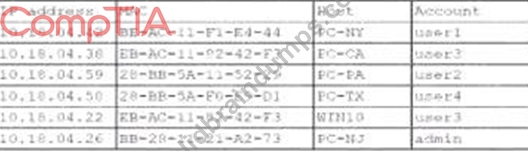
Which of the following is the most likely way a rogue device was allowed to connect?
- A. An administrator bypassed the security controls for testing.
- B. DNS hijacking let an attacker intercept the captive portal traffic.
- C. A DMCP failure caused an incorrect IP address to be distributed
- D. A user performed a MAC cloning attack with a personal device.
Answer: D
Explanation:
The most likely way a rogue device was able to connect to the network is through a MAC cloning attack. In this attack, a personal device copies the MAC address of an authorized device, bypassing the 802.1X access control that relies on known hardware addresses for network access. The matching MAC addresses in the audit report suggest that this technique was used to gain unauthorized network access.
References =
CompTIA Security+ SY0-701 Course Content: Domain 03 Security Architecture.
CompTIA Security+ SY0-601 Study Guide: Chapter on Network Security and MAC Address Spoofing.
NEW QUESTION # 320
Which of the following describes effective change management procedures?
- A. Using a spreadsheet for tracking changes
- B. Using an automatic change control bypass for security updates
- C. Having a backout plan when a patch fails
- D. Approving the change after a successful deployment
Answer: C
Explanation:
Effective change management includes having a backout plan, so that if a patch or change fails, systems can be restored to their previous, stable state.
NEW QUESTION # 321
A company needs to keep the fewest records possible, meet compliance needs, and ensure destruction of records that are no longer needed. Which of the following best describes the policy that meets these requirements?
- A. Classification policy
- B. Access control policy
- C. Security policy
- D. Retention policy
Answer: D
NEW QUESTION # 322
Which of the following security concepts is accomplished when granting access after an individual has logged into a computer network?
- A. Non-repudiation
- B. Identification
- C. Authentication
- D. Authorization
Answer: D
Explanation:
Authorization refers to the process of granting or denying specific rights to a user after verifying their identity through authentication.
NEW QUESTION # 323
During a recent company safety stand-down, the cyber-awareness team gave a presentation on the importance of cyber hygiene. One topic the team covered was best practices for printing centers. Which of the following describes an attack method that relates to printing centers?
- A. Prepending
- B. Credential harvesting
- C. Whaling
- D. Dumpster diving
Answer: D
Explanation:
Dumpster diving is an attack method where attackers search through physical waste, such as discarded documents and printouts, to find sensitive information that has not been properly disposed of. In the context of printing centers, this could involve attackers retrieving printed documents containing confidential data that were improperly discarded without shredding or other secure disposal methods. This emphasizes the importance of proper disposal and physical security measures in cyber hygiene practices.
References =
CompTIA Security+ SY0-701 Course Content: Domain 04 Security Operations.
CompTIA Security+ SY0-601 Study Guide: Chapter on Physical Security and Cyber Hygiene.
NEW QUESTION # 324
An organization discovers that its cold site does not have enough storage and computers available. Which of the following was most likely the cause of this failure?
- A. Load balancing
- B. Capacity planning
- C. Backups
- D. Platform diversity
Answer: B
Explanation:
A cold site is a backup facility that provides basic power, space, and environmental controls but does not include hardware or preconfigured systems. It is the organization's responsibility to ensure the site has adequate storage, servers, and equipment staged or available for rapid procurement.
If the cold site "does not have enough storage and computers," the cause is a failure in capacity planning (A).
CompTIA Security+ SY0-701 highlights the need for organizations to determine:
Required compute capacity
Storage needs
Network bandwidth
Expected recovery workload
Hardware replacement timelines
Load balancing (B) distributes traffic; it has nothing to do with cold-site readiness. Backups (C) store data, not physical resources. Platform diversity (D) refers to using multiple technologies to reduce systemic risk.
The issue is specifically the lack of resources, which directly reflects inadequate capacity planning. Therefore, A is the correct answer.
NEW QUESTION # 325
Which of the following describes the reason root cause analysis should be conducted as part of incident response?
- A. To eradicate any trace of malware on the network
- B. To gather loCs for the investigation
- C. To prevent future incidents of the same nature
- D. To discover which systems have been affected
Answer: C
Explanation:
Root cause analysis is a process of identifying and resolving the underlying factors that led to an incident. By conducting root cause analysis as part of incident response, security professionals can learn from the incident and implement corrective actions to prevent future incidents of the same nature. For example, if the root cause of a data breach was a weak password policy, the security team can enforce a stronger password policy and educate users on the importance of password security. Root cause analysis can also help to improve security processes, policies, and procedures, and to enhance security awareness and culture within the organization.
Root cause analysis is not meant to gather loCs (indicators of compromise) for the investigation, as this is a task performed during the identification and analysis phases of incident response. Root cause analysis is also not meant to discover which systems have been affected or to eradicate any trace of malware on the network, as these are tasks performed during the containment and eradication phases of incident response. References = CompTIA Security+ SY0-701 Certification Study Guide, page 424-425; Professor Messer's CompTIA SY0-701 Security+ Training Course, video 5.1 - Incident Response, 9:55 - 11:18.
NEW QUESTION # 326
Which of the following are the best security controls for controlling on-premises access? (Select two.)
- A. Biometric scanner
- B. Picture ID
- C. Memorable
- D. Swipe card
- E. Phone authentication application
- F. Camera
Answer: A,D
Explanation:
Detailed Explanation:Swipe cards and biometric scanners are commonly used to control on-premises access due to their reliability and ability to restrict unauthorized entry. Swipe cards provide physical access control, while biometric scanners ensure identity verification. Reference: CompTIA Security+ SY0-701 Study Guide, Domain 1: General Security Concepts, Section: "Physical Security Controls".
NEW QUESTION # 327
Sine a recent upgrade (o a WLAN infrastructure, several mobile users have been unable to access the internet from the lobby. The networking team performs a heat map survey of the building and finds several WAPs in the area. The WAPs are using similar frequencies with high power settings. Which of the following installation considerations should the security team evaluate next?
- A. Encryption type
- B. Channel overlap
- C. WAP placement
- D. New WLAN deployment
Answer: B
NEW QUESTION # 328
After a security incident, a systems administrator asks the company to buy a NAC platform. Which of the following attack surfaces is the systems administrator trying to protect?
- A. Bluetooth
- B. Wired
- C. NFC
- D. SCADA
Answer: B
Explanation:
A NAC (network access control) platform is a technology that enforces security policies on devices that attempt to access a network. A NAC platform can verify the identity, role, and compliance of the devices, and grant or deny access based on predefined rules. A NAC platform can protect both wired and wireless networks, but in this scenario, the systems administrator is trying to protect the wired attack surface, which is the set of vulnerabilities that can be exploited through a physical connection to the network12.
NEW QUESTION # 329
Which of the following is the most important security concern when using legacy systems to provide production service?
- A. Loss of availability
- B. Instability
- C. Use of insecure protocols
- D. Lack of vendor support
Answer: C
Explanation:
Legacy systems often utilize outdated communication protocols that lack modern security features, such as encryption. For instance, protocols like HTTP, Telnet, and early versions of SMB are commonly found in older systems and are known for their vulnerabilities. The continued use of these insecure protocols exposes organizations to significant risks, including data interception, unauthorized access, and exploitation by cyber attackers. A report by Cato Networks highlights that many enterprises still rely on such protocols, leaving their networks susceptible to threats.
NEW QUESTION # 330
An enterprise has been experiencing attacks focused on exploiting vulnerabilities in older browser versions with well-known exploits. Which of the following security solutions should be configured to best provide the ability to monitor and block these known signature-based attacks?
- A. DLP
- B. IPS
- C. ACL
- D. IDS
Answer: B
NEW QUESTION # 331
An employee receives a text message that appears to have been sent by the payroll department and is asking for credential verification. Which of the following social engineering techniques are being attempted?
(Choose two.)
- A. Impersonation
- B. Smishing
- C. Misinformation
- D. Typosquatting
- E. Phishing
- F. Vishing
Answer: B,E
Explanation:
Smishing is a type of social engineering technique that uses text messages (SMS) to trick victims into revealing sensitive information, clicking malicious links, or downloading malware. Smishing messages often appear to come from legitimate sources, such as banks, government agencies, or service providers, and use urgent or threatening language to persuade the recipients to take action12. In this scenario, the text message that claims to be from the payroll department is an example of smishing.
Impersonation is a type of social engineering technique that involves pretending to be someone else, such as an authority figure, a trusted person, or a colleague, to gain the trust or cooperation of the target. Impersonation can be done through various channels, such as phone calls, emails, text messages, or in- person visits, and can be used to obtain information, access, or money from the victim34. In this scenario, the text message that pretends to be from the payroll department is an example of impersonation.
A: Typosquatting is a type of cyberattack that involves registering domain names that are similar to popular or well-known websites, but with intentional spelling errors or different extensions. Typosquatting aims to exploit the common mistakes that users make when typing web addresses, and redirect them to malicious or fraudulent sites that may steal their information, install malware, or display ads56. Typosquatting is not related to text messages or credential verification.
B: Phishing is a type of social engineering technique that uses fraudulent emails to trick recipients into revealing sensitive information, clicking malicious links, or downloading malware. Phishing emails often mimic the appearance and tone of legitimate organizations, such as banks, retailers, or service providers, and use deceptive or urgent language to persuade the recipients to take action78. Phishing is not related to text messages or credential verification.
D: Vishing is a type of social engineering technique that uses voice calls to trick victims into revealing sensitive information, such as passwords, credit card numbers, or bank account details. Vishing calls often appear to come from legitimate sources, such as law enforcement, government agencies, or technical support, and use scare tactics or false promises to persuade the recipients to comply9 . Vishing is not related to text messages or credential verification.
F: Misinformation is a type of social engineering technique that involves spreading false or misleading information to influence the beliefs, opinions, or actions of the target. Misinformation can be used to manipulate public perception, create confusion, damage reputation, or promote an agenda . Misinformation is not related to text messages or credential verification.
References = 1: What is Smishing? | Definition and Examples | Kaspersky 2: Smishing - Wikipedia 3:
Impersonation Attacks: What Are They and How Do You Protect Against Them? 4: Impersonation - Wikipedia 5: What is Typosquatting? | Definition and Examples | Kaspersky 6: Typosquatting - Wikipedia 7: What is Phishing? | Definition and Examples | Kaspersky 8: Phishing - Wikipedia 9: What is Vishing? | Definition and Examples | Kaspersky : Vishing - Wikipedia : What is Misinformation? | Definition and Examples | Britannica : Misinformation - Wikipedia
NEW QUESTION # 332
Which of the following receives logs from various devices and services, and then presents alerts?
- A. SIEM
- B. SNMP
- C. SCAP
- D. SCADA
Answer: A
Explanation:
A SIEM (Security Information and Event Management) system aggregates logs from diverse sources, analyzes them, and generates alerts on suspicious activities. It provides centralized monitoring and incident detection.
SCADA (B) is industrial control, SNMP (C) is a protocol for network management, and SCAP (D) is a standard for security content automation.
SIEMs are foundational in Security Operations monitoring#6:Chapter 14 CompTIA Security+ Study Guide#.
NEW QUESTION # 333
A company is considering an expansion of access controls for an application that contractors and internal employees use to reduce costs. Which of the following risk elements should the implementation team understand before granting access to the application?
- A. Register
- B. Avoidance
- C. Threshold
- D. Appetite
Answer: D
Explanation:
Risk appetiterefers to thelevel of risk an organization is willing to acceptbefore implementing security measures. When expanding access controls, the company must assess how much risk is acceptable in terms ofdata exposure, unauthorized access, and compliance obligations.
Reference:CompTIA Security+ SY0-701 Official Study Guide, Risk Management domain.
NEW QUESTION # 334
After a security awareness training session, a user called the IT help desk and reported a suspicious call. The suspicious caller stated that the Chief Financial Officer wanted credit card information in order to close an invoice. Which of the following topics did the user recognize from the training?
- A. Executive whaling
- B. Insider threat
- C. Social engineering
- D. Email phishing
Answer: C
Explanation:
Social engineering is the practice of manipulating people into performing actions or divulging confidential information, often by impersonating someone else or creating a sense of urgency or trust. The suspicious caller in this scenario was trying to use social engineering to trick the user into giving away credit card information by pretending to be the CFO and asking for a payment. The user recognized this as a potential scam and reported it to the IT help desk. The other topics are not relevant to this situation. Reference: CompTIA Security+ Study Guide: Exam SY0-701, 9th Edition, page 19 1
NEW QUESTION # 335
Which of the following is the most closely associated with confidentiality?
- A. MOU
- B. NDA
- C. BPA
- D. SOW
Answer: B
Explanation:
An NDA legally binds parties to keep specified information secret, directly enforcing the confidentiality pillar of security by prohibiting unauthorized disclosure of protected data.
NEW QUESTION # 336
A company is planning a disaster recovery site and needs to ensure that a single natural disaster would not result in the complete loss of regulated backup dat
- A. Hot site
- B. Which of the following should the company consider?
- C. Load balancing
- D. Geographic dispersion
- E. Platform diversity
Answer: B
Explanation:
Geographic dispersion is the practice of having backup data stored in different locations that are far enough apart to minimize the risk of a single natural disaster affecting both sites. This ensures that the company can recover its regulated data in case of a disaster at the primary site. Platform diversity, hot site, and load balancing are not directly related to the protection of backup data from natural disasters.
NEW QUESTION # 337
Which of the following is themostlikely to be included as an element of communication in a security awareness program?
- A. Performing social engineering as part of third-party penetration testing
- B. Verifying information when modifying wire transfer data
- C. Reporting phishing attempts or other suspicious activities
- D. Detecting insider threats using anomalous behavior recognition
Answer: C
Explanation:
A security awareness program is a set of activities and initiatives that aim to educate and inform the users and employees of an organization about the security policies, procedures, and best practices. A security awareness program can help to reduce the human factor in security risks, such as social engineering, phishing, malware, data breaches, and insider threats. A security awareness program should include various elements of communication, such as newsletters, posters, videos, webinars, quizzes, games, simulations, and feedback mechanisms, to deliver the security messages and reinforce the security culture. One of the most likely elements of communication to be included in a security awareness program is reporting phishing attempts or other suspicious activities, as this can help to raise the awareness of the users and employees about the common types of cyberattacks and how to respond to them. Reporting phishing attempts or other suspicious activities can also help to alert the security team and enable them to take appropriate actions to prevent or mitigate the impact of the attacks. Therefore, this is the best answer among the given options.
The other options are not as likely to be included as elements of communication in a security awareness program, because they are either technical or operational tasks that are not directly related to the security awareness of the users and employees. Detecting insider threats using anomalous behavior recognition is a technical task that involves using security tools or systems to monitor and analyze theactivities and behaviors of the users and employees and identify any deviations or anomalies that may indicate malicious or unauthorized actions. This task is usually performed by the security team or the security operations center, and it does not require the communication or participation of the users and employees. Verifying information when modifying wire transfer data is an operational task that involves using verification methods, such as phone calls, emails, or digital signatures, to confirm the authenticity and accuracy of the information related to wire transfers, such as the account number, the amount, or the recipient. This task is usually performed by the financial or accounting department, and it does not involve the security awareness of the users and employees.
Performing social engineering as part of third-party penetration testing is a technical task that involves using deception or manipulation techniques, such as phishing, vishing, or impersonation, to test the security posture and the vulnerability of the users and employees to social engineering attacks. This task is usually performed by external security professionals or consultants, and it does not require the communication or consent of the users and employees. Therefore, these options are not the best answer for this question. References = Security Awareness and Training - CompTIA Security+ SY0-701: 5.2, video at 0:00; CompTIA Security+ SY0-701 Certification Study Guide, page 263.
NEW QUESTION # 338
A security team wants to work with the development team to ensure WAF policies are automatically created when applications are deployed. Which concept describes this capability?
- A. IoC
- B. IaC
- C. IaaS
- D. IoT
Answer: B
Explanation:
The ability to automatically generate WAF (Web Application Firewall) policies during application deployment is a characteristic of Infrastructure as Code (IaC). IaC allows infrastructure components-such as firewalls, WAF policies, load balancers, and security groups-to be defined, version-controlled, and deployed programmatically.
According to Security+ SY0-701, IaC enhances DevSecOps workflows by embedding security controls directly into deployment pipelines, ensuring consistent, repeatable, and automated application protection. This reduces human error, eliminates configuration drift, and ensures that every new application instance is deployed with the correct WAF rules already in place.
IoT (B) involves connected devices.
IoC (C) refers to Indicators of Compromise.
IaaS (D) provides cloud infrastructure but does not itself automate security policy generation.
Thus, A: IaC is the correct concept enabling automated WAF policy creation.
NEW QUESTION # 339
Which of the following activities is used to determine the reason an incident occurred, prior to closing the incident?
- A. E-discovery
- B. Detection
- C. Lessons learned
- D. Root cause analysis
Answer: D
Explanation:
Root cause analysis is the process of identifying the fundamental reason an incident occurred, ensuring that underlying issues are addressed before the incident is closed.
NEW QUESTION # 340
Which of the following can automate vulnerability management?
- A. SCAP
- B. CVSS
- C. CVE
- D. OSINT
Answer: A
Explanation:
SCAP (Security Content Automation Protocol) is a standardized framework that enables automated vulnerability management, compliance checking, and security measurement.
NEW QUESTION # 341
An attacker gained access to a virtual machine and was able to access the hypervisor. Which of the following describes this attack?
- A. Logic bomb
- B. VM escape
- C. SQL injection
- D. Privilege escalation
Answer: B
Explanation:
VM escape is an attack in which a malicious actor breaks out of the confines of a virtual machine to gain access to the underlying hypervisor or other virtual machines, matching the scenario described.
NEW QUESTION # 342
......
Updated Test Engine to Practice SY0-701 Dumps & Practice Exam: https://www.validbraindumps.com/SY0-701-exam-prep.html
Dumps Collection SY0-701 Test Engine Dumps Training With 765 Questions: https://drive.google.com/open?id=1YCozZmUjh92ZlnCpSXZbyU7lZq_Wt1b2