

Practice Adobe Certified Expert AD0-E605 exam. Online Exam Practice Tests with detailed explanations! Pass AD0-E605 with confidence!
AD0-E605 - Adobe Real-Time CDP Business Practitioner Professional Practice Tests 2025 | ValidBraindumps
NEW QUESTION # 81
What is the primary goal of activation in Adobe RT-CDP?
- A. Creating static customer profiles.
- B. Delivering personalized experiences across various destinations.
- C. Storing customer data for future analysis.
- D. Enforcing data governance policies.
Answer: B
NEW QUESTION # 82
Which key distinction differentiates edge profiles from hub profiles?
- A. Edge profiles only support structured data, while hub profiles support unstructured data.
- B. Edge profiles store data locally for low-latency processing, while hub profiles store data centrally.
- C. Edge profiles are used for batch processing, while hub profiles are for real-time actions.
- D. Edge profiles are exclusive to offline data sources, while hub profiles handle online data.
Answer: B
NEW QUESTION # 83
Which type of attributes or fields can be exported to batch destinations in Real-Time CDP?
- A. Experience event class-based schema attributes
- B. Custom class-based schema attributes
- C. Individual profile class-based schema attributes
- D. Pseudonymous profile class-based schema attributes
Answer: C
NEW QUESTION # 84
Which component plays a key role in identity stitching in Adobe RT-CDP?
- A. Identity Graph
- B. Data Governance Service
- C. Unified Profile Dashboard
- D. Data Ingestion APIs
Answer: A
NEW QUESTION # 85
Which are two considerations to keep in mind when architecting data using dimensional entities?
(Choose two.)
- A. Dimensional entities can be used as lookups or classifications to simplify the data modeling process.
- B. Dimensional entities can be either time series data or record data.
- C. Profile data populated through dimensional entities require batch segmentation evaluation.
- D. Dimensional entities require secondary identities to link to profiles through schema relationships.
Answer: A,C
NEW QUESTION # 86
What is a key difference between static and dynamic segments?
- A. Dynamic segments automatically update based on real-time data, while static segments remain fixed.
- B. Dynamic segments only work with structured data.
- C. Static segments are used for batch processing, while dynamic segments cannot be activated.
- D. Static segments support real-time updates, while dynamic segments do not.
Answer: A
NEW QUESTION # 87
What does license usage tracking in Adobe RT-CDP help organizations manage?
- A. Batch ingestion workflows.
- B. Customer segmentation rules.
- C. Compliance with data usage policies.
- D. Platform resource utilization and quota limits.
Answer: D
NEW QUESTION # 88
While modeling the real-time customer profile, it is discovered that a single customer profile can have multiple address types (Home, Office, Shipping) as seen from the customer's data warehouse. Given this discovery, what is the best option to choose for modeling the customer addresses for the Real-Time Customer Profile?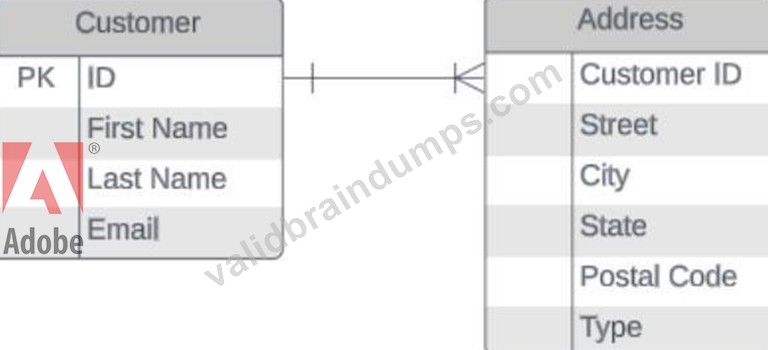
- A. Model each address as its own distinct object within an XDM Individual Profile class-based schema
- B. Model addresses as individual events using an XDM Experience Event class-based schema
- C. Model addresses as static key-value pairs in a lookup table outside of the XDM schema
- D. Model addresses as an array of addresses in an XDM Individual Profile class-based schema
Answer: A
NEW QUESTION # 89
A financial institution needs to ingest sensitive customer data, including credit card transactions, while ensuring real-time updates to customer profiles.
What considerations should they prioritize?
- A. Rely solely on batch ingestion workflows.
- B. Disable real-time updates to ensure data consistency.
- C. Avoid using streaming connectors for sensitive data.
- D. Enable Edge ingestion with encryption for sensitive data.
Answer: D
NEW QUESTION # 90
What are common activation patterns in Adobe RT-CDP? (Select two.)
- A. Manual activation for immediate campaign needs.
- B. Batch activation for large datasets.
- C. Edge-based activation for real-time use cases.
- D. On-site segmentation for batch exports.
Answer: B,C
NEW QUESTION # 91
A data engineer must set up alerts for a Real-Time CDP project. Which two channels of Alerts are available to the engineer? (Choose two.)
- A. Alerts API
- B. Adobe IO Events
- C. Platform UI
- D. Data Collection UI Alerts
Answer: B,C
NEW QUESTION # 92
The marketer notices some strange behavior in emails that were going out and noticed a Profile that had multiple email identities.
What would the marketer do next to identify the root cause?
- A. Use the Identity graph viewer to retrieve the Identity Map linked to the profile
- B. Use Identity graph viewer to retrieve the list of data sources
- C. Use the Identity API to get the details of the Identity Namespace definition
- D. Use the Identity API to list the Identity Mappings for the email
Answer: B
NEW QUESTION # 93
A financial institution needs to store customer transaction data along with unstructured notes from customer service interactions.
Which feature of Adobe RT-CDP should they use?
- A. Schema-on-write with strict normalization.
- B. Hierarchical data modeling in NoSQL schemas.
- C. Batch processing workflows.
- D. Deterministic identity resolution.
Answer: B
NEW QUESTION # 94
What is the primary consideration when designing identity relationships for modeling in Adobe RT- CDP?
- A. Avoid using secondary identity relationships.
- B. Use one-to-one relationships exclusively.
- C. Ensure all identities are linked to a primary namespace.
- D. Disable deterministic identity resolution.
Answer: C
NEW QUESTION # 95
A company based out of California would like to delete profile data from the Adobe Experience Platform (AEP) profile store and data lake based on their customer request. They have reached out to a Real-Time CDP consultant with the list of profiles to perform the deletion task for them.
What is the recommended approach to delete the profile data from AEP?
- A. Build a custom solution by leveraging the delete entity API to delete the profiles from both data lake and profile store
- B. Use the Segment Export feature to delete the profiles from the dataset and profile store
- C. Leverage privacy service and submit the delete request under CCPA regulation type for a given namespace and identity value
- D. Leverage query service, create a query by excluding the profiles shared by customer, delete the batches from dataset, and insert data from query output
Answer: C
NEW QUESTION # 96
A segment has a total audience size of 12 million profiles. The segment is activated to an Amazon S3 destination.
How many files would land in the Amazon S3 destination?
- A. Two files (filename.csv, filename_1.csv)
filename.csv (6 million Profiles)
filename_1.csv (6 million Profiles) - B. One file (filename.csv)
filename.csv (12 million profiles) - C. Four files (filename.csv, filename_1.csv, filename_2.csv, filename_3.csv)
- D. Three files (filename.csv, filename_1.csv, filename_2.csv)
filename.csv (5 million profiles)
filename_1.csv (5 million profiles)
filename_2.csv (2 million profiles)
Answer: D
NEW QUESTION # 97
What is a common use case for batch data ingestion in Adobe RT-CDP?
- A. Identity stitching for cross-device activities.
- B. Low-latency personalization for email campaigns.
- C. Periodic uploads of customer transaction history.
- D. Real-time website interaction tracking.
Answer: C
NEW QUESTION # 98
A data engineer has configured a new dataset for Adobe Experience Platform which is enabled for Profile. The new source uses an individual profile-based schema with its primary identity as Email. The initial file that is loaded to create the profiles contains 100 profile fragments (records), but after ingestion, only 75 profile fragments are created. No errors were observed during the ingestion.
What could be the reason for this?
- A. The identity graph collapsed 25 of the profile fragments into the existing 75 profile fragments
- B. The dataset schema used was not compatible with the ingestion workflow
- C. 25 of the profile fragments had repeated Primary Identity values
- D. 75 profile fragments ingested successfully and 25 profile fragments failed to ingest
Answer: C
NEW QUESTION # 99
A company has a policy to restrict access of marketers from viewing PII fields within the Real- Time CDP. The data architect plans to use the attribute-based access control feature to fulfill this requirement. The data architect notices that when they apply labels in one schema, other schemas inherit those same labels.
Why is this happening?
- A. Labels are applied at a field within a field group and inherited by the schemas that use that field group.
- B. Labels are applied to datasets, and all schemas linked to those datasets inherit the labels.
- C. Labels are applied at a field level and inherited by the schemas that use that field.
- D. Labels are applied at a field group and inherited by the schemas that use that field group.
Answer: A
NEW QUESTION # 100
......
Get instant access to AD0-E605 practice exam questions: https://drive.google.com/open?id=1PFlg-Hgbu8GKbQol23LwGM0q4GPBzMof
The best AD0-E605 exam study material and preparation tool is here: https://www.validbraindumps.com/AD0-E605-exam-prep.html