

Pass Your Network Security Administrator NetSec-Analyst Exam Easily with Accurate PDF Questions [Jan 05, 2026]
NetSec-Analyst Certification Exam Dumps Questions in here
Palo Alto Networks NetSec-Analyst Exam Syllabus Topics:
| Topic | Details |
|---|---|
| Topic 1 |
|
| Topic 2 |
|
| Topic 3 |
|
| Topic 4 |
|
NEW QUESTION # 21
A Network Security Analyst is tasked with investigating a persistent 'High Severity' alert on the Incidents and Alerts page, categorizing it as 'Malware Download'. Log Viewer analysis shows repeated 'threat' logs with 'file-type: PE', 'action: alert', and 'verdict: malicious' from WildFire. The logs consistently show the same internal source IP downloading the same malicious executable from various external, compromised web servers. Despite the alerts, the internal host remains infected. What is the MOST likely root cause of the persistent infection, and what advanced remediation steps should the analyst prioritize?
- A. The internal host is bypassing the firewall (e.g., using a VPN or direct internet access), so the malicious files are not traversing the firewall. The analyst should investigate network architecture and endpoint configurations.
- B. The 'decryption profile' on the firewall is not enabled, preventing the firewall from inspecting encrypted traffic where the malware might be hidden. The analyst should enable SSL decryption.
- C. The malicious file is polymorphic, and WildFire is only detecting some variants. The analyst should submit the observed malicious files manually to WildFire for deeper analysis and wait for new signatures.
- D. The internal host is infected with persistent malware that re-downloads itself even after initial detection. The analyst must contain the host, initiate forensic analysis, and deploy endpoint detection and response (EDR) solutions.
- E. The firewall's WildFire profile is configured in 'monitor' mode instead of 'block'. The analyst should change the WildFire profile to 'block' or 'reset-both' for malicious verdicts and update the security policy.
Answer: D
Explanation:
The key phrase here is 'persistent infection' and 'repeated threat logs... from various external, compromised web servers' despite the firewall 'alerting' on the downloads. If the firewall is detecting the downloads and logging them, it implies traffic is traversing the firewall and WildFire is working. However, if the action is 'alert' only, the file is allowed to pass. Even with alerts, if the host remains infected and repeatedly downloads the same malware, the most likely root cause is a highly persistent malware on the internal host that automatically attempts to re- establish its presence or re-download components. Simply blocking future downloads (Option A) won't remediate the already infected host. Option B is less likely if the logs clearly show the firewall is seeing and alerting on the traffic. Option C suggests a detection gap, but the logs explicitly state 'verdict: malicious', implying detection is happening. Option E is plausible if no logs were being generated at all, but they are. Therefore, the priority shifts from network-level prevention to endpoint-level containment and remediation. Option D describes the correct and necessary advanced remediation steps for a persistent infection.
NEW QUESTION # 22
Consider the following Python script designed to generate an External Dynamic List for Palo Alto Networks firewalls. The script pulls data from an API and formats it. If an administrator notices that their firewall EDL is always empty, despite the API returning data, what could be the issue with the generated file or its handling by the firewall?
- A. The API rate limits the script's requests, causing intermittent failures.
- B. The script is not accessible via HTTP/HTTPS at the configured EDL source URL.
- C. The output file does not contain a new line character after each entry, or the file is not served with the correct MIME type (e.g.,
- D. The 'Repeat' interval on the firewall's EDL configuration is set to 'Never'.
- E. The firewall does not support the Python script's execution environment.
Answer: C
Explanation:
If the EDL is consistently empty, it implies the firewall is fetching something but isn't finding valid entries. Option B (Correct): Palo Alto Networks firewalls are strict about EDL file formatting. Each entry must be on a new line. If entries are concatenated or the file is not served as plain text, the firewall will likely parse it as empty or invalid. This is a common pitfall when scripting EDL generation. Option A would result in a 'connection refused' or 'file not found' error, not an empty list. Option C is irrelevant; the script runs on the web server, not the firewall. Option D would mean the EDL never updates at all, not that it's empty after updates. Option E would cause intermittent failures, not consistently empty lists.
NEW QUESTION # 23
Which component is a building block in a Security policy rule?
- A. destination interface
- B. application
- C. timeout (min)
- D. decryption profile
Answer: B
Explanation:
Explanation/Reference:
Reference:
https://docs.paloaltonetworks.com/pan-os/9-0/pan-os-web-interface-help/policies/policies- security/buildingblocks-in-a-security-policy-rule.html
NEW QUESTION # 24
You are debugging a connectivity issue where an internal application server, running a custom SSH service on port 2222, cannot establish connections to an external cloud logging service. The firewall logs show 'deny' actions with application 'ssh' and service 'application-default', even though a specific policy rule allows 'custom_ssh_app' (a custom App-ID for port 2222) to the logging service. What is the most likely cause and solution?
- A. The security policy rule for 'custom_ssh_app' has a lower priority than a generic 'deny all SSH' rule. The solution is to move the 'custom_ssh_app' rule to a higher priority.
- B. The issue is with Application Override. The firewall is incorrectly overriding the custom App-ID with the default 'ssh' App-I The solution is to remove any Application Override rules that might conflict with this custom application.
- C. The custom App-ID 'custom_ssh_app' is incorrectly defined and is not identifying the traffic as SSH. The solution is to redefine the custom App-ID to accurately match the SSH handshake on port 2222.
- D. The traffic is being identified as 'application-incomplete' before the custom App-ID can classify it. The solution is to allow 'application-incomplete' for the destination IP, then refine the rule.
- E. The firewall is correctly identifying the traffic as standard SSH (App-ID: ssh) despite the custom port. The solution is to modify the allowing rule to explicitly allow 'ssh' application and 'tcp/2222' as the service.
Answer: E
Explanation:
This is a classic App-ID behavior scenario. Palo Alto Networks firewalls perform deep packet inspection. Even if you define a custom App-ID for a non-standard port, if the traffic itself inherently resembles a known application (like SSH), the firewall will identify it as that known application's App-ID. The log showing 'application: ssh' confirms this. Therefore, the allowing rule needs to specify the 'ssh' App-ID and the custom port 'tcp/2222' as the service. Option A is unlikely if the custom App-ID was meant for a custom protocol, but here it's still SSH. Option B is possible but the log showing 'ssh' indicates App-ID identification, not just a generic deny. Option D is incorrect; Application Override forces a specific application, it wouldn't cause it to be seen as 'ssh' if a custom App-ID was intended. Option E is incorrect as the application IS identified as 'ssh'.
NEW QUESTION # 25
Based on the show security policy rule would match all FTP traffic from the inside zone to the outside zone?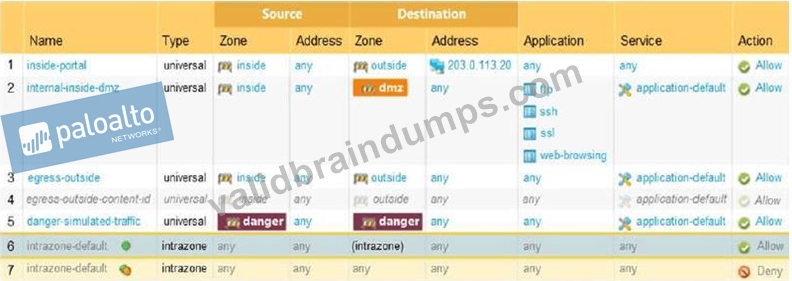
- A. engress outside
- B. inside-portal
- C. internal-inside-dmz
- D. intercone-default
Answer: A
NEW QUESTION # 26
An administrator would like to see the traffic that matches the interzone-default rule in the traffic logs.
What is the correct process to enable this logging1?
- A. Select the interzone-default rule and edit the rule on the Actions tab select Log at Session Start and click OK
- B. Select the interzone-default rule and edit the rule on the Actions tab select Log at Session End and click OK
- C. This rule has traffic logging enabled by default no further action is required
- D. Select the interzone-default rule and click Override on the Actions tab select Log at Session End and click OK
Answer: D
NEW QUESTION # 27
Which feature would be useful for preventing traffic from hosting providers that place few restrictions on content, whose services are frequently used by attackers to distribute illegal or unethical material?
- A. Palo Alto Networks Known Malicious IP Addresses
- B. Palo Alto Networks High-Risk IP Addresses
- C. Palo Alto Networks Bulletproof IP Addresses
- D. Palo Alto Networks C&C IP Addresses
Answer: C
Explanation:
To block hosts that use bulletproof hosts to provide malicious, illegal, and/or unethical content, use the bulletproof IP address list in policy.
https://docs.paloaltonetworks.com/pan-os/9-0/pan-os-new-features/content-inspection-features/edl-for- bulletproof-isps#:~:text=A%20new%20built%2Din%20external,%2C%20illegal%2C%20and%20unethical%
20content.
NEW QUESTION # 28
How can a complete overview of the logs be displayed to an administrator who has permission in the system to view them?
- A. Select the unified log entry in the side menu.
- B. Modify the number of columns visible on the page
- C. Select the system logs entry in the side menu.
- D. Modify the number of logs visible on each page.
Answer: A
Explanation:
The best way to view a complete overview of the logs is to select the unified log entry in the side menu. The unified log is a single view that displays all the logs generated by the firewall, such as traffic, threat, URL filtering, data filtering, and WildFire logs1. The unified log allows the administrator to filter, sort, and export the logs based on various criteria, such as time range, severity, source, destination, application, or action1.
Modifying the number of columns visible on the page or the number of logs visible on each page does not provide a complete overview of the logs, but only changes the display settings of the current log view. Selecting the system logs entry in the side menu does not show all the logs generated by the firewall, but only shows the logs related to system events, such as configuration changes, system alerts, or HA status2.
References:
1: View Logs - Palo Alto Networks 2: View and Manage Logs - Palo Alto Networks
NEW QUESTION # 29
When HTTPS for management and GlobalProtect are enabled on the same interface, which TCP port is used for management access?
- A. 0
- B. 1
- C. 2
- D. 3
Answer: D
Explanation:
Reference: https://knowledgebase.paloaltonetworks.com/KCSArticleDetail?id=kA10g000000Cm8SCAS#:~:
text=Details,using%20https%20on%20port%204443
NEW QUESTION # 30
Based on the graphic which statement accurately describes the output shown in the server monitoring panel?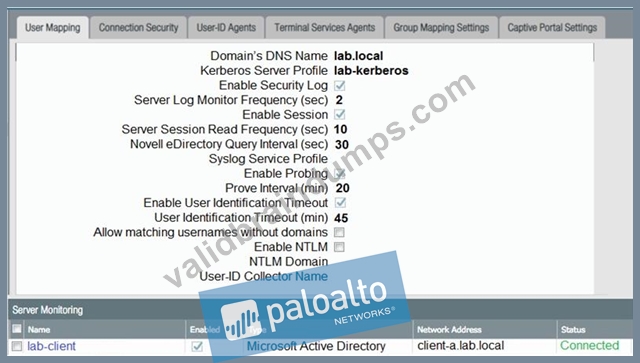
- A. The User-ID agent is connected to the firewall labeled lab-client.
- B. The User-ID agent is connected to a domain controller labeled lab-client.
- C. The host lab-client has been found by the User-ID agent.
- D. The host lab-client has been found by a domain controller.
Answer: B
NEW QUESTION # 31
Which URL Filtering Profile action does not generate a log entry when a user attempts to access a URL?
- A. override
- B. allow
- C. continue
- D. block
Answer: B
NEW QUESTION # 32
Given the scenario, which two statements are correct regarding multiple static default routes? (Choose two.)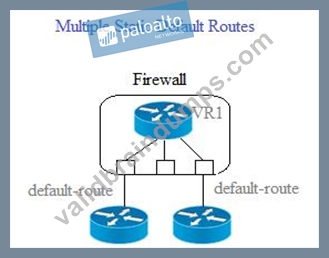
- A. Route with lowest metric is actively used
- B. Route with highest metric is actively used
- C. Path monitoring does not determine if route is useable
- D. Path monitoring determines if route is useable
Answer: A,D
NEW QUESTION # 33
An administrator notices that protection is needed for traffic within the network due to malicious lateral movement activity. Based on the image shown, which traffic would the administrator need to monitor and block to mitigate the malicious activity?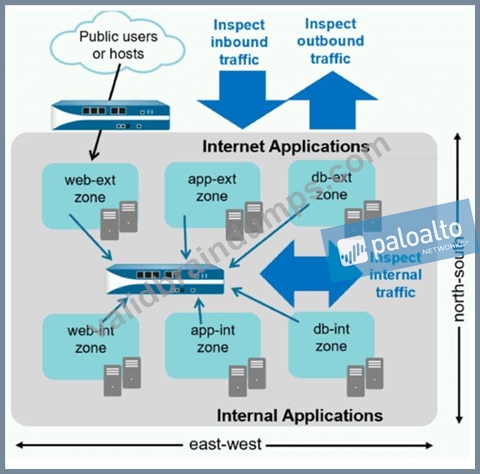
- A. perimeter traffic
- B. north-south traffic
- C. branch office traffic
- D. east-west traffic
Answer: D
NEW QUESTION # 34
What in the minimum frequency for which you can configure the firewall too check for new wildfire antivirus signatures?
- A. every 1 minute
- B. every 30 minutes
- C. every 5 minutes
- D. every 24 hours
Answer: A
Explanation:
NEW QUESTION # 35
An enterprise is planning to deploy custom applications in a private cloud, with strict requirements for end-to-end encryption. These applications will use certificate pinning to prevent Man-in-the-Middle attacks. The security team needs to ensure that Palo Alto Networks firewalls provide application-level visibility (App-ID, Content-ID, Threat Prevention) into this traffic without breaking the certificate pinning.
Which of the following approaches is feasible, and what is a critical consideration?
- A. Use SSL Inbound Inspection, ensuring the firewall's decryption profile is configured to 'Block Sessions with Untrusted Certificates'.
- B. Implement 'SSL Decryption Excluding Server Certificates' to allow initial handshake logging, and use a custom URL category for these applications to bypass all decryption.
- C. Leverage a 'No Decryption' policy rule for the pinned applications, acknowledging that App-ID will still function for initial session identification, but Content-ID and Threat Prevention will be limited for the encrypted payload.
- D. Certificate pinning is inherently incompatible with inline SSL decryption. The firewall should be configured for 'No Decryption' for this traffic, and visibility will be limited to Layer 3/4 information and initial App-ID derived from handshake. Application-level security should be enforced at the endpoint or application layer itself, potentially using a Web Application Firewall (WAF) or API Gateway.
- E. Configure SSL Forward Proxy decryption with the firewall's root CA certificate installed on all application servers.
Answer: D
Explanation:
Certificate pinning means the client (or server) is configured to only trust a specific certificate or public key, not just any certificate signed by a trusted CA. When an inline firewall performs SSL decryption, it presents its own generated certificate (signed by its root CA) to the client. This certificate will not match the pinned certificate/key, causing the client application to terminate the connection due to a trust violation. Therefore, certificate pinning is fundamentally incompatible with inline SSL decryption. The best approach is to exempt this traffic from decryption and rely on other security controls or logging at different layers for visibility. Option C is partially correct in that App-ID works, but it doesn't fully explain the implication on Content-ID/Threat-ID. Option E is the most comprehensive and accurate answer, acknowledging the inherent conflict and suggesting alternative security measures.
NEW QUESTION # 36
Which two components are utilized within the Single-Pass Parallel Processing architecture on a Palo Alto Networks Firewall? (Choose two.)
- A. Layer-ID
- B. QoS-ID
- C. User-ID
- D. App-ID
Answer: C,D
NEW QUESTION # 37
Which two matching criteria are used when creating a Security policy involving NAT? (Choose two.)
- A. Pre-NAT zone
- B. Post-NAT zone
- C. Post-NAT address
- D. Pre-NAT address
Answer: B,D
NEW QUESTION # 38
A cloud-native application leverages multiple dynamically assigned ephemeral ports within a specific range (e.g., TCP/30000-35000) for internal service-to-service communication. Due to the dynamic nature and potential for rapid changes in underlying protocols (Grpc over HTTP/2, custom protobufs), App-ID frequently labels this traffic as 'unknown-tcp' or 'unknown-udp', hindering security visibility. The security team wants to consolidate all traffic within this port range between specific internal subnets (10.0.1.0/24 to 10.0.2.0/24) as a single logical application, 'cloud-microservices', regardless of the underlying protocol, to apply consistent security profiles and logging.
Which of the following approaches is the most appropriate and why?
- A. Configure a Service Object for the port range TCP/30000-35000 and UDP/30000-35000, then create security policies that use these service objects without specifying any application.
- B. Implement an Application Override policy:

- C. Create an Application Filter that groups all 'unknown-tcp' and 'unknown-udp' applications, and apply it to a security policy for the internal subnets.
- D. Disable App-ID for the entire 10.0.1.0/24 to 10.0.2.0/24 traffic flow and rely solely on port-based security policies.
- E. Develop custom application signatures for each potential protocol (gRPC, protobufs, etc.) within the dynamic port range, and update them regularly.
Answer: B
Explanation:
This scenario precisely describes a use case for Application Override. When you have a clear understanding of the traffic's source, destination, and ports, but App-ID struggles due to dynamic or proprietary protocols, an override forces the desired classification. Option C provides this targeted approach: it defines a specific application 'cloud-microservices' for all traffic within the specified port range and subnets, regardless of the actual protocol. This allows for consistent policy enforcement and logging. Option A merely groups misidentified applications without reclassifying them. Option B is overly complex and unsustainable for dynamic environments. Options D and E sacrifice the benefits of App-ID and provide less granular control.
NEW QUESTION # 39
Which two DNS policy actions in the anti-spyware security profile can prevent hacking attacks through DNS queries to malicious domains? (Choose two.)
- A. Block
- B. Deny
- C. Sinkhole
- D. Override
Answer: A,C
Explanation:
A DNS policy action is a setting in an Anti-Spyware security profile that defines how the firewall handles DNS queries to malicious domains. A malicious domain is a domain name that is associated with a known threat, such as malware, phishing, or botnet1.
There are four possible DNS policy actions: alert, allow, block, and sinkhole1.
The alert action logs the DNS query and allows it to proceed to the intended destination. This action does not prevent hacking attacks, but only notifies the administrator of the potential threat1.
The allow action allows the DNS query to proceed to the intended destination without logging it. This action does not prevent hacking attacks, but only bypasses the DNS security inspection2.
The block action blocks the DNS query and sends a response to the client with an NXDOMAIN (non-existent domain) error code. This action prevents hacking attacks by preventing the client from resolving the malicious domain1.
The sinkhole action redirects the DNS query to a predefined IP address (the sinkhole IP address) that is under the control of the administrator. This action prevents hacking attacks by isolating the client from the malicious domain and allowing the administrator to monitor and remediate the infected host1.
The override action is not a valid DNS policy action, but a setting in an Anti-Spyware security profile that allows the administrator to create exceptions for specific spyware signatures that they want to override the default action or log settings3.
Therefore, the two DNS policy actions that can prevent hacking attacks through DNS queries to malicious domains are block and sinkhole.
Reference:
1: Enable DNS Security - Palo Alto Networks 2: How To Disable the DNS Security Feature from an Anti-Spyware Profile - Palo Alto Networks 3: Security Profile: Anti-Spyware - Palo Alto Networks
NEW QUESTION # 40
......
Verified NetSec-Analyst dumps Q&As 100% Pass in First Attempt Guaranteed Updated Dump: https://drive.google.com/open?id=1WNfcho9K949-2XbhJrrR8d6VSBVcT7fV
Updated NetSec-Analyst Exam Practice Test Questions: https://www.validbraindumps.com/NetSec-Analyst-exam-prep.html