

Use Free FCP_ZCS_AD-7.4 Exam Questions that Stimulates Actual EXAM
Get 100% Real FCP_ZCS_AD-7.4 Free Online Practice Test
NEW QUESTION # 16
Which Azure feature enables an organization (tenant) to manage and secure users, groups, and permissions within a single domain?
Response:
- A. Azure Kubernetes Service (AKS)
- B. Azure Cosmos DB
- C. Azure Microsoft Entra ID
- D. Azure Active Directory B2C
Answer: C
NEW QUESTION # 17
Refer to the exhibit.
In an expanding corporation, the different branches share resources connecting to Azure through Azure VPN Gateway and ExpressRoute Gateway.
Which Azure solution can you implement to simplify and centralize the seamless sharing of the dynamic routing between FortiGate VMs and branches?
- A. Azure Virtual WAN
- B. Azure Route Server
- C. Azure Virtual Hub
- D. Azure Traffic Manager
Answer: B
Explanation:
Azure Route Server simplifies dynamic routing by allowing your FortiGate VMs to exchange BGP routes directly with Azure's networking fabric. This eliminates the need to manually update route tables and enables seamless, centralized communication between on-premises branches and Azure resources through both VPN Gateway and ExpressRoute Gateway.
NEW QUESTION # 18
What role does the Azure Route Server play in network architecture?
Response:
- A. It facilitates the management of routing tables
- B. It provides encrypted VPN access
- C. It serves as a primary storage solution
- D. It acts as a firewall between different network segments
Answer: A
NEW QUESTION # 19
Which Azure service provides distributed denial of service (DDoS) protection by monitoring and mitigating potential threats?
Response:
- A. Azure Sentinel
- B. Azure Firewall
- C. Azure Application Gateway
- D. Azure DDoS Protection
Answer: D
NEW QUESTION # 20
Your organization is in the process of optimizing its Azure network architecture and wants to dynamically manage and exchange routing information between its virtual networks and on-premises networks.
Which Azure service would help to provide a centralized point for efficient route management and dynamic routing?
- A. Azure ExpressRoute
- B. Azure Virtual WAN
- C. Azure Route Server
- D. Azure VPN Gateway
Answer: C
Explanation:
Azure Route Server enables dynamic route exchange using BGP between your Azure virtual network and network virtual appliances (NVAs) or on-premises networks. It provides a centralized and scalable solution for route management, allowing seamless integration of routing updates without manual configuration changes.
NEW QUESTION # 21
Refer to the exhibit.
A high availability, active-active FortiGate with Elastic Load Balancing (ELB) and Internal Load Balancing (ILB) was deployed in your Azure environment.
Which tools can you use to configure synchronization? (Choose two.)
- A. Heartbeat interfaces
- B. FortiGate Clustering Protocol (FGCP)
- C. FortiManager
- D. Autoscale
- E. Software-defined network (SDN) Fabric Connector
Answer: A,B
Explanation:
In a FortiGate active-active HA deployment in Azure, synchronization between instances is achieved using:
NEW QUESTION # 22
What is a key advantage of the branch-to-hub to hub-to-branch topology in an Azure virtual WAN?
- A. Increased security through isolated connections between branches and hubs
- B. Enhanced scalability enables communication between branch offices
- C. Load balancing enabled by the simultaneous connection of each branch to multiple hubs
- D. Improved branch-to-branch communication for faster data transfer
Answer: D
Explanation:
The branch-to-hub to hub-to-branch topology in Azure Virtual WAN enables efficient branch-to-branch communication by routing traffic through connected hubs. This improves data transfer speed and reliability between branches without needing direct connections between all sites, simplifying management while maintaining performance.
NEW QUESTION # 23
You are deploying a site-to-site IPsec VPN connection between your on-premise subnet and your Azure VNets.
What is the most important advantage for using FortiGate at both ends of the tunnel?
- A. It reduces the need for troubleshooting due to FortiGate automatic configuration
- B. It allows scaling based on performance and capacity requirements
- C. It provides consistent security policies and configurations
- D. It minimizes the need for encryption in transit
Answer: C
Explanation:
Using FortiGate at both ends of a site-to-site IPsec VPN tunnel provides the advantage of applying consistent security policies, configurations, and management tools across both the on-premises and Azure environments. This simplifies policy enforcement, improves operational efficiency, and ensures uniform threat protection.
NEW QUESTION # 24
Which role does the local network gateway play in FortiGate to Azure VPN connectivity?
- A. It represents the Azure VPN Gateway in the FortiGate configuration
- B. It defines the IP addresses of the on-premises network
- C. It is responsible for load balancing traffic between FortiGate and Azure
- D. It manages the encryption keys for the VPN connection
Answer: B
Explanation:
The local network gateway in Azure represents the on-premises VPN device (such as FortiGate) and defines the on-premises public IP address and the address prefixes of the on-premises network. This is essential for configuring site-to-site VPN connections from Azure to FortiGate.
NEW QUESTION # 25
Refer to the exhibit.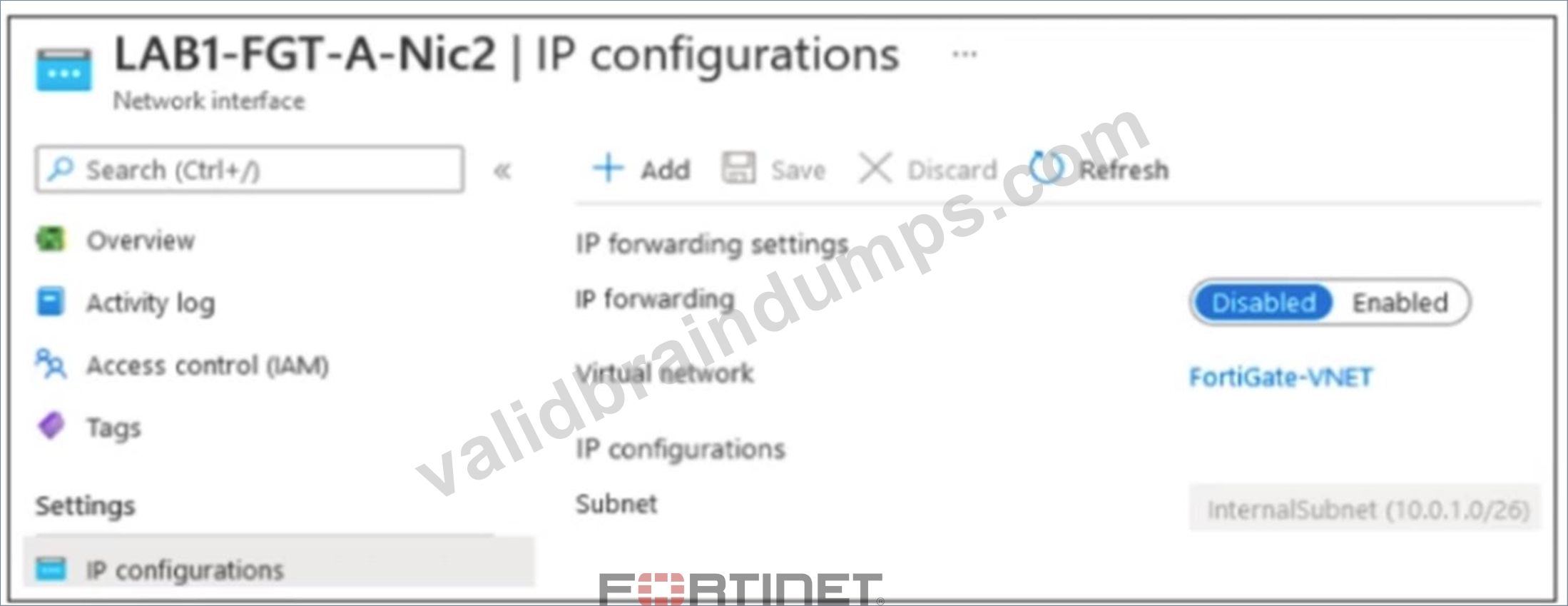
The exhibit shows some of the properties of a virtual NIC that is used by a FortiGate VM deployed in Azure.
The virtual NIC shown is connected to a subnet (10.0.1.0/26) with several VMs that will be accessing the internet through the FortiGate VM.
Which statement is true for this scenario?
- A. The parameters of the virtual NIC are not configured correctly.
- B. The VMs in the 10.0.1.0/26 subnet can access the internet through FortiGate.
- C. The NIC in the exhibit needs to be assigned a public IP address.
- D. You must change the default gateway on the VMs in the Internal Subnet for this to work.
Answer: D
Explanation:
For VMs in the 10.0.1.0/26 subnet to access the internet through the FortiGate VM, their default gateway must be changed to the internal IP address of the FortiGate's NIC in that subnet (e.g., LAB1-FGT-A-Nic2). This ensures traffic is routed through FortiGate for inspection and NAT, rather than directly using Azure's default system routes.
NEW QUESTION # 26
Which VPN protocol is used when configuring a FortiGate device to connect to an Azure VPN gateway?
Response:
- A. L2TP
- B. IPsec
- C. SSTP
- D. PPTP
Answer: B
NEW QUESTION # 27
Refer to the exhibit.
Your organization is planning the implementation of a complex hub-to-spoke solution to meet automated large-scale branch connectivity with multiple regions, offering a diverse range of connectivity options.
Which Azure networking service can deliver a solution?
- A. Azure SD-WAN
- B. Azure Firewall Manager
- C. Azure Virtual WAN
- D. Azure VPN Gateway
Answer: C
Explanation:
Azure Virtual WAN is designed for large-scale, automated, and global branch connectivity, supporting hub-and-spoke architectures across multiple regions. It enables centralized routing, hub-to-hub connectivity, and integrates with VPN, ExpressRoute, and SD-WAN solutions, making it ideal for complex, multi-region deployments as shown in the diagram.
NEW QUESTION # 28
Which feature of Azure Security Center helps in identifying and reacting to threats across Azure and hybrid environments?
Response:
- A. Regulatory compliance dashboards
- B. Custom alert rules
- C. Advanced threat protection
- D. Security score
Answer: C
NEW QUESTION # 29
What is a requirement when you deploy a FortiGate active-active cluster in Azure?
- A. You must use unicast FGCP to synchronize the configurations.
- B. You must configure all FortiGate VMs with three or more interfaces.
- C. You must assign the public IP address to an Azure load balancer.
- D. You must configure both load balancers to allow administrative access.
Answer: C
Explanation:
In an active-active FortiGate cluster deployment in Azure, you must assign the public IP address to an Azure load balancer. This is required because Azure does not support multiple VMs sharing a single public IP directly. The Azure Load Balancer handles inbound traffic and distributes it to the active FortiGate instances.
NEW QUESTION # 30
Which Azure component plays a critical role in managing and routing communication between different Azure services?
Response:
- A. Azure Service Bus
- B. Azure Logic Apps
- C. Azure Functions
- D. Azure Event Grid
Answer: A
NEW QUESTION # 31
What are the core components of the Azure public cloud architecture?
(Choose Two)
Response:
- A. Local area networks
- B. On-premises data centers
- C. Azure Virtual Machines
- D. Azure Blob Storage
Answer: C,D
NEW QUESTION # 32
......
Fortinet FCP_ZCS_AD-7.4 Exam Syllabus Topics:
| Topic | Details |
|---|---|
| Topic 1 |
|
| Topic 2 |
|
| Topic 3 |
|
| Topic 4 |
|
| Topic 5 |
|
BEST Verified Fortinet FCP_ZCS_AD-7.4 Exam Questions (2025) : https://www.validbraindumps.com/FCP_ZCS_AD-7.4-exam-prep.html
The Best Practice Test Preparation for the FCP_ZCS_AD-7.4 Certification Exam: https://drive.google.com/open?id=1PlD4oMoPSlVLhQEFoz4i3inphD9fUkrL