

[Aug 31, 2024] 100% Real & Accurate DP-100 Questions with Free and Fast Updates
Self-Study Guide for Becoming an Designing and Implementing a Data Science Solution on Azure Expert
NEW QUESTION # 100
You are developing a hands-on workshop to introduce Docker for Windows to attendees.
You need to ensure that workshop attendees can install Docker on their devices.
Which two prerequisite components should attendees install on the devices? Each correct answer presents part of the solution.
NOTE: Each correct selection is worth one point.
- A. VirtualBox
- B. Microsoft Hardware-Assisted Virtualization Detection Tool
- C. Windows 10 64-bit Professional
- D. Kitematic
- E. BIOS-enabled virtualization
Answer: C,E
Explanation:
C: Make sure your Windows system supports Hardware Virtualization Technology and that virtualization is enabled.
Ensure that hardware virtualization support is turned on in the BIOS settings. For example: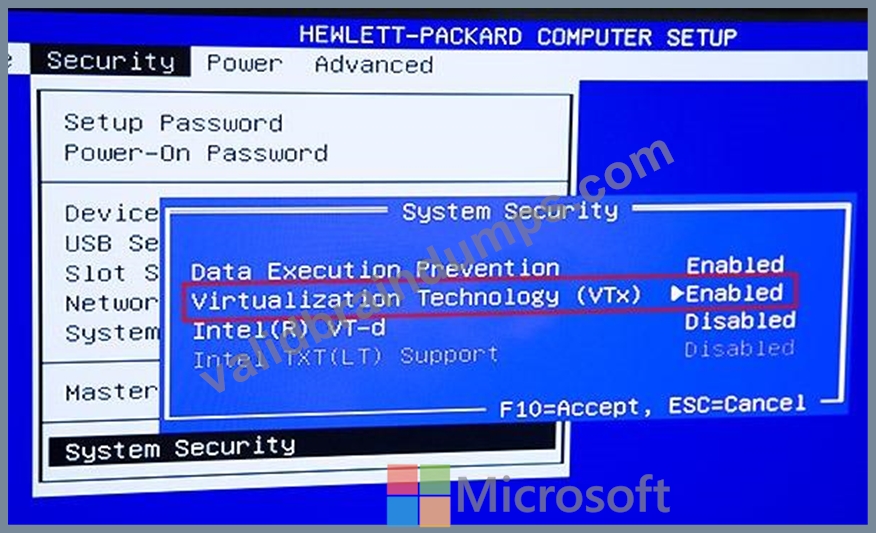
E: To run Docker, your machine must have a 64-bit operating system running Windows 7 or higher.
Reference:
https://docs.docker.com/toolbox/toolbox_install_windows/
https://blogs.technet.microsoft.com/canitpro/2015/09/08/step-by-step-enabling-hyper-v-for-use-on-windows-10/
NEW QUESTION # 101
You create a Python script named train.py and save it in a folder named scripts. The script uses the scikit-learn framework to train a machine learning model.
You must run the script as an Azure Machine Learning experiment on your local workstation.
You need to write Python code to initiate an experiment that runs the train.py script.
How should you complete the code segment? To answer, select the appropriate options in the answer area.
NOTE: Each correct selection is worth one point.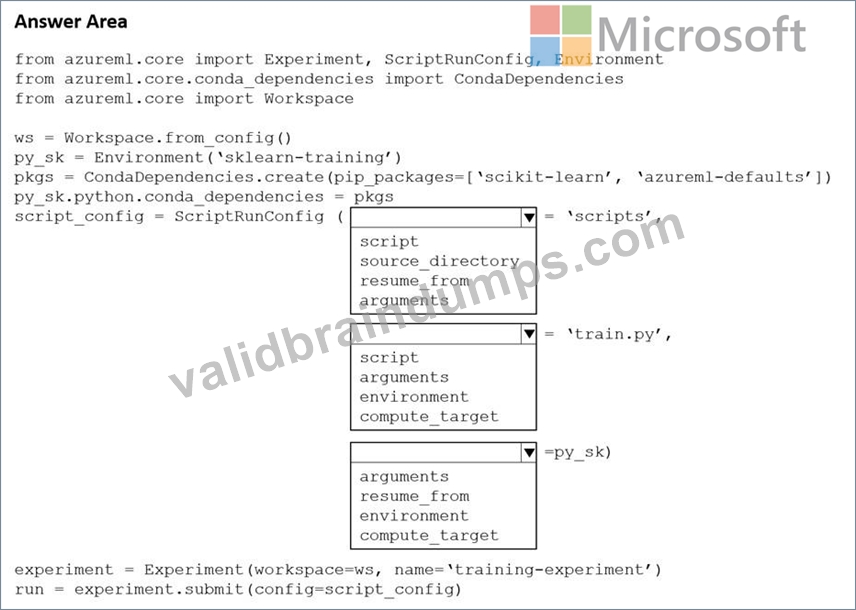
Answer:
Explanation:
Reference:
https://docs.microsoft.com/en-us/python/api/azureml-core/azureml.core.scriptrunconfig
NEW QUESTION # 102
You plan to explore demographic data for home ownership in various cities. The data is in a CSV file with the following format:
age,city,income,home_owner
21,Chicago,50000,0
35,Seattle,120000,1
23,Seattle,65000,0
45,Seattle,130000,1
18,Chicago,48000,0
You need to run an experiment in your Azure Machine Learning workspace to explore the data and log the results. The experiment must log the following information:
the number of observations in the dataset
a box plot of income by home_owner
a dictionary containing the city names and the average income for each city You need to use the appropriate logging methods of the experiment's run object to log the required information.
How should you complete the code? To answer, drag the appropriate code segments to the correct locations.
Each code segment may be used once, more than once, or not at all. You may need to drag the split bar between panes or scroll to view content.
NOTE: Each correct selection is worth one point.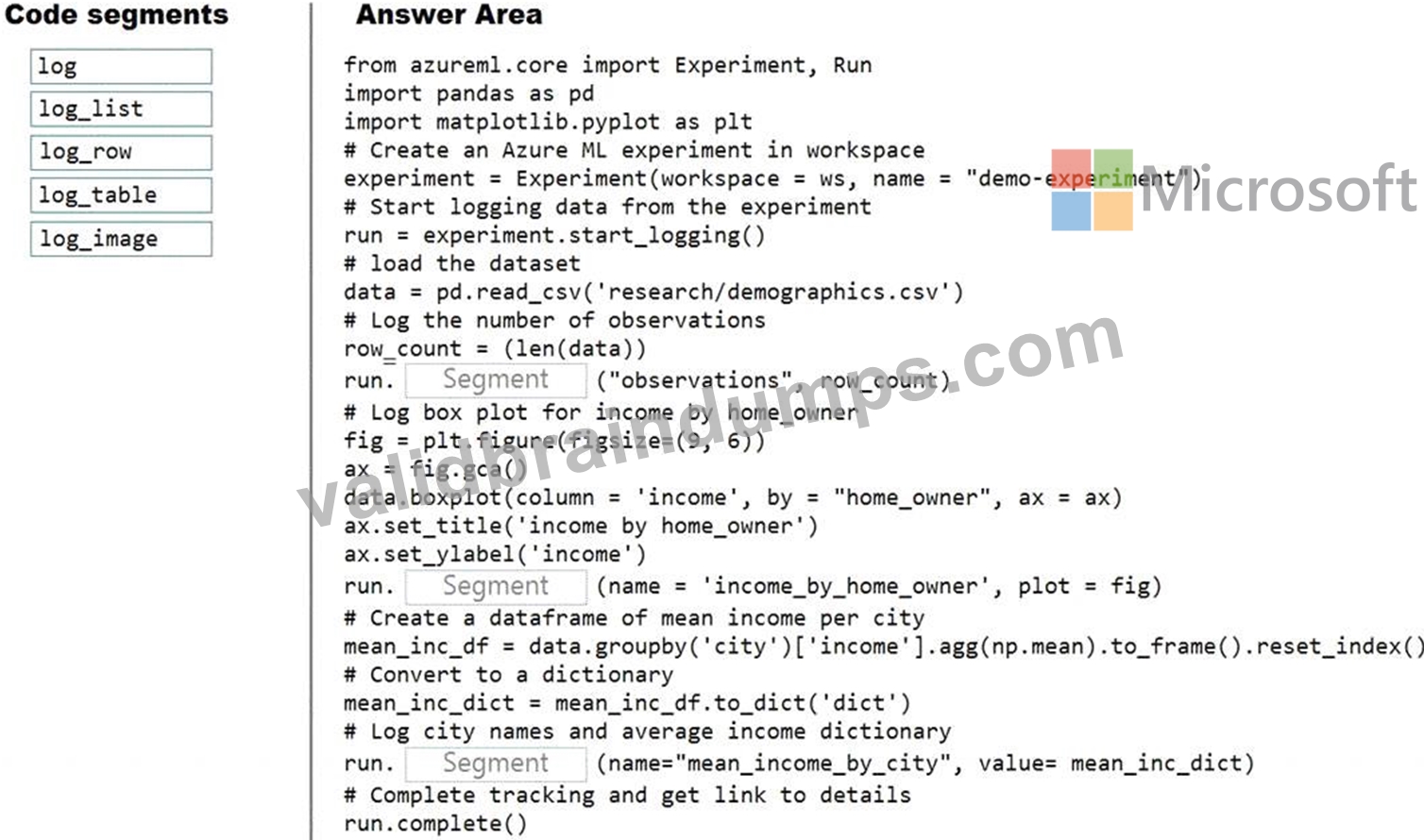
Answer:
Explanation: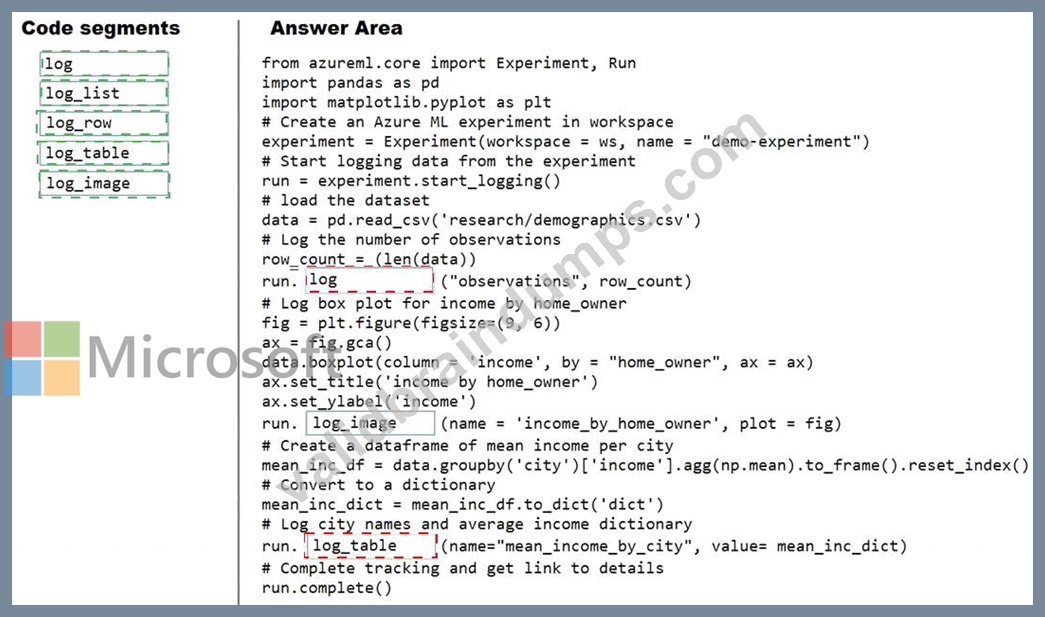
Explanation
Box 1: log
The number of observations in the dataset.
run.log(name, value, description='')
Scalar values: Log a numerical or string value to the run with the given name. Logging a metric to a run causes that metric to be stored in the run record in the experiment. You can log the same metric multiple times within a run, the result being considered a vector of that metric.
Example: run.log("accuracy", 0.95)
Box 2: log_image
A box plot of income by home_owner.
log_image Log an image to the run record. Use log_image to log a .PNG image file or a matplotlib plot to the run. These images will be visible and comparable in the run record.
Example: run.log_image("ROC", plot=plt)
Box 3: log_table
A dictionary containing the city names and the average income for each city.
log_table: Log a dictionary object to the run with the given name.
NEW QUESTION # 103 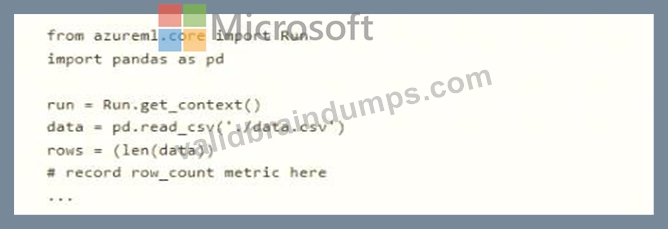
You need to record the row count as a metric named row_count that can be returned using the get_metrics method of the Run object after the experiment run completes. Which code should you use?
- A. run.tag('row_count', rows)
- B. run.log('row_count', rows)
- C. run.log_row('row_count', rows)
- D. run.log_table('row_count', rows)
- E. run.upload_file('row_count', './data.csv')
Answer: B
Explanation:
Explanation
Log a numerical or string value to the run with the given name using log(name, value, description=''). Logging a metric to a run causes that metric to be stored in the run record in the experiment. You can log the same metric multiple times within a run, the result being considered a vector of that metric.
Example: run.log("accuracy", 0.95)
Reference:
https://docs.microsoft.com/en-us/python/api/azureml-core/azureml.core.run
NEW QUESTION # 104
You are performing sentiment analysis using a CSV file that includes 12,000 customer reviews written in a short sentence format. You add the CSV file to Azure Machine Learning Studio and configure it as the starting point dataset of an experiment. You add the Extract N-Gram Features from Text module to the experiment to extract key phrases from the customer review column in the dataset.
You must create a new n-gram dictionary from the customer review text and set the maximum n-gram size to trigrams.
What should you select? To answer, select the appropriate options in the answer area.
NOTE: Each correct selection is worth one point.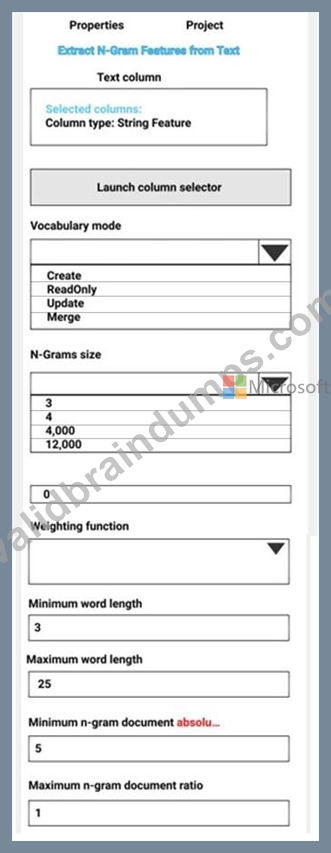
Answer:
Explanation:
Reference:
https://docs.microsoft.com/en-us/azure/machine-learning/studio-module-reference/extract-n-gram-features-from-text
NEW QUESTION # 105
You need to define a process for penalty event detection.
Which three actions should you perform in sequence? To answer, move the appropriate actions from the list of actions to the answer area and arrange them in the correct order.
Answer:
Explanation:
1 - Vary the length of frequency bands between modeling epochs
2 - Standerdize to mono audio clips.
3 - Use a Fast Fourier transform on frequancy changes over time.
NEW QUESTION # 106
Note: This question is part of a series of questions that present the same scenario. Each question in the series contains a unique solution that might meet the stated goals. Some question sets might have more than one correct solution, while others might not have a correct solution.
After you answer a question in this section, you will NOT be able to return to it. As a result, these questions will not appear in the review screen.
An IT department creates the following Azure resource groups and resources: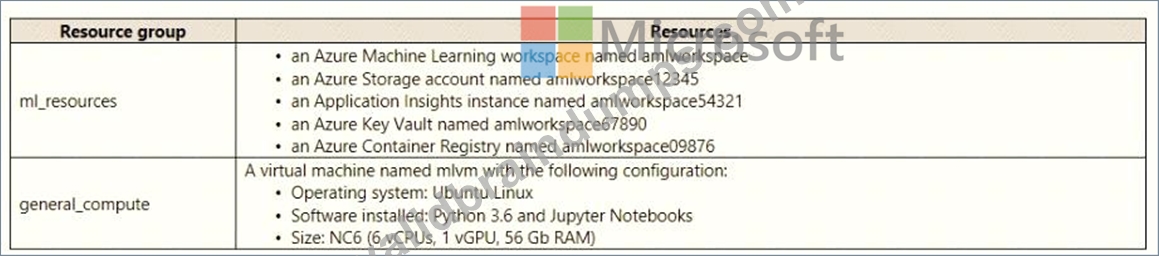
The IT department creates an Azure Kubernetes Service (AKS)-based inference compute target named aks-cluster in the Azure Machine Learning workspace. You have a Microsoft Surface Book computer with a GPU. Python 3.6 and Visual Studio Code are installed.
You need to run a script that trains a deep neural network (DNN) model and logs the loss and accuracy metrics.
Solution: Install the Azure ML SDK on the Surface Book. Run Python code to connect to the workspace. Run the training script as an experiment on the aks-cluster compute target.
Does the solution meet the goal?
- A. Yes
- B. No
Answer: B
Explanation:
Explanation
Need to attach the mlvm virtual machine as a compute target in the Azure Machine Learning workspace.
Reference:
https://docs.microsoft.com/en-us/azure/machine-learning/concept-compute-target
NEW QUESTION # 107
You plan to deliver a hands-on workshop to several students. The workshop will focus on creating data visualizations using Python. Each student will use a device that has internet access.
Student devices are not configured for Python development. Students do not have administrator access to install software on their devices. Azure subscriptions are not available for students.
You need to ensure that students can run Python-based data visualization code.
Which Azure tool should you use?
- A. Azure BatchAl
- B. Anaconda Data Science Platform
- C. Azure Machine Learning Service
- D. Azure Notebooks
Answer: D
Explanation:
Reference:
https://notebooks.azure.com/
NEW QUESTION # 108
You plan to use a Deep Learning Virtual Machine (DLVM) to train deep learning models using Compute Unified Device Architecture (CUDA) computations.
You need to configure the DLVM to support CUDA.
What should you implement?
- A. Intel Software Guard Extensions (Intel SGX) technology
- B. Solid State Drives (SSD)
- C. Graphic Processing Unit (GPU)
- D. Computer Processing Unit (CPU) speed increase by using overclocking
- E. High Random Access Memory (RAM) configuration
Answer: C
Explanation:
A Deep Learning Virtual Machine is a pre-configured environment for deep learning using GPU instances.
References:
https://azuremarketplace.microsoft.com/en-au/marketplace/apps/microsoft-ads.dsvm-deep-learning
NEW QUESTION # 109
You use the following code to define the steps for a pipeline:
from azureml.core import Workspace, Experiment, Run
from azureml.pipeline.core import Pipeline
from azureml.pipeline.steps import PythonScriptStep
ws = Workspace.from_config()
. . .
step1 = PythonScriptStep(name="step1", ...)
step2 = PythonScriptsStep(name="step2", ...)
pipeline_steps = [step1, step2]
You need to add code to run the steps.
Which two code segments can you use to achieve this goal? Each correct answer presents a complete solution.
NOTE: Each correct selection is worth one point.
- A. experiment = Experiment(workspace=ws,
name='pipeline-experiment')
run = experiment.submit(config=pipeline_steps) - B. pipeline = Pipeline(workspace=ws, steps=pipeline_steps)
experiment = Experiment(workspace=ws,
name='pipeline-experiment')
run = experiment.submit(pipeline) - C. run = Run(pipeline_steps)
- D. pipeline = Pipeline(workspace=ws, steps=pipeline_steps)
run = pipeline.submit(experiment_name='pipeline-experiment')
Answer: B,D
Explanation:
After you define your steps, you build the pipeline by using some or all of those steps.
# Build the pipeline. Example:
pipeline1 = Pipeline(workspace=ws, steps=[compare_models])
# Submit the pipeline to be run
pipeline_run1 = Experiment(ws, 'Compare_Models_Exp').submit(pipeline1)
Reference:
https://docs.microsoft.com/en-us/azure/machine-learning/how-to-create-machine-learning-pipelines
NEW QUESTION # 110
You train a machine learning model by using Aunt Machine Learning.
You use the following training script m Python to log an accuracy value.
You must use a Python script to define a sweep job.
You need to provide the primary metric and goal you want hyper parameter tuning to optimize.
How should you complete the Python script? To answer select the appropriate options in the answer area NOTE: Each correct selection is worth one point.
Answer:
Explanation:
NEW QUESTION # 111
You plan to build a team data science environment. Data for training models in machine learning pipelines will be over 20 GB in size.
You have the following requirements:
Models must be built using Caffe2 or Chainer frameworks.
Data scientists must be able to use a data science environment to build the machine learning pipelines
and train models on their personal devices in both connected and disconnected network environments.
Personal devices must support updating machine learning pipelines when connected to a network.
You need to select a data science environment.
Which environment should you use?
- A. Azure Kubernetes Service (AKS)
- B. Azure Machine Learning Service
- C. Azure Databricks
- D. Azure Machine Learning Studio
Answer: B
Explanation:
Explanation/Reference:
Explanation:
The Data Science Virtual Machine (DSVM) is a customized VM image on Microsoft's Azure cloud built specifically for doing data science. Caffe2 and Chainer are supported by DSVM.
DSVM integrates with Azure Machine Learning.
Incorrect Answers:
B: Use Machine Learning Studio when you want to experiment with machine learning models quickly and easily, and the built-in machine learning algorithms are sufficient for your solutions.
References:
https://docs.microsoft.com/en-us/azure/machine-learning/data-science-virtual-machine/overview
NEW QUESTION # 112
You create a training pipeline using the Azure Machine Learning designer. You upload a CSV file that contains the data from which you want to train your model.
You need to use the designer to create a pipeline that includes steps to perform the following tasks:
Select the training features using the pandas filter method.
Train a model based on the naive_bayes.GaussianNB algorithm.
Return only the Scored Labels column by using the query SELECT [Scored Labels] FROM t1; Which modules should you use? To answer, drag the appropriate modules to the appropriate locations. Each module name may be used once, more than once, or not at all. You may need to drag the split bar between panes or scroll to view content.
NOTE: Each correct selection is worth one point.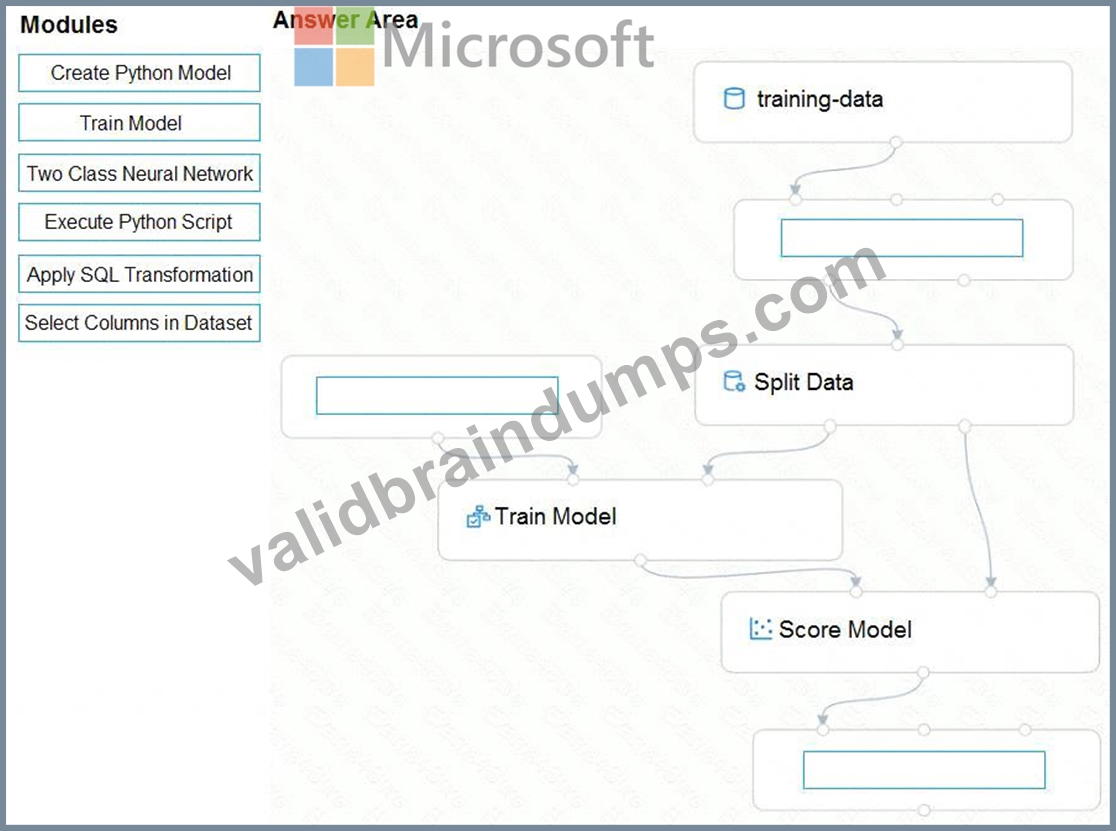
Answer:
Explanation:
Explanation

NEW QUESTION # 113
You are using the Azure Machine Learning Service to automate hyperparameter exploration of your neural network classification model.
You must define the hyperparameter space to automatically tune hyperparameters using random sampling according to following requirements:
The learning rate must be selected from a normal distribution with a mean value of 10 and a standard deviation of 3.
Batch size must be 16, 32 and 64.
Keep probability must be a value selected from a uniform distribution between the range of 0.05 and 0.1.
You need to use the param_sampling method of the Python API for the Azure Machine Learning Service.
How should you complete the code segment? To answer, select the appropriate options in the answer area.
NOTE: Each correct selection is worth one point.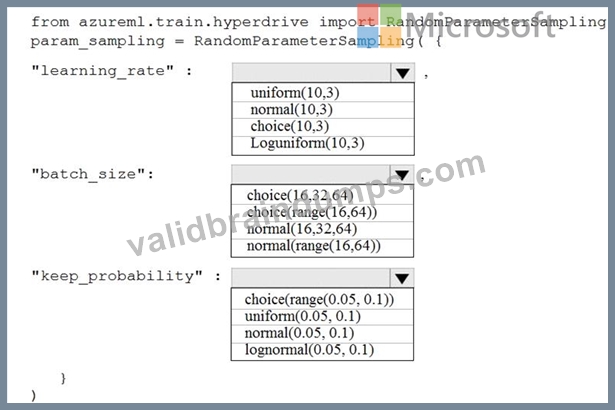
Answer:
Explanation: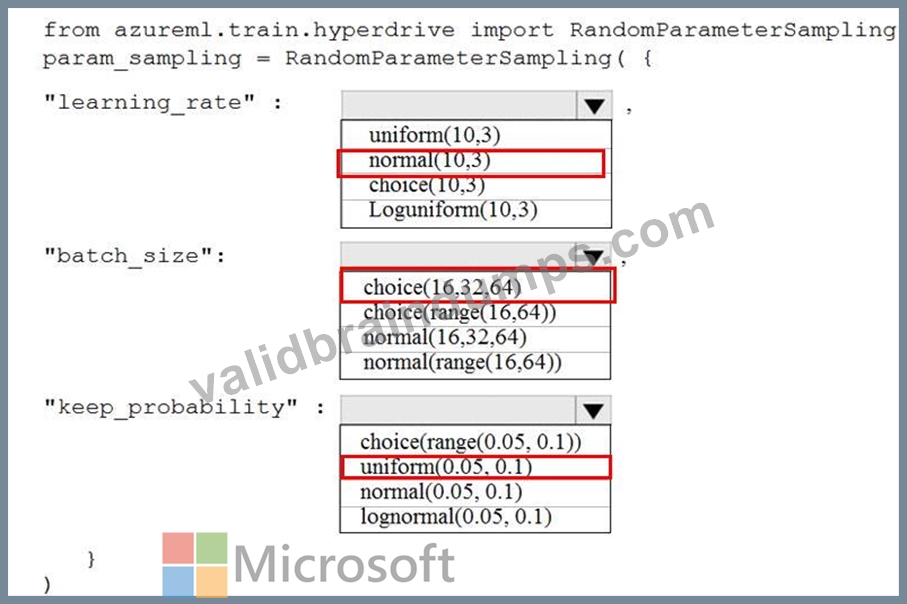
Explanation:
In random sampling, hyperparameter values are randomly selected from the defined search space. Random sampling allows the search space to include both discrete and continuous hyperparameters.
Example:
from azureml.train.hyperdrive import RandomParameterSampling
param_sampling = RandomParameterSampling( {
"learning_rate": normal(10, 3),
"keep_probability": uniform(0.05, 0.1),
"batch_size": choice(16, 32, 64)
}
Reference:
https://docs.microsoft.com/en-us/azure/machine-learning/service/how-to-tune-hyperparameters
NEW QUESTION # 114
The finance team asks you to train a model using data in an Azure Storage blob container named finance-data.
You need to register the container as a datastore in an Azure Machine Learning workspace and ensure that an error will be raised if the container does not exist.
How should you complete the code? To answer, select the appropriate options in the answer area.
NOTE: Each correct selection is worth one point.
Answer:
Explanation: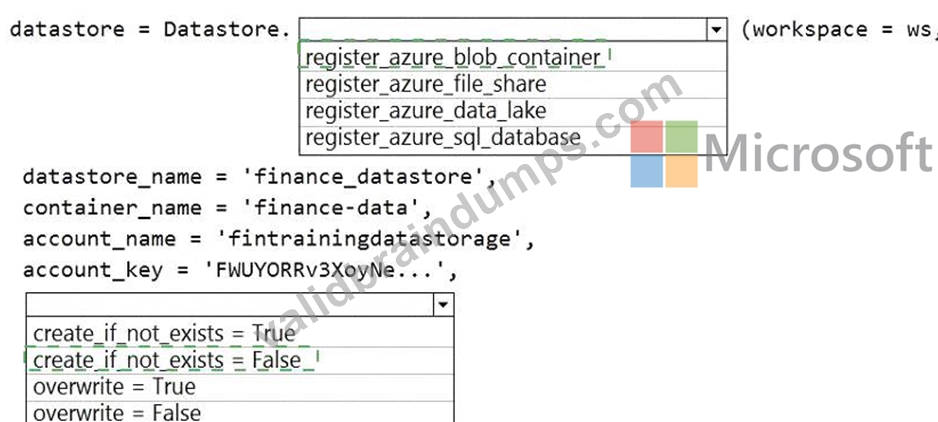
Explanation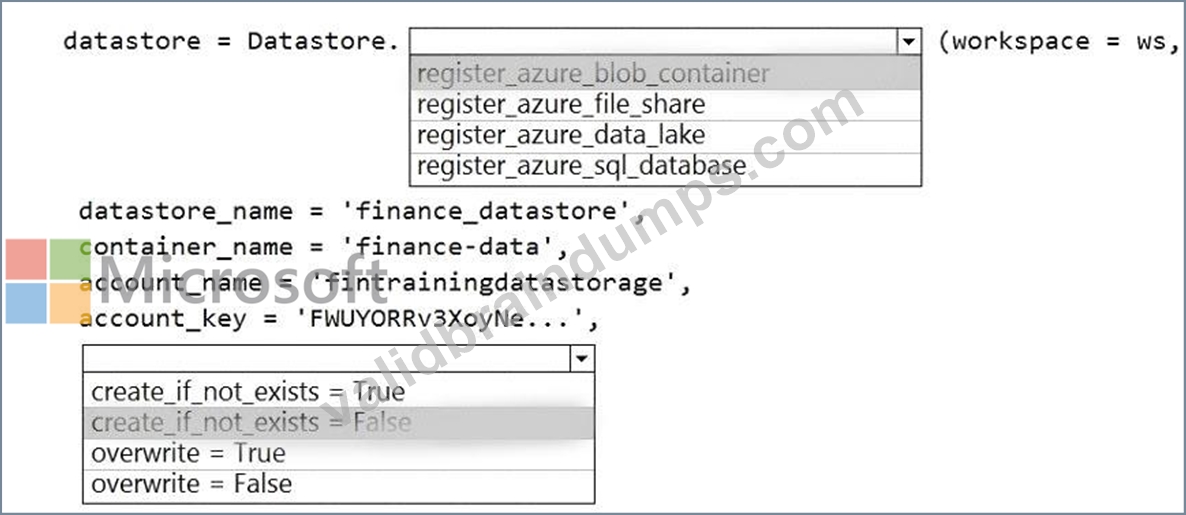
Box 1: register_azure_blob_container
Register an Azure Blob Container to the datastore.
Box 2: create_if_not_exists = False
Create the file share if it does not exists, defaults to False.
Reference:
https://docs.microsoft.com/en-us/python/api/azureml-core/azureml.core.datastore.datastore
NEW QUESTION # 115
You need to define a process for penalty event detection.
Which three actions should you perform in sequence? To answer, move the appropriate actions from the list of actions to the answer area and arrange them in the correct order.
Answer:
Explanation:
NEW QUESTION # 116
You have a dataset that contains over 150 features. You use the dataset to train a Support Vector Machine (SVM) binary classifier.
You need to use the Permutation Feature Importance module in Azure Machine Learning Studio to compute a set of feature importance scores for the dataset.
In which order should you perform the actions? To answer, move all actions from the list of actions to the answer area and arrange them in the correct order.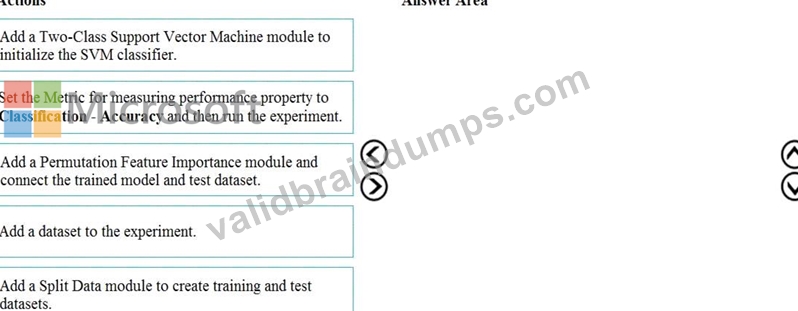
Answer:
Explanation:
Explanation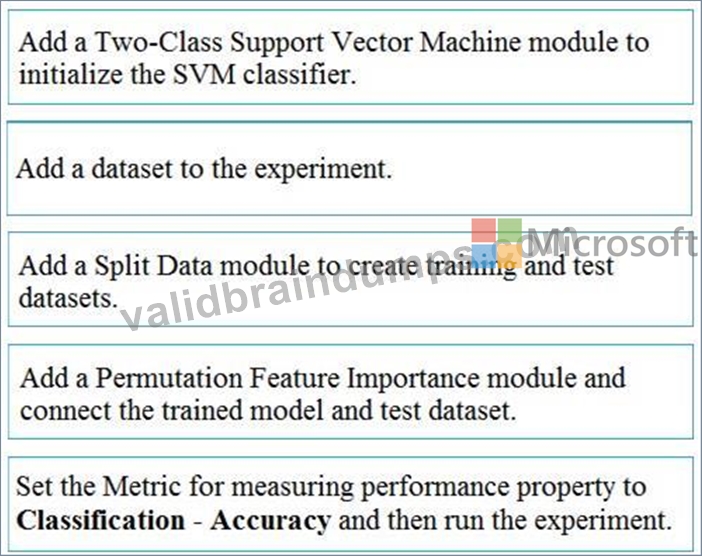
Step 1: Add a Two-Class Support Vector Machine module to initialize the SVM classifier.
Step 2: Add a dataset to the experiment
Step 3: Add a Split Data module to create training and test dataset.
To generate a set of feature scores requires that you have an already trained model, as well as a test dataset.
Step 4: Add a Permutation Feature Importance module and connect to the trained model and test dataset.
Step 5: Set the Metric for measuring performance property to Classification - Accuracy and then run the experiment.
Reference:
https://docs.microsoft.com/en-us/azure/machine-learning/studio-module-reference/two-class-support-vector-mac
https://docs.microsoft.com/en-us/azure/machine-learning/studio-module-reference/permutation-feature-importan
NEW QUESTION # 117
An organization uses Azure Machine Learning service and wants to expand their use of machine learning.
You have the following compute environments. The organization does not want to create another compute environment.
You need to determine which compute environment to use for the following scenarios.
Which compute types should you use? To answer, drag the appropriate compute environments to the correct scenarios. Each compute environment may be used once, more than once, or not at all. You may need to drag the split bar between panes or scroll to view content.
NOTE: Each correct selection is worth one point.
Answer:
Explanation:
Reference:
https://docs.microsoft.com/en-us/azure/machine-learning/concept-compute-target
https://docs.microsoft.com/en-us/azure/machine-learning/how-to-set-up-training-targets
NEW QUESTION # 118
......
DP-100 Study Guide Realistic Verified DP-100 Dumps: https://www.validbraindumps.com/DP-100-exam-prep.html
DP-100 Questions & Practice Test are Available On-Demand: https://drive.google.com/open?id=1LAJwJv7iPRrWeF6Z4WSsff_ZLzHPYMzR