

[Dec 09, 2021] DP-201 Dumps Full Questions - Exam Study Guide
Azure Data Engineer Associate Free Certification Exam Material from ValidBraindumps with 207 Questions
NEW QUESTION 116
You need to design the solution for analyzing customer data.
What should you recommend?
- A. Azure Cognitive Services
- B. Azure SQL Data Warehouse
- C. Azure Data Lake Storage
- D. Azure Batch
- E. Azure Databricks
Answer: E
Explanation:
Customer data must be analyzed using managed Spark clusters.
You create spark clusters through Azure Databricks.
References:
https://docs.microsoft.com/en-us/azure/azure-databricks/quickstart-create-databricks-workspace-portal
Topic 3, Case study
Case study
This is a case study. Case studies are not timed separately. You can use as much exam time as you would like to complete each case. However, there may be additional case studies and sections on this exam. You must manage your time to ensure that you are able to complete all questions included on this exam in the time provided.
To answer the questions included in a case study, you will need to reference information that is provided in the case study. Case studies might contain exhibits and other resources that provide more information about the scenario that is described in the case study. Each question is independent of the other question on this case study.
At the end of this case study, a review screen will appear. This screen allows you to review your answers and to make changes before you move to the next sections of the exam. After you begin a new section, you cannot return to this section.
To start the case study
To display the first question on this case study, click the Next button. Use the buttons in the left pane to explore the content of the case study before you answer the questions. Clicking these buttons displays information such as business requirements, existing environment, and problem statements. If the case study has an All Information tab, note that the information displayed is identical to the information displayed on the subsequent tabs. When you are ready to answer a question, click the Question button to return to the question.
Background
Current environment
The company has the following virtual machines (VMs):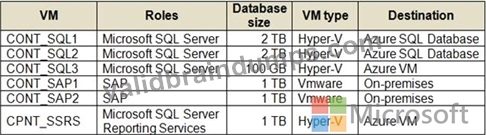
Requirements
Storage and processing
You must be able to use a file system view of data stored in a blob.
You must build an architecture that will allow Contoso to use the DB FS filesystem layer over a blob store. The architecture will need to support data files, libraries, and images. Additionally, it must provide a web-based interface to documents that contain runnable command, visualizations, and narrative text such as a notebook.
CONT_SQL3 requires an initial scale of 35000 IOPS.
CONT_SQL1 and CONT_SQL2 must use the vCore model and should include replicas. The solution must support 8000 IOPS.
The storage should be configured to optimized storage for database OLTP workloads.
Migration
* You must be able to independently scale compute and storage resources.
* You must migrate all SQL Server workloads to Azure. You must identify related machines in the on-premises environment, get disk size data usage information.
* Data from SQL Server must include zone redundant storage.
* You need to ensure that app components can reside on-premises while interacting with components that run in the Azure public cloud.
* SAP data must remain on-premises.
* The Azure Site Recovery (ASR) results should contain per-machine data.
Business Requirements
* You must design a regional disaster recovery topology.
* The database backups have regulatory purposes and must be retained for seven years.
* CONT_SQL1 stores customers sales data that requires ETL operations for data analysis. A solution is required that reads data from SQL, performs ETL, and outputs to Power BI. The solution should use managed clusters to minimize costs. To optimize logistics, Contoso needs to analyze customer sales data to see if certain products are tied to specific times in the year.
* The analytics solution for customer sales data must be available during a regional outage.
Security and auditing
* Contoso requires all corporate computers to enable Windows Firewall.
* Azure servers should be able to ping other Contoso Azure servers.
* Employee PII must be encrypted in memory, in motion, and at rest. Any data encrypted by SQL Server must support equality searches, grouping, indexing, and joining on the encrypted data.
* Keys must be secured by using hardware security modules (HSMs).
* CONT_SQL3 must not communicate over the default ports
Cost
* All solutions must minimize cost and resources.
* The organization does not want any unexpected charges.
* The data engineers must set the SQL Data Warehouse compute resources to consume 300 DWUs.
* CONT_SQL2 is not fully utilized during non-peak hours. You must minimize resource costs for during non-peak hours.
NEW QUESTION 117
A company stores large datasets in Azure, including sales transactions and customer account information.
You must design a solution to analyze the data. You plan to create the following HDInsight clusters:
You need to ensure that the clusters support the query requirements.
Which cluster types should you recommend? To answer, select the appropriate configuration in the answer area.
NOTE: Each correct selection is worth one point.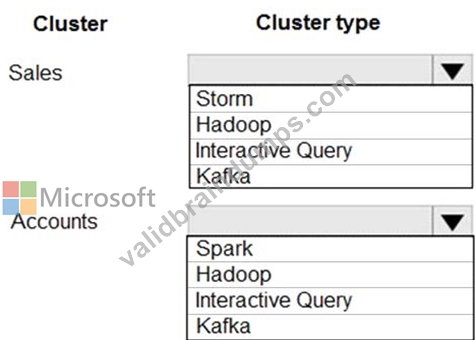
Answer:
Explanation: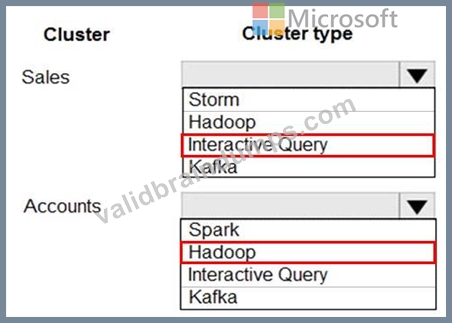
Explanation:
Box 1: Interactive Query
Choose Interactive Query cluster type to optimize for ad hoc, interactive queries.
Box 2: Hadoop
Choose Apache Hadoop cluster type to optimize for Hive queries used as a batch process.
Note: In Azure HDInsight, there are several cluster types and technologies that can run Apache Hive queries. When you create your HDInsight cluster, choose the appropriate cluster type to help optimize performance for your workload needs.
For example, choose Interactive Query cluster type to optimize for ad hoc, interactive queries. Choose Apache Hadoop cluster type to optimize for Hive queries used as a batch process. Spark and HBase cluster types can also run Hive queries.
References:
https://docs.microsoft.com/bs-latn-ba/azure/hdinsight/hdinsight-hadoop-optimize-hive-query?toc=%2Fko-kr%2Fazure%2Fhdinsight%2Finteractive-query%2FTOC.json&bc=%2Fbs-latn-ba%2Fazure%2Fbread%2Ftoc.json
NEW QUESTION 118
You are planning a design pattern based on the Lambda architecture as shown in the exhibit.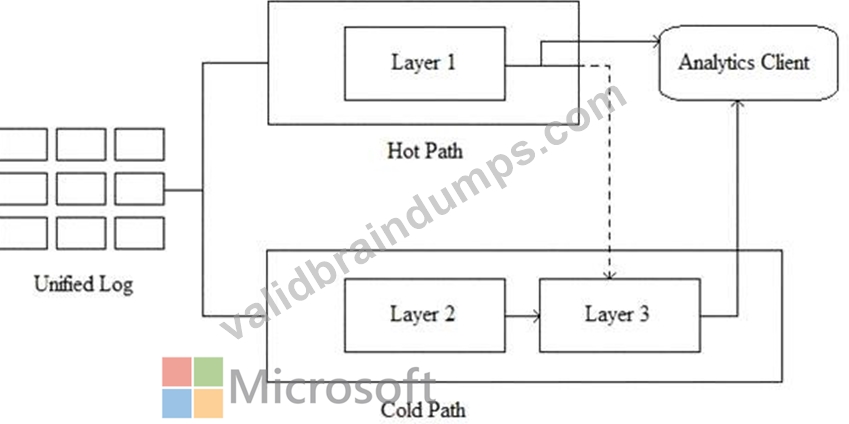
Which Azure service should you use for the hot path?
- A. Azure Data Factory
- B. Azure Databricks
- C. Azure Database for PostgreSQL
- D. Azure SQL Database
Answer: B
Explanation:
Explanation
In Azure, all of the following data stores will meet the core requirements supporting real-time processing:
* Apache Spark in Azure Databricks
* Azure Stream Analytics
* HDInsight with Spark Streaming
* HDInsight with Storm
* Azure Functions
* Azure App Service WebJobs
Note: Lambda architectures use batch-processing, stream-processing, and a serving layer to minimize the latency involved in querying big data.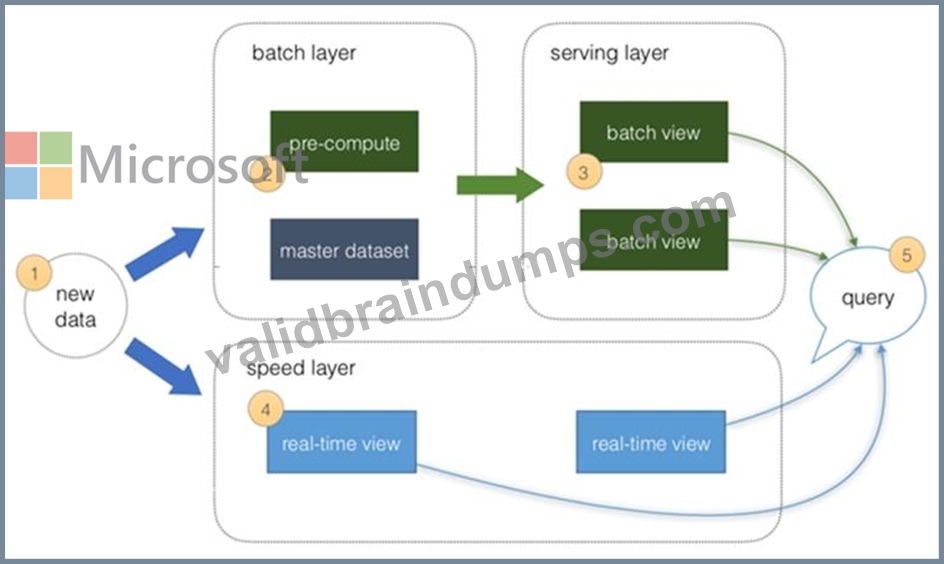
References:
https://azure.microsoft.com/en-us/blog/lambda-architecture-using-azure-cosmosdb-faster-performance-low-tco-l
https://docs.microsoft.com/en-us/azure/architecture/data-guide/technology-choices/stream-processing
NEW QUESTION 119
Note: This question is part of a series of questions that present the same scenario. Each question in the series contains a unique solution that might meet the stated goals. Some question sets might have more than one correct solution, while others might not have a correct solution.
After you answer a question in this section, you will NOT be able to return to it. As a result, these questions will not appear in the review screen.
You are designing an HDInsight/Hadoop cluster solution that uses Azure Data Lake Gen1 Storage.
The solution requires POSIX permissions and enables diagnostics logging for auditing.
You need to recommend solutions that optimize storage.
Proposed Solution: Ensure that files stored are smaller than 250MB.
Does the solution meet the goal?
- A. Yes
- B. No
Answer: B
Explanation:
Ensure that files stored are larger, not smaller than 250MB.
You can have a separate compaction job that combines these files into larger ones.
Note: The file POSIX permissions and auditing in Data Lake Storage Gen1 comes with an overhead that becomes apparent when working with numerous small files. As a best practice, you must batch your data into larger files versus writing thousands or millions of small files to Data Lake Storage Gen1. Avoiding small file sizes can have multiple benefits, such as:
* Lowering the authentication checks across multiple files
* Reduced open file connections
* Faster copying/replication
* Fewer files to process when updating Data Lake Storage Gen1 POSIX permissions Reference:
https://docs.microsoft.com/en-us/azure/data-lake-store/data-lake-store-best-practices
NEW QUESTION 120
You are designing a new application that uses Azure Cosmos DB. The application will support a variety of data patterns including log records and social media mentions.
You need to recommend which Cosmos DB API to use for each data pattern. The solution must minimize resource utilization.
Which API should you recommend for each data pattern? To answer, select the appropriate options in the answer area.
NOTE: Each correct selection is worth one point.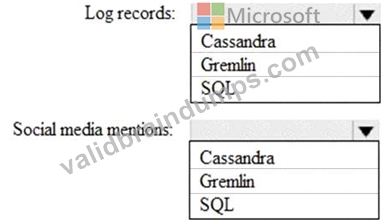
Answer:
Explanation: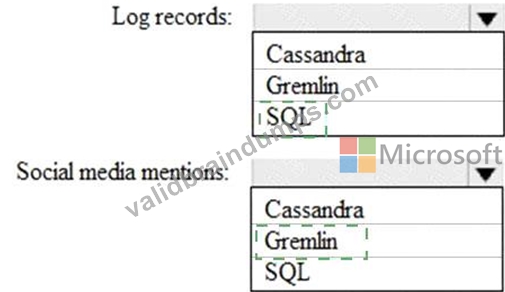
Explanation
Log records: SQL
Social media mentions: Gremlin
You can store the actual graph of followers using Azure Cosmos DB Gremlin API to create vertexes for each user and edges that maintain the "A-follows-B" relationships. With the Gremlin API, you can get the followers of a certain user and create more complex queries to suggest people in common. If you add to the graph the Content Categories that people like or enjoy, you can start weaving experiences that include smart content discovery, suggesting content that those people you follow like, or finding people that you might have much in common with.
References:
https://docs.microsoft.com/en-us/azure/cosmos-db/social-media-apps
NEW QUESTION 121
You are designing a data processing solution that will implement the lambda architecture pattern. The solution will use Spark running on HDInsight for data processing.
You need to recommend a data storage technology for the solution.
Which two technologies should you recommend? Each correct answer presents a complete solution.
NOTE: Each correct selection is worth one point.
- A. Kafka HDInsight
- B. Apache Cassandra
- C. Azure Storage Queue
- D. Azure Cosmos DB
- E. Azure Service Bus
Answer: A,D
Explanation:
To implement a lambda architecture on Azure, you can combine the following technologies to accelerate real- time big data analytics:
* Azure Cosmos DB, the industry's first globally distributed, multi-model database service.
* Apache Spark for Azure HDInsight, a processing framework that runs large-scale data analytics applications
* Azure Cosmos DB change feed, which streams new data to the batch layer for HDInsight to process
* The Spark to Azure Cosmos DB Connector
E: You can use Apache Spark to stream data into or out of Apache Kafka on HDInsight using DStreams.
Reference:
https://docs.microsoft.com/en-us/azure/cosmos-db/lambda-architecture
NEW QUESTION 122
A company plans to use Azure SQL Database to support a line of business applications. The application will manage sensitive employee data.
The solution must meet the following requirements:
* Encryption must be performed by the application.
* Only the client application must have access keys for encrypting and decrypting data.
* Data must never appear as plain text in the database.
* The strongest possible encryption method must be used.
* Searching must be possible on selected data.
What should you recommend? To answer, select the appropriate options in the answer area.
NOTE: Each correct selection is worth one point.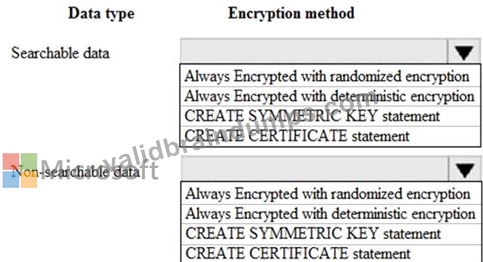
Answer:
Explanation: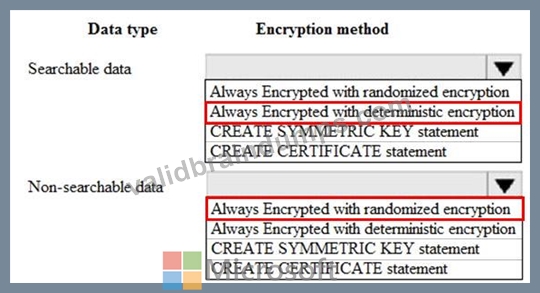
Explanation:
Box 1: Always Encrypted with deterministic encryption
Deterministic encryption always generates the same encrypted value for any given plain text value. Using deterministic encryption allows point lookups, equality joins, grouping and indexing on encrypted columns. However, it may also allow unauthorized users to guess information about encrypted values by examining patterns in the encrypted column, especially if there is a small set of possible encrypted values, such as True/False, or North/South/East/West region. Deterministic encryption must use a column collation with a binary2 sort order for character columns.
Box 2: Always Encrypted with Randomized encryption
* Randomized encryption uses a method that encrypts data in a less predictable manner. Randomized encryption is more secure, but prevents searching, grouping, indexing, and joining on encrypted columns.
Note: With Always Encrypted the Database Engine never operates on plaintext data stored in encrypted columns, but it still supports some queries on encrypted data, depending on the encryption type for the column. Always Encrypted supports two types of encryption: randomized encryption and deterministic encryption.
Use deterministic encryption for columns that will be used as search or grouping parameters, for example a government ID number. Use randomized encryption, for data such as confidential investigation comments, which are not grouped with other records and are not used to join tables.
References:
https://docs.microsoft.com/en-us/sql/relational-databases/security/encryption/always-encrypted-database-engine
NEW QUESTION 123
You store data in a data warehouse in Azure Synapse Analytics.
You need to design a solution to ensure that the data warehouse and the most current data is available within one hour of a datacenter failure.
Which three actions should you include in the design? Each correct answer presents part of the solution.
NOTE: Each correct selection is worth one point.
- A. Each day, create Azure Firewall rules that allow access to the restored data warehouse.
- B. Each day, restore the data warehouse from a geo-redundant backup to an available Azure region.
- C. If a failure occurs, modify the Azure Firewall rules of the data warehouse.
- D. Each day, restore the data warehouse from a user-defined restore point to an available Azure region.
- E. If a failure occurs, update the connection strings to point to the recovered data warehouse.
Answer: A,D,E
Explanation:
E: You can create a user-defined restore point and restore from the newly created restore point to a new data warehouse in a different region.
Note: A data warehouse snapshot creates a restore point you can leverage to recover or copy your data warehouse to a previous state.
A data warehouse restore is a new data warehouse that is created from a restore point of an existing or deleted data warehouse. On average within the same region, restore rates typically take around 20 minutes.
Incorrect Answers:
A: SQL Data Warehouse performs a geo-backup once per day to a paired data center. The RPO for a geo- restore is 24 hours. You can restore the geo-backup to a server in any other region where SQL Data Warehouse is supported. A geo-backup ensures you can restore data warehouse in case you cannot access the restore points in your primary region.
Reference:
https://docs.microsoft.com/en-us/azure/sql-data-warehouse/backup-and-restore
NEW QUESTION 124
You are planning a design pattern based on the Kappa architecture as shown in the exhibit.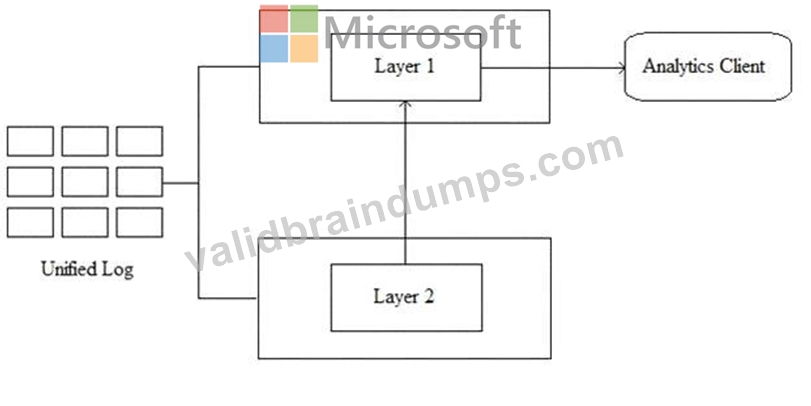
Which Azure service should you use for each layer? To answer, select the appropriate options in the answer area.
NOTE: Each correct selection is worth one point.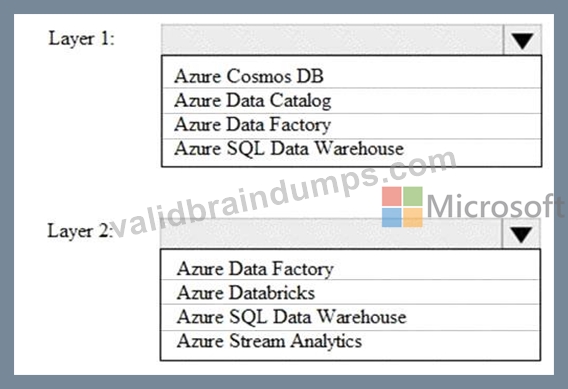
Answer:
Explanation: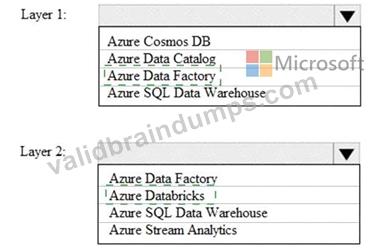
Explanation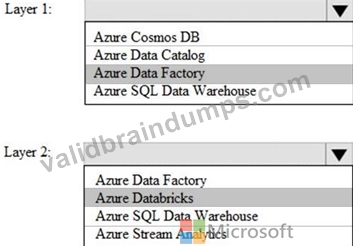
Layer 1: Azure Data Factory
Layer 2: Azure Databricks
Azure Databricks is fully integrated with Azure Data Factory .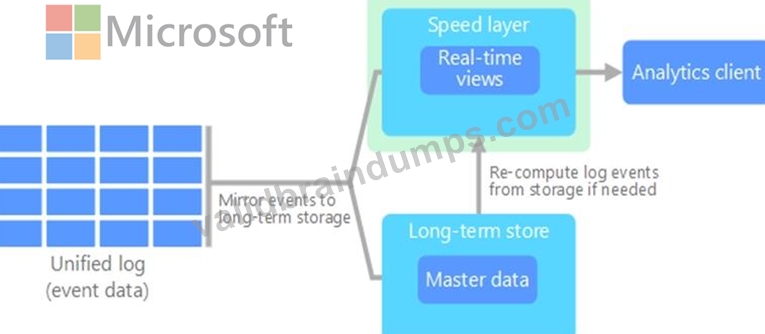
References:
https://docs.microsoft.com/en-us/azure/architecture/data-guide/big-data/
NEW QUESTION 125
You are designing a storage solution to store CSV files.
You need to grant a data scientist access to read all the files in a single container of an Azure Storage account.
The solution must use the principle of least privilege and provide the highest level of security.
What are two possible ways to achieve the goal? Each correct answer presents part of the solution.
NOTE: Each correct selection is worth one point.
- A. Assign the Storage Blob Data Reader role at the container level.
- B. Assign the Reader role to the storage account.
- C. Provide an account shared access signature (SAS).
- D. Provide a user delegation shared access signature (SAS).
- E. Provide an access key.
Answer: A,D
Explanation:
B: When an Azure role is assigned to an Azure AD security principal, Azure grants access to those resources for that security principal. Access can be scoped to the level of the subscription, the resource group, the storage account, or an individual container or queue.
The built-in Data Reader roles provide read permissions for the data in a container or queue.
Note: Permissions are scoped to the specified resource.
For example, if you assign the Storage Blob Data Reader role to user Mary at the level of a container named sample-container, then Mary is granted read access to all of the blobs in that container.
E: A user delegation SAS is secured with Azure Active Directory (Azure AD) credentials and also by the permissions specified for the SAS. A user delegation SAS applies to Blob storage only.
Reference:
https://docs.microsoft.com/en-us/azure/storage/common/storage-auth-aad-rbac-portal
https://docs.microsoft.com/en-us/azure/storage/common/storage-sas-overview
NEW QUESTION 126
You use Azure Data Lake Storage Gen2 to store data that data scientists and data engineers will query by using Azure Databricks interactive notebooks. The folders in Data Lake Storage will be secured, and users will have access only to the folders that relate to the projects on which they work.
You need to recommend which authentication methods to use for Databricks and Data Lake Storage to provide the users with the appropriate access. The solution must minimize administrative effort and development effort Which authentication method should you recommend for each Azure service? To answer, select the appropriate options in the answer area NOTE: Each correct selection is worth one point.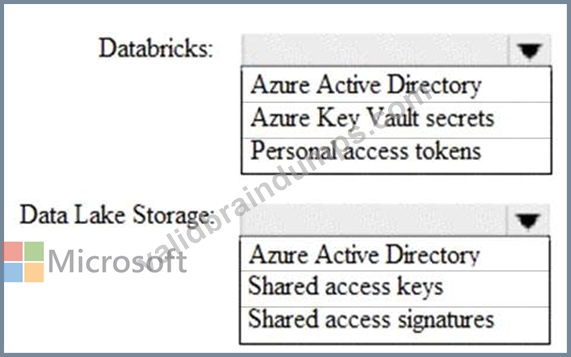
Answer:
Explanation: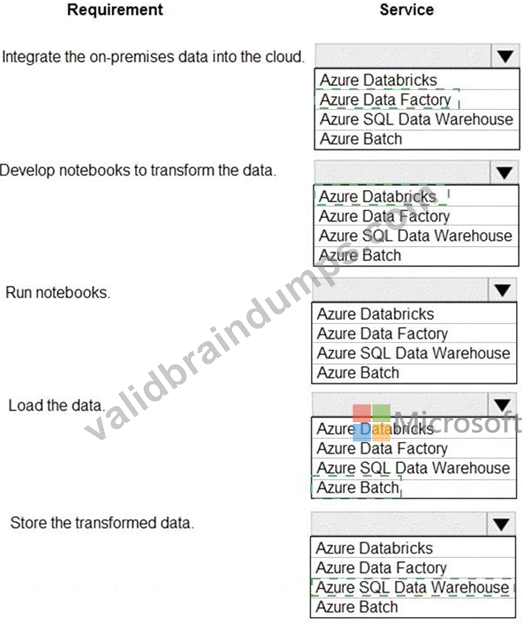
Explanation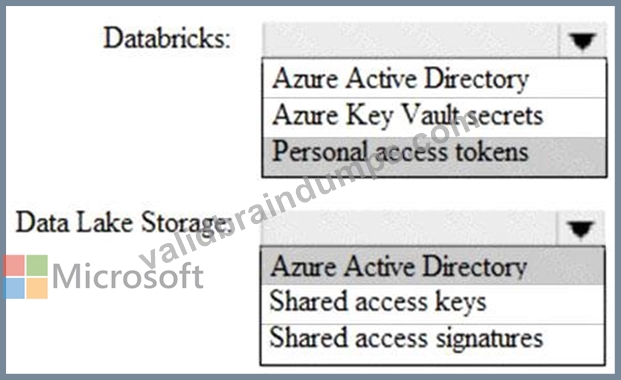
Databricks: Personal access tokens
To authenticate and access Databricks REST APIs, you use personal access tokens. Tokens are similar to passwords; you should treat them with care. Tokens expire and can be revoked.
Data Lake Storage: Azure Active Directory
Azure Data Lake Storage Gen1 uses Azure Active Directory for authentication.
References:
https://docs.azuredatabricks.net/dev-tools/api/latest/authentication.html
https://docs.microsoft.com/en-us/azure/data-lake-store/data-lakes-store-authentication-using-azure-active-directo
NEW QUESTION 127
You are designing an Azure SQL data warehouse that will contain a table named Customers. Customers will contain credit card information.
You need to recommend a solution to provide salespeople with the ability to view all the entries in Customers.
The solution must prevent all the salespeople from viewing or inferring the credit card information.
What should you include in the recommendation?
- A. column-level security
- B. Always Encrypted
- C. data masking
- D. row-level security
Answer: C
Explanation:
Explanation
SQL Database dynamic data masking limits sensitive data exposure by masking it to non-privileged users.
The Credit card masking method exposes the last four digits of the designated fields and adds a constant string as a prefix in the form of a credit card.
Example: XXXX-XXXX-XXXX-1234
References:
https://docs.microsoft.com/en-us/azure/sql-database/sql-database-dynamic-data-masking-get-started
NEW QUESTION 128
You design data engineering solutions for a company.
A project requires analytics and visualization of large set of dat
a. The project has the following requirements:
Notebook scheduling
Cluster automation
Power BI Visualization
You need to recommend the appropriate Azure service.
Which Azure service should you recommend?
- A. Azure Batch
- B. Azure ML Studio
- C. Azure Databricks
- D. Azure HDInsight
- E. Azure Stream Analytics
Answer: C
Explanation:
A databrick job is a way of running a notebook or JAR either immediately or on a scheduled basis.
Azure Databricks has two types of clusters: interactive and job. Interactive clusters are used to analyze data collaboratively with interactive notebooks. Job clusters are used to run fast and robust automated workloads using the UI or API.
You can visualize Data with Azure Databricks and Power BI Desktop.
References:
https://docs.azuredatabricks.net/user-guide/clusters/index.html
https://docs.azuredatabricks.net/user-guide/jobs.html
NEW QUESTION 129
You need to design the image processing solution to meet the optimization requirements for image tag data.
What should you configure? To answer, drag the appropriate setting to the correct drop targets.
Each source may be used once, more than once, or not at all. You may need to drag the split bar between panes or scroll to view content.
NOTE: Each correct selection is worth one point.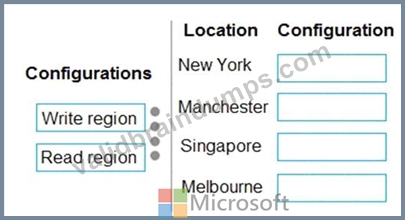
Answer:
Explanation: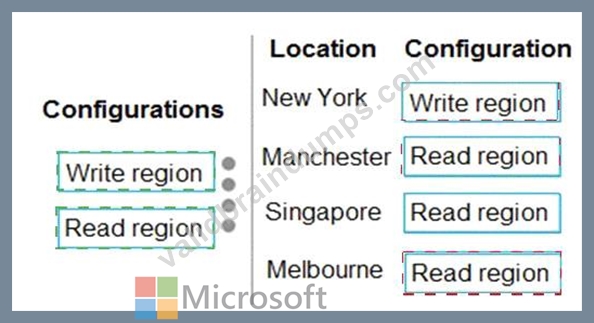
Explanation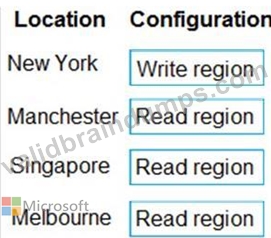
Tagging data must be uploaded to the cloud from the New York office location.
Tagging data must be replicated to regions that are geographically close to company office locations.
NEW QUESTION 130
You are designing a solution to process data from multiple Azure event hubs in near real-time.
Once processed, the data will be written to an Azure SQL database.
The solution must meet the following requirements:
* Support the auditing of resource and data changes.
* Support data versioning and rollback.
What should you recommend? To answer, select the appropriate options in the answer area.
NOTE: Each correct selection is worth one point.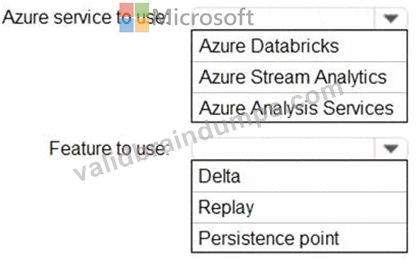
Answer:
Explanation: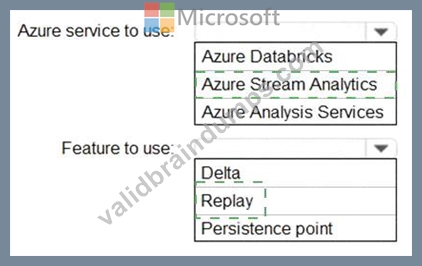
Explanation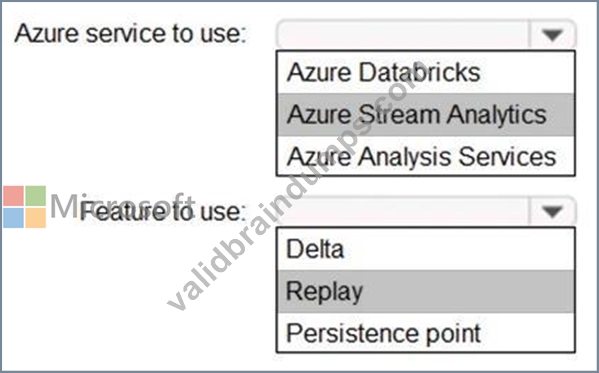
Box 1: Azure Stream Analytics
Users can now ingest, process, view, and analyze real-time streaming data into a table directly from a database in Azure SQL Database. They do so in the Azure portal using Azure Stream Analytics.
In the Azure portal, you can select an events source (Event Hub/IoT Hub), view incoming real-time events, and select a table to store events.
Stream Analytics leverages versioning of reference data to augment streaming data with the reference data that was valid at the time the event was generated. This ensures repeatability of results.
Box 2: Replay
Reference data is versioned, enabling to always get the same results, even when we "replay" the stream.
Reference:
https://docs.microsoft.com/en-us/azure/azure-sql/database/stream-data-stream-analytics-integration
https://azure.microsoft.com/en-us/updates/additional-support-for-managed-identity-and-new-features-in-azure-st
NEW QUESTION 131
Note: This question is part of a series of questions that present the same scenario. Each question in the series contains a unique solution that might meet the stated goals. Some question sets might have more than one correct solution, while others might not have a correct solution.
After you answer a question in this section, you will NOT be able to return to it. As a result, these questions will not appear in the review screen.
You have an Azure Data Lake Storage account that contains a staging zone.
You need to design a daily process to ingest incremental data from the staging zone, transform the data by executing an R script, and then insert the transformed data into a data warehouse in Azure Synapse Analytics.
Solution: You use an Azure Data Factory schedule trigger to execute a pipeline that executes an Azure Databricks notebook, and then inserts the data into the data warehouse.
Does this meet the goal?
- A. Yes
- B. No
Answer: B
Explanation:
Explanation
Use a stored procedure, not an Azure Databricks notebook to invoke the R script.
Reference:
https://docs.microsoft.com/en-US/azure/data-factory/transform-data
NEW QUESTION 132
You are designing a Spark job that performs batch processing of daily web log traffic.
When you deploy the job in the production environment, it must meet the following requirements:
* Run once a day.
* Display status information on the company intranet as the job runs.
You need to recommend technologies for triggering and monitoring jobs.
Which technologies should you recommend? To answer, drag the appropriate technologies to the correct locations. Each technology may be used once, more than once, or not at all. You may need to drag the split bar between panes or scroll to view content.
NOTE: Each correct selection is worth one point.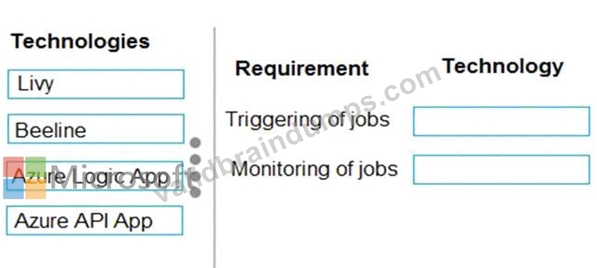
Answer:
Explanation: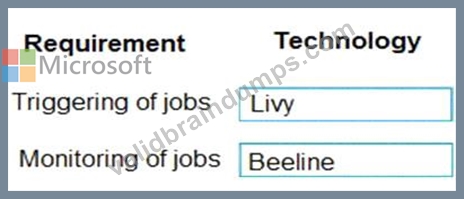
Box 1: Livy
You can use Livy to run interactive Spark shells or submit batch jobs to be run on Spark.
Box 2: Beeline
Apache Beeline can be used to run Apache Hive queries on HDInsight. You can use Beeline with Apache Spark.
Note: Beeline is a Hive client that is included on the head nodes of your HDInsight cluster. Beeline uses JDBC to connect to HiveServer2, a service hosted on your HDInsight cluster. You can also use Beeline to access Hive on HDInsight remotely over the internet.
References:
https://docs.microsoft.com/en-us/azure/hdinsight/spark/apache-spark-livy-rest-interface
https://docs.microsoft.com/en-us/azure/hdinsight/hadoop/apache-hadoop-use-hive-beeline
NEW QUESTION 133
Which Azure data storage solution should you recommend for each application? To answer, select the appropriate options in the answer area.
NOTE: Each correct selection is worth one point.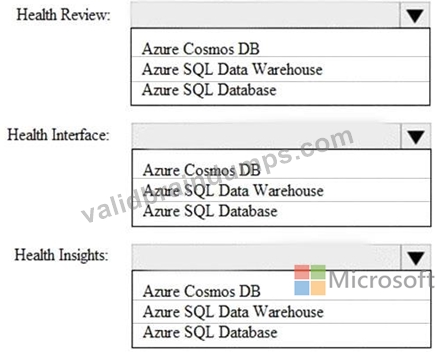
Answer:
Explanation: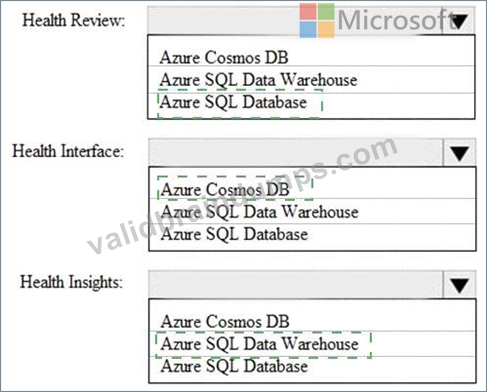
Explanation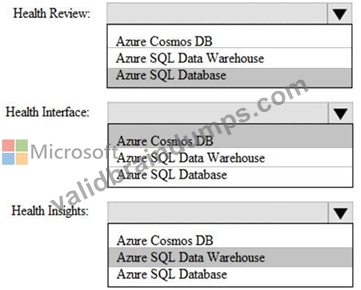
Health Review: Azure SQL Database
Scenario: ADatum identifies the following requirements for the Health Review application:
* Ensure that sensitive health data is encrypted at rest and in transit.
* Tag all the sensitive health data in Health Review. The data will be used for auditing.
Health Interface: Azure Cosmos DB
ADatum identifies the following requirements for the Health Interface application:
* Upgrade to a data storage solution that will provide flexible schemas and increased throughput for writing data. Data must be regionally located close to each hospital, and reads must display be the most recent committed version of an item.
* Reduce the amount of time it takes to add data from new hospitals to Health Interface.
* Support a more scalable batch processing solution in Azure.
* Reduce the amount of development effort to rewrite existing SQL queries.
Health Insights: Azure SQL Data Warehouse
Azure SQL Data Warehouse is a cloud-based enterprise data warehouse that leverages massively parallel processing (MPP) to quickly run complex queries across petabytes of data. Use SQL Data Warehouse as a key component of a big data solution.
You can access Azure SQL Data Warehouse (SQL DW) from Databricks using the SQL Data Warehouse connector (referred to as the SQL DW connector), a data source implementation for Apache Spark that uses Azure Blob Storage, and PolyBase in SQL DW to transfer large volumes of data efficiently between a Databricks cluster and a SQL DW instance.
Scenario: ADatum identifies the following requirements for the Health Insights application:
* The new Health Insights application must be built on a massively parallel processing (MPP) architecture that will support the high performance of joins on large fact tables References:
https://docs.databricks.com/data/data-sources/azure/sql-data-warehouse.html
NEW QUESTION 134
What should you recommend as a batch processing solution for Health Interface?
- A. Azure Stream Analytics
- B. Azure Data Factory
- C. Azure Databricks
- D. Azure CycleCloud
Answer: A
Explanation:
Scenario: A Datum identifies the following requirements for the Health Interface application:
Support a more scalable batch processing solution in Azure.
Reduce the amount of time it takes to add data from new hospitals to Health Interface.
Data Factory integrates with the Azure Cosmos DB bulk executor library to provide the best performance when you write to Azure Cosmos DB.
References:
https://docs.microsoft.com/en-us/azure/data-factory/connector-azure-cosmos-db
NEW QUESTION 135
You need to design the image processing solution to meet the optimization requirements for image tag data.
What should you configure? To answer, drag the appropriate setting to the correct drop targets.
Each source may be used once, more than once, or not at all. You may need to drag the split bar between panes or scroll to view content.
NOTE: Each correct selection is worth one point.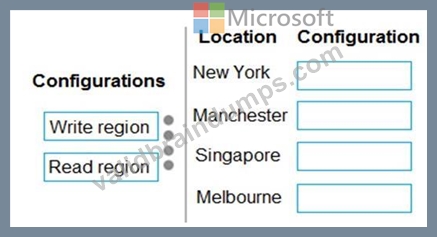
Answer:
Explanation: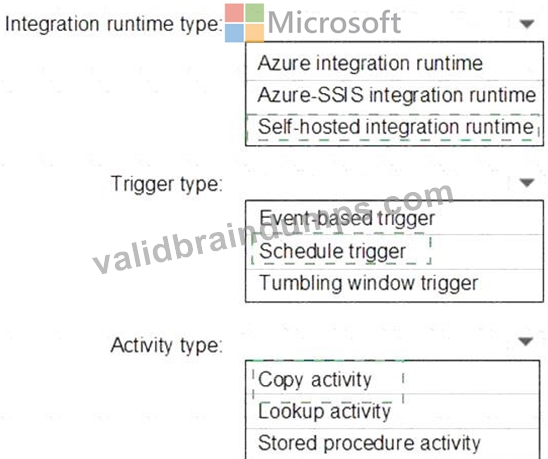
Explanation
Tagging data must be uploaded to the cloud from the New York office location.
Tagging data must be replicated to regions that are geographically close to company office locations.
NEW QUESTION 136
A company stores large datasets in Azure, including sales transactions and customer account information.
You must design a solution to analyze the data. You plan to create the following HDInsight clusters:
You need to ensure that the clusters support the query requirements.
Which cluster types should you recommend? To answer, select the appropriate configuration in the answer area.
NOTE: Each correct selection is worth one point.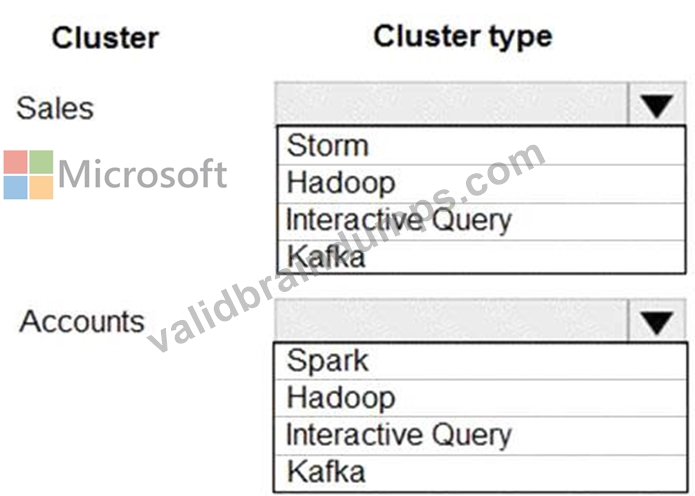
Answer:
Explanation: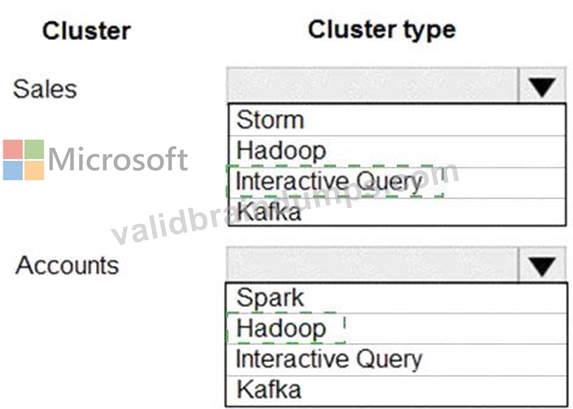
Explanation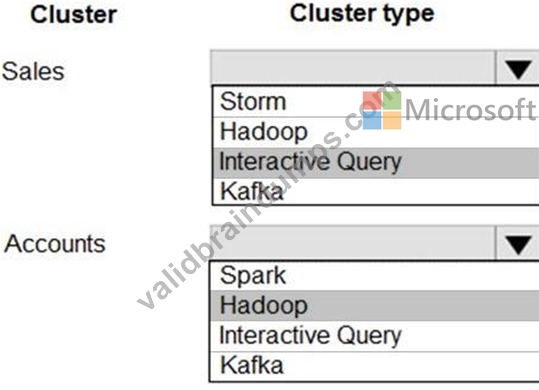
Box 1: Interactive Query
Choose Interactive Query cluster type to optimize for ad hoc, interactive queries.
Box 2: Hadoop
Choose Apache Hadoop cluster type to optimize for Hive queries used as a batch process.
Note: In Azure HDInsight, there are several cluster types and technologies that can run Apache Hive queries.
When you create your HDInsight cluster, choose the appropriate cluster type to help optimize performance for your workload needs.
For example, choose Interactive Query cluster type to optimize for ad hoc, interactive queries. Choose Apache Hadoop cluster type to optimize for Hive queries used as a batch process. Spark and HBase cluster types can also run Hive queries.
References:
https://docs.microsoft.com/bs-latn-ba/azure/hdinsight/hdinsight-hadoop-optimize-hive-query?toc=%2Fko-kr%2F
NEW QUESTION 137
......
Dumps Brief Outline Of The DP-201 Exam: https://www.validbraindumps.com/DP-201-exam-prep.html