

Free 2021 NSE 7 Network Security Architect NSE7_PBC-6.4 dumps are available on Google Drive shared by ValidBraindumps
Welcome to download the newest ValidBraindumps NSE7_PBC-6.4 PDF dumps: https://www.validbraindumps.com/NSE7_PBC-6.4-exam-prep.html ( 30 Q&As)
NEW QUESTION 17
An organization deployed a FortiGate-VM in the Google Cloud Platform and initially configured it with two vNICs. Now, the same organization wants to add additional vNICs to this existing FortiGate-VM to support different workloads in their environment.
How can they do this?
- A. They can use the Compute Engine API Explorer.
- B. They cannot create and add additional vNICs to an existing FortiGate-VM.
- C. They can create additional vNICs using the Cloud Shell.
- D. They can create additional vNICs in the UI console.
Answer: A
NEW QUESTION 18
You need to deploy FortiGate VM devices in a highly available topology in the Microsoft Azure cloud. The following are the requirements of your deployment:
* Two FortiGate devices must be deployed; each in a different availability zone.
* Each FortiGate requires two virtual network interfaces: one will connect to a public subnet and the other will connect to a private subnet.
* An external Microsoft Azure load balancer will distribute ingress traffic to both FortiGate devices in an active- active topology.
* An internal Microsoft Azure load balancer will distribute egress traffic from protected virtual machines to both FortiGate devices in an active-active topology.
* Traffic should be accepted or denied by a firewall policy in the same way by either FortiGate device in this topology.
Which FortiOS CLI configuration can help reduce the administrative effort required to maintain the FortiGate devices, by synchronizing firewall policy and object configuration between the FortiGate devices?
- A. config system sdn-connector
- B. config system session-sync
- C. config system ha
- D. config system auto-scale
Answer: C
NEW QUESTION 19
Which three properties are configurable Microsoft Azure network security group rule settings? (Choose three.)
- A. Destination port ranges
- B. Source and destination IP ranges
- C. Source port ranges
- D. Action
- E. Sequence number
Answer: A,C,D
Explanation:
Explanation/Reference: https://docs.microsoft.com/en-us/azure/virtual-network/network-security-groups-overview
NEW QUESTION 20 
Refer to the exhibit. Consider an active-passive HA deployment in Microsoft Azure. The exhibit shows an excerpt from the passive FortiGate-VM node.
If the active FortiGate-VM fails, what are the results of the API calls made by the FortiGate named SSTENTAZFGT-0302? (Choose two.)
- A. 172.29.32.71is set as a next hop IP for all routes under FortigateUDR-01
- B. The network interface of the active unit moves to itself
- C. SSTENTAZFGT-03-FloatingPIP is assigned to the IP configuration with the name SSTENTAZFGT-
0302-Nic-01, under the network interface SSTENTAZFGT-0302-Nic-01 - D. SSTENTAZFGT-03-FloatingPIP public IP is assigned to NIC SSTENTAZFGT-0302-Nic-01
Answer: A,C
NEW QUESTION 21
An organization deploys a FortiGate-VM (VM04 / c4.xlarge) in Amazon Web Services (AWS) and configures two elastic network interfaces (ENIs). Now, the same organization wants to add additional ENIs to support different workloads in their environment.
Which action can you take to accomplish this?
- A. Create the ENI and attach it to FortiGate.
- B. None, you cannot create and add additional ENIs to an existing FortiGate-VM.
- C. Create the ENI, attach it to FortiGate, and then restart FortiGate.
- D. Create the ENI, shut down FortiGate, attach the ENI to FortiGate, and then start FortiGate.
Answer: D
NEW QUESTION 22
What is the bandwidth limitation of an Amazon Web Services (AWS) transit gateway VPC attachment?
- A. Up to 50 Gbps per attachment
- B. Up to 1 Gbps per attachment
- C. Up to 10 Gbps per attachment
- D. Up to 1.25 Gbps per attachment
Answer: D
NEW QUESTION 23
When configuring the FortiCASB policy, which three configuration options are available? (Choose three.)
- A. Data loss prevention policies
- B. Antivirus policies
- C. Compliance policies
- D. Threat protection policies
- E. Intrusion prevention policies
Answer: A,C,D
NEW QUESTION 24
Your company deploys FortiGate VM devices in high availability (HA) (active-active) mode with Microsoft Azure load balancers using the Microsoft Azure ARM template. Your senior administrator instructs you to connect to one of the FortiGate devices and configure the necessary firewall rules. However, you are not sure now to obtain the correct public IP address of the deployed FortiGate VM and identify the access ports.
How do you obtain the public IP address of the FortiGate VM and identify the correct ports to access the device?
- A. In the configured load balancer, access the inbound NAT rules section.
- B. In the configured load balancer, access the backend pools section.
- C. In the configured load balancer, access the inbound and outbound NAT rules section.
- D. In the configured load balancer, access the health probes section.
Answer: C
NEW QUESTION 25
Refer to the exhibit.
Which two conditions will enable you to segregate and secure the traffic between the hub and the spokes in Microsoft Azure? (Choose two.)
- A. Use ExpressRoute to interconnect the hub VNets and spoke VNets.
- B. Implement the FortiGate-VM network virtual appliance (NVA) in the hub and use user-defined routes (UDRs) in the spokes.
- C. Configure VNet peering between the hub and spokes.
- D. Configure VNet peering between the spokes only.
Answer: A,C
NEW QUESTION 26
Refer to the exhibit.
You are configuring an active-passive FortiGate clustering protocol (FGCP) HA configuration in a single availability zone in Amazon Web Services (AWS), using a cloud formation template.
After deploying the template, you notice that the AWS console has IP information listed in the FortiGate VM firewalls in the HA configuration. However, within the configuration of FortiOS, you notice that port1 is using an IP of 10.0.0.13, and port2 is using an IP of 10.0.1.13.
What should you do to correct this issue?
- A. Configure FortiOS to use static IP addresses with the IP addresses reflected in the ENI primary IP address configuration (as per the exhibit).
- B. Nothing, in AWS cloud, it is normal for a FortiGate ENI primary IP address to be different than the FortiOS IP address configuration.
- C. Delete the deployment and start again. You have in put the wrong parameters during the cloud formation template deployment.
- D. Configure FortiOS to use DHCP so that it will get the correct IP addresses on the ports.
Answer: D
NEW QUESTION 27
You have previously deployed an Amazon Web Services (AWS) transit virtual private cloud (VPC) with a pair of FortiGate firewalls (VM04 / c4.xlarge) as your security perimeter. You are beginning to see high CPU usage on the FortiGate instances.
Which action will fix this issue?
- A. Convert the c4.xlarge instances to m4.xlarge instances.
- B. Convert the transit VPC firewalls into an auto-scaling group and launch additional EC2 instances in that group.
- C. Migrate the transit VPNs to new and larger instances (VM08 / c4.2xlarge).
- D. Convert from IPsec tunnels to generic routing encapsulation (GRE) tunnels, for the VPC peering connections.
Answer: B
NEW QUESTION 28
Which two statements about the Amazon Cloud Services (AWS) network access control lists (ACLs) are true? (Choose two.)
- A. Network ACLs support allow rules and deny rules.
- B. Network ACLs are stateful, and inbound and outbound rules are used for traffic filtering.
- C. Network ACLs must be manually applied to virtual network interfaces.
- D. Network ACLs are stateless, and inbound and outbound rules are used for traffic filtering.
Answer: A,D
NEW QUESTION 29
Which three properties are configurable Microsoft Azure network security group rule settings? (Choose three.)
- A. Destination port ranges
- B. Source and destination IP ranges
- C. Source port ranges
- D. Action
- E. Sequence number
Answer: A,C,D
NEW QUESTION 30 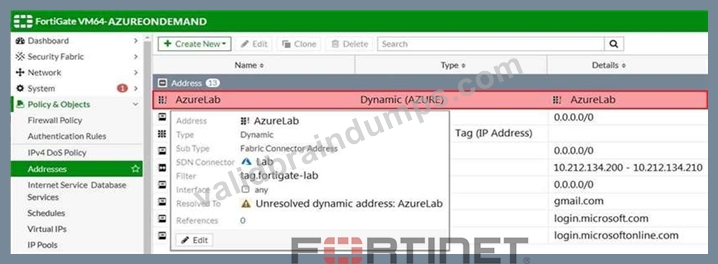
Refer to the exhibit. Your senior administrator successfully configured a FortiGate fabric connector with the Azure resource manager, and created a dynamic address object on the FortiGate VM to connect with a windows server in Microsoft Azure. However, there is now an error on the dynamic address object, and you must resolve the issue.
How do you resolve this issue?
- A. In the Microsoft Azure portal, set the correct tag values for the windows server.
- B. In the Microsoft Azure portal, access the windows server, obtain the private IP address, and assign the IP address under the FortiGate-VM AzureLab address object.
- C. Delete the address object and recreate a new address object with the type set to FQDN.
- D. Run diagnose debug application azd -lon FortiGate.
Answer: B
Explanation:
Explanation
NEW QUESTION 31
You have been tasked with deploying FortiGate VMs in a highly available topology on the Amazon Web Services (AWS) cloud. The requirements for your deployment are as follows:
* You must deploy two FortiGate VMs in a single virtual private cloud (VPC), with an external elastic load balancer which will distribute ingress traffic from the internet to both FortiGate VMs in an active-active topology.
* Each FortiGate VM must have two elastic network interfaces: one will connect to a public subnet and other will connect to a private subnet.
* To maintain high availability, you must deploy the FortiGate VMs in two different availability zones.
How many public and private subnets will you need to configure within the VPC?
- A. One public subnet and one private subnet
- B. Two public subnets and one private subnet
- C. One public subnet and two private subnets
- D. Two public subnets and two private subnets
Answer: C
NEW QUESTION 32
Refer to the exhibit.
You are deploying a FortiGate-VM in Microsoft Azure using the PAYG/On-demand licensing model. After you configure the FortiGate-VM, the validation process fails, displaying the error shown in the exhibit.
What caused the validation process to fail?
- A. You selected the incorrect resource group.
- B. You selected the PAYG/On-demand licensing model, but did not associate a valid Azure subscription.
- C. You selected the PAYG/On-demand licensing model, but did not select correct virtual machine size.
- D. You selected the Bring Your Own License (BYOL) licensing mode.
Answer: A
NEW QUESTION 33
You are deploying Amazon Web Services (AWS) GuardDuty to monitor malicious or unauthorized behaviors related to AWS resources. You will also use the Fortinet aws-lambda-guarddutyscript to translate feeds from AWS GuardDuty findings into a list of malicious IP addresses. FortiGate can then consume this list as an external threat feed.
Which Amazon AWS services must you subscribe to in order to use this feature?
- A. Inspector, Shield, GuardDuty, S3, and DynamoDB.
- B. WAF, Shield, GuardDuty, S3, and DynamoDB.
- C. GuardDuty, CloudWatch, S3, and DynamoDB.
- D. GuardDuty, CloudWatch, S3, Inspector, WAF, and Shield.
Answer: D
Explanation:
Explanation/Reference: https://fortinetweb.s3.amazonaws.com/docs.fortinet.com/v2/attachments/ed901ad2-4424-11e9-
94bf-00505692583a/FortiOS_6.2.0_AWS_Cookbook.pdf
NEW QUESTION 34
......
Tested Material Used To NSE7_PBC-6.4: https://www.validbraindumps.com/NSE7_PBC-6.4-exam-prep.html
Following are some new NSE7_PBC-6.4 Real Exam Questions!: https://drive.google.com/open?id=1ruWO57UZism1kfQi6TS7YWysUdnmWGUQ