

[May-2024] The CertNexus AIP-210 Exam Test For Brief Preparation
Revolutionary Guide To Exam CertNexus Dumps
CertNexus AIP-210 Exam Syllabus Topics:
| Topic | Details |
|---|---|
| Topic 1 |
|
| Topic 2 |
|
| Topic 3 |
|
| Topic 4 |
|
| Topic 5 |
|
| Topic 6 |
|
NEW QUESTION # 15
You train a neural network model with two layers, each layer having four nodes, and realize that the model is underfit. Which of the actions below will NOT work to fix this underfitting?
- A. Increase the complexity of the model
- B. Train the model for more epochs
- C. Add features to training data
- D. Get more training data
Answer: D
Explanation:
Explanation
Underfitting is a problem that occurs when a model learns too little from the training data and fails to capture the underlying complexity or structure of the data. Underfitting can result from using insufficient or irrelevant features, a low complexity of the model, or a lack of training data. Underfitting can reduce the accuracy and generalization of the model, as it may produce oversimplified or inaccurate predictions. Some of the ways to fix underfitting are:
Add features to training data: Adding more features or variables to the training data can help increase the information and diversity of the data, which can help the model learn more complex patterns and relationships.
Increase the complexity of the model: Increasing the complexity of the model can help increase its expressive power and flexibility, which can help it fit better to the data. For example, adding more layers or nodes to a neural network can increase its complexity.
Train the model for more epochs: Training the model for more epochs can help increase its learning ability and convergence, which can help it optimize its parameters and reduce its error.
Getting more training data will not work to fix underfitting, as it will not change the complexity or structure of the data or the model. Getting more training data may help with overfitting, which is when a model learns too much from the training data and fails to generalize well to new or unseen data.
NEW QUESTION # 16
A data scientist is tasked to extract business intelligence from primary data captured from the public. Which of the following is the most important aspect that the scientist cannot forget to include?
- A. Cybersecurity
- B. Data security
- C. Data privacy
- D. Cyberprotection
Answer: C
Explanation:
Explanation
Data privacy is the right of individuals to control how their personal data is collected, used, shared, and protected. It also involves complying with relevant laws and regulations that govern the handling of personal data. Data privacy is especially important when extracting business intelligence from primary data captured from the public, as it may contain sensitive or confidential information that could harm the individuals if misused or breached .
NEW QUESTION # 17
Which of the following statements are true regarding highly interpretable models? (Select two.)
- A. They are usually referred to as "black box" models.
- B. They usually compromise on model accuracy for the sake of interpretability.
- C. They are usually easier to explain to business stakeholders.
- D. They are usually binary classifiers.
- E. They are usually very good at solving non-linear problems.
Answer: B,C
Explanation:
Explanation
Highly interpretable models are models that can provide clear and intuitive explanations for their predictions, such as decision trees, linear regression, or logistic regression. Some of the statements that are true regarding highly interpretable models are:
They are usually easier to explain to business stakeholders: Highly interpretable models can help communicate the logic and reasoning behind their predictions, which can increase trust and confidence among business stakeholders. For example, a decision tree can show how each feature contributes to a decision outcome, or a linear regression can show how each coefficient affects the dependent variable.
They usually compromise on model accuracy for the sake of interpretability: Highly interpretable models may not be able to capture complex or non-linear patterns in the data, which can reduce their accuracy and generalization. For example, a decision tree may overfit or underfit the data if it is too deep or too shallow, or a linear regression may not be able to model curved relationships between variables.
NEW QUESTION # 18
Which of the following scenarios is an example of entanglement in ML pipelines?
- A. Change in normalization function in the feature engineering step.
- B. Add a new pipeline for retraining the model in the model training step.
- C. Change the way output is visualized in the monitoring step.
- D. Add a new method for drift detection in the model evaluation step.
Answer: A
Explanation:
Explanation
Entanglement in ML pipelines occurs when a change in one step affects other steps that depend on it.
Changing the normalization function in the feature engineering step would affect the model training and evaluation steps, as they rely on the features generated by the feature engineering step. Therefore, this scenario is an example of entanglement in ML pipelines. The other scenarios are not examples of entanglement, as they do not affect other steps in the pipeline.
NEW QUESTION # 19
Which of the following is the primary purpose of hyperparameter optimization?
- A. Makes models easier to explain to business stakeholders
- B. Controls the learning process of a given algorithm
- C. Improves model interpretability
- D. Increases recall over precision
Answer: B
Explanation:
Explanation
Hyperparameter optimization is the process of finding the optimal values for hyperparameters that control the learning process of a given algorithm. Hyperparameters are parameters that are not learned by the algorithm but are set by the user before training. Hyperparameters can affect the performance and behavior of the algorithm, such as its speed, accuracy, complexity, or generalization. Hyperparameter optimization can help improve the efficiency and effectiveness of the algorithm by tuning its hyperparameters to achieve the best results.
NEW QUESTION # 20
Which two of the following criteria are essential for machine learning models to achieve before deployment?
(Select two.)
- A. Scalability
- B. Portability
- C. Complexity
- D. Explainability
- E. Data size
Answer: A,D
Explanation:
Explanation
Scalability and explainability are two criteria that are essential for ML models to achieve before deployment.
Scalability is the ability of an ML model to handle increasing amounts of data or requests without compromising its performance or quality. Scalability can help ensure that the model can meet the demand and expectations of users or customers, as well as adapt to changing conditions or environments. Explainability is the ability of an ML model to provide clear and intuitive explanations for its predictions or decisions.
Explainability can help increase trust and confidence among users or stakeholders, as well as enable accountability and responsibility for the model's actions and outcomes.
NEW QUESTION # 21
Which of the following tools would you use to create a natural language processing application?
- A. NLTK
- B. Azure Search
- C. DeepDream
- D. AWS DeepRacer
Answer: A
Explanation:
Explanation
NLTK (Natural Language Toolkit) is a Python library that provides a set of tools and resources for natural language processing (NLP). NLP is a branch of AI that deals with analyzing, understanding, and generating natural language texts or speech. NLTK offers modules for various NLP tasks, such as tokenization, stemming, lemmatization, parsing, tagging, chunking, sentiment analysis, named entity recognition, machine translation, text summarization, and more .
NEW QUESTION # 22
We are using the k-nearest neighbors algorithm to classify the new data points. The features are on different scales.
Which method can help us to solve this problem?
- A. Normalization
- B. Log transformation
- C. Standardization
- D. Square-root transformation
Answer: A
Explanation:
Explanation
Normalization is a method that can help us to solve the problem of features being on different scales when using the k-nearest neighbors algorithm. Normalization is a technique that rescales the values of features to a common range, such as [0, 1] or [-1, 1]. Normalization can help reduce the influence or dominance of some features over others, as well as improve the accuracy and performance of the algorithm2.
NEW QUESTION # 23
An HR solutions firm is developing software for staffing agencies that uses machine learning.
The team uses training data to teach the algorithm and discovers that it generates lower employability scores for women. Also, it predicts that women, especially with children, are less likely to get a high-paying job.
Which type of bias has been discovered?
- A. Automation
- B. Preexisting
- C. Technical
- D. Emergent
Answer: B
Explanation:
Explanation
Preexisting bias is a type of bias that originates from historical or social contexts, such as stereotypes, prejudices, or discriminations. Preexisting bias can affect the data or the algorithm used for machine learning, as well as the outcomes or decisions made by machine learning. Preexisting bias can cause unfair or harmful impacts on certain groups or individuals based on their attributes, such as gender, race, age, or disability3. In this case, the software that uses machine learning generates lower employability scores for women and predicts that women, especially with children, are less likely to get a high-paying job. This indicates that the software has preexisting bias against women, which may reflect the historical or social inequalities or expectations in the labor market.
NEW QUESTION # 24
Which of the following is the definition of accuracy?
- A. (True Positives + True Negatives) / Total Predictions
- B. True Positives / (True Positives + False Negatives)
- C. (True Positives + False Positives) / Total Predictions
- D. True Positives / (True Positives + False Positives)
Answer: A
Explanation:
Explanation
Accuracy is a measure of how well a classifier can correctly predict the class of an instance. Accuracy is calculated by dividing the number of correct predictions (true positives and true negatives) by the total number of predictions. True positives are instances that are correctly predicted as positive (belonging to the target class). True negatives are instances that are correctly predicted as negative (not belonging to the target class).
NEW QUESTION # 25
Below are three tables: Employees, Departments, and Directors.
Employee_Table
Department_Table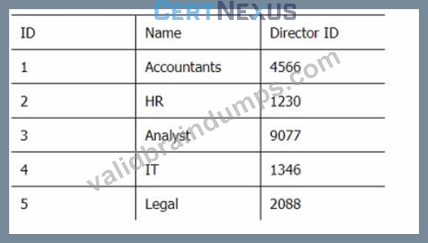
Director_Table
ID
Firstname
Lastname
Age
Salary
DeptJD
4566
Joey
Morin
62
$ 122,000
1
1230
Sam
Clarck
43
$ 95,670
2
9077
Lola
Russell
54
$ 165,700
3
1346
Lily
Cotton
46
$ 156,000
4
2088
Beckett
Good
52
$ 165,000
5
Which SQL query provides the Directors' Firstname, Lastname, the name of their departments, and the average employee's salary?
- A. SELECT m.Firstname, m.Lastname, d.Name, AVG(e.Salary) as Dept_avg_Salary FROM Employee_Table as e RIGHT JOIN Departmentjable as d on e.Dept = d.Name INNER JOIN Directorjable as m on d.ID = m.DeptJD GROUP BY d.Name
- B. SELECT m.Firstname, m.Lastname, d.Name, AVG(e.Salary) as Dept_avg_Salary FROM Employee_Table as e RIGHT JOIN Department_Table as d on e.Dept = d.Name INNER JOIN Directorjable as m on d.ID = m.DeptJD GROUP BY e.Salary
- C. SELECT m.Firstname, m.Lastname, d.Name, AVG(e.Salary) as Dept_avg_Salary FROM Employee_Table as e RIGHT JOIN Department_Table as d on e.Dept = d.Name INNER JOIN Directorjable as m on d.ID = m.DeptID GROUP BY m.Firstname, m.Lastname, d.Name
- D. SELECT m.Firstname, m.Lastname, d.Name, AVG(e.Saiary) as Dept_avg_Saiary FROM Employee_Table as e LEFT JOIN Department_Table as d on e.Dept = d.Name LEFT JOIN Directorjable as m on d.ID = m.DeptJD GROUP BY m.Firstname, m.Lastname, d.Name
Answer: C
Explanation:
Explanation
This SQL query provides the Directors' Firstname, Lastname, the name of their departments, and the average employee's salary by joining the three tables using the appropriate join types and conditions. The RIGHT JOIN between Employee_Table and Department_Table ensures that all departments are included in the result, even if they have no employees. The INNER JOIN between Department_Table and Directorjable ensures that only departments with directors are included in the result. The GROUP BY clause groups the result by the directors' names and departments' names, and calculates the average salary for each group using the AVG function. References: SQL Joins - W3Schools, SQL GROUP BY Statement - W3Schools
NEW QUESTION # 26
Which of the following is a common negative side effect of not using regularization?
- A. Low test accuracy
- B. Slow convergence time
- C. Overfitting
- D. Higher compute resources
Answer: C
Explanation:
Explanation
Overfitting is a common negative side effect of not using regularization. Regularization is a technique that reduces the complexity of a model by adding a penalty term to the loss function, which prevents the model from learning too many parameters that may fit the noise in the training data. Overfitting occurs when the model performs well on the training data but poorly on the test data or new data, because it has memorized the training data and cannot generalize well. References: Regularization (mathematics) - Wikipedia, Overfitting in Machine Learning: What It Is and How to Prevent It
NEW QUESTION # 27
You are developing a prediction model. Your team indicates they need an algorithm that is fast and requires low memory and low processing power. Assuming the following algorithms have similar accuracy on your data, which is most likely to be an ideal choice for the job?
- A. Random forest
- B. Support-vector machine
- C. Ridge regression
- D. Deep learning neural network
Answer: C
Explanation:
Explanation
Ridge regression is a type of linear regression that adds a regularization term to the loss function to reduce overfitting and improve generalization. Ridge regression is fast and requires low memory and low processing power, as it only involves solving a system of linear equations. Ridge regression can also handle multicollinearity (high correlation among predictors) by shrinking the coefficients of correlated predictors.
NEW QUESTION # 28 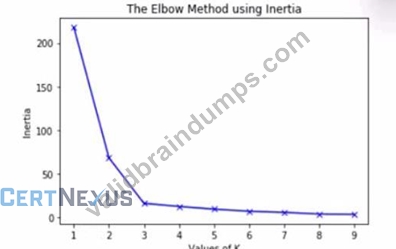
The graph is an elbow plot showing the inertia or within-cluster sum of squares on the y-axis and number of clusters (also called K) on the x-axis, denoting the change in inertia as the clusters change using k-means algorithm.
What would be an optimal value of K to ensure a good number of clusters?
- A. 0
- B. 1
- C. 2
- D. 3
Answer: C
Explanation:
Explanation
The optimal value of K is the one that minimizes the inertia or within-cluster sum of squares, while avoiding too many clusters that may overfit the data. The elbow plot shows a sharp decrease in inertia from K = 1 to K
= 2, and then a more gradual decrease from K = 2 to K = 3. After K = 3, the inertia does not change much as K increases. Therefore, the elbow point is at K = 3, which is the optimal value of K for this data. References:
How to Run K-Means Clustering in Python, K-means clustering - Wikipedia
NEW QUESTION # 29
Workflow design patterns for the machine learning pipelines:
- A. Aim to explain how the machine learning model works.
- B. Seek to simplify the management of machine learning features.
- C. Separate inputs from features.
- D. Represent a pipeline with directed acyclic graph (DAG).
Answer: D
Explanation:
Explanation
Workflow design patterns for machine learning pipelines are common solutions to recurring problems in building and managing machine learning workflows. One of these patterns is to represent a pipeline with a directed acyclic graph (DAG), which is a graph that consists of nodes and edges, where each node represents a step or task in the pipeline, and each edge represents a dependency or order between the tasks. A DAG has no cycles, meaning there is no way to start at one node and return to it by following the edges. A DAG can help visualize and organize the pipeline, as well as facilitate parallel execution, fault tolerance, and reproducibility.
NEW QUESTION # 30
When working with textual data and trying to classify text into different languages, which approach to representing features makes the most sense?
- A. Bag of words model with TF-IDF
- B. Word2Vec algorithm
- C. Clustering similar words and representing words by group membership
- D. Bag of bigrams (2 letter pairs)
Answer: D
Explanation:
Explanation
A bag of bigrams (2 letter pairs) is an approach to representing features for textual data that involves counting the frequency of each pair of adjacent letters in a text. For example, the word "hello" would be represented as
{"he": 1, "el": 1, "ll": 1, "lo": 1}. A bag of bigrams can capture some information about the spelling and structure of words, which can be useful for identifying the language of a text. For example, some languages have more common bigrams than others, such as "th" in English or "ch" in German .
NEW QUESTION # 31
When should the model be retrained in the ML pipeline?
- A. A new monitoring component is added.
- B. Some outliers are detected in live data.
- C. More data become available for the training phase.
- D. Concept drift is detected in the pipeline.
Answer: D
Explanation:
Explanation
When concept drift is detected in the pipeline, it means that the model performance has degraded over time due to changes in the underlying data generating process. This requires retraining the model with new data that reflects the current situation and updating the model parameters accordingly. References: Use pipeline parameters to retrain models in the designer - Azure Machine Learning | Microsoft Learn, Retraining Model During Deployment: Continuous Training and Continuous Testing
NEW QUESTION # 32
Which of the following are true about the transform-design pattern for a machine learning pipeline? (Select three.) It aims to separate inputs from features.
- A. It transforms the output data after production.
- B. It encapsulates the processing steps of ML pipelines.
- C. It represents steps in the pipeline with a directed acyclic graph (DAG).
- D. It ensures reproducibility.
- E. It seeks to isolate individual steps of ML pipelines.
Answer: B,D,E
Explanation:
Explanation
The transform-design pattern for ML pipelines aims to separate inputs from features, encapsulate the processing steps of ML pipelines, and represent steps in the pipeline with a DAG. These goals help to make the pipeline modular, reusable, and easy to understand. The transform-design pattern does not seek to isolate individual steps of ML pipelines, as this would create entanglement and dependency issues. It also does not transform the output data after production, as this would violate the principle of separation of concerns.
NEW QUESTION # 33
Which of the following tests should be performed at the production level before deploying a newly retrained model?
- A. A/Btest
- B. Security test
- C. Performance test
- D. Unit test
Answer: C
Explanation:
Explanation
Performance testing is a type of testing that should be performed at the production level before deploying a newly retrained model. Performance testing measures how well the model meets the non-functional requirements, such as speed, scalability, reliability, availability, and resource consumption. Performance testing can help identify any bottlenecks or issues that may affect the user experience or satisfaction with the model. References: [Performance Testing Tutorial: What is, Types, Metrics & Example], [Performance Testing for Machine Learning Systems | by David Talby | Towards Data Science]
NEW QUESTION # 34
Which of the following can benefit from deploying a deep learning model as an embedded model on edge devices?
- A. Increase in data bandwidth consumption
- B. A more complex model
- C. Guaranteed availability of enough space
- D. Reduction in latency
Answer: D
Explanation:
Explanation
Latency is the time delay between a request and a response. Latency can affect the performance and user experience of an application, especially when real-time or near-real-time responses are required. Deploying a deep learning model as an embedded model on edge devices can reduce latency, as the model can run locally on the device without relying on network connectivity or cloud servers. Edge devices are devices that are located at the edge of a network, such as smartphones, tablets, laptops, sensors, cameras, or drones.
NEW QUESTION # 35
Personal data should not be disclosed, made available, or otherwise used for purposes other than specified with which of the following exceptions? (Select two.)
- A. If the data is only collected once.
- B. If it is for a good cause.
- C. If it was collected accidentally.
- D. If it was requested by the authority of law.
- E. If it was with consent of the person it is collected from.
Answer: D,E
Explanation:
Explanation
Personal data is any information that relates to an identified or identifiable individual, such as name, address, email, phone number, or biometric data. Personal data should not be disclosed, made available, or otherwise used for purposes other than specified, except with:
The consent of the person it is collected from: Consent is a clear and voluntary indication of agreement by the person to the processing of their personal data for a specific purpose. Consent can be given by a statement or a clear affirmative action, such as ticking a box or clicking a button.
The authority of law: The authority of law is a legal basis or obligation that requires or permits the processing of personal data for a legitimate purpose. For example, the authority of law could be a court order, a subpoena, a warrant, or a statute.
NEW QUESTION # 36
Which two of the following statements about the beta value in an A/B test are accurate? (Select two.)
- A. The Beta value is the rate of type I errors for the test.
- B. The Beta in an Alpha/Beta test represents one of the two variants of the A/B test.
- C. The Beta value is the rate of type II errors for the test.
- D. The statistical power of a test is the inverse of the Beta value, or 1 - Beta.
Answer: C
Explanation:
Explanation
The Beta value in an A/B test is the probability of making a type II error, which is failing to reject the null hypothesis when it is false. The statistical power of a test is the probability of correctly rejecting the null hypothesis when it is false, which is equal to 1 - Beta. References: Formulas for Bayesian A/B Testing - Evan Miller, The Practical Guide To AB testing statistics | Convertize
NEW QUESTION # 37
Which three security measures could be applied in different ML workflow stages to defend them against malicious activities? (Select three.)
- A. Monitor model degradation.
- B. Use max privilege to control access to ML artifacts.
- C. Launch ML Instances In a virtual private cloud (VPC).
- D. Use data encryption.
- E. Disable logging for model access.
- F. Use Secrets Manager to protect credentials.
Answer: C,D,F
Explanation:
Explanation
Security measures can be applied in different ML workflow stages to defend them against malicious activities, such as data theft, model tampering, or adversarial attacks. Some of the security measures are:
Launch ML Instances In a virtual private cloud (VPC): A VPC is a logically isolated section of a cloud provider's network that allows users to launch and control their own resources. By launching ML instances in a VPC, users can enhance the security and privacy of their data and models, as well as restrict the access and traffic to and from the instances.
Use data encryption: Data encryption is the process of transforming data into an unreadable format using a secret key or algorithm. Data encryption can protect the confidentiality, integrity, and availability of data at rest (stored in databases or files) or in transit (transferred over networks). Data encryption can prevent unauthorized access, modification, or leakage of sensitive data.
Use Secrets Manager to protect credentials: Secrets Manager is a service that helps users securely store, manage, and retrieve secrets, such as passwords, API keys, tokens, or certificates. Secrets Manager can help users protect their credentials from unauthorized access or exposure, as well as rotate them automatically to comply with security policies.
NEW QUESTION # 38
......
AIP-210 Free Study Guide! with New Questions: https://www.validbraindumps.com/AIP-210-exam-prep.html
Pass AIP-210 Exam Latest Practice Questions: https://drive.google.com/open?id=1WT_TnbUq8NPbqWvwK5yNztLjHJ9Qip5U