

Quality NCP-CI-Azure PDF Dumps - NCP-CI-Azure Exam Questions
Most UptoDate Nutanix NCP-CI-Azure Exam Dumps PDF 2024
NEW QUESTION # 20
An administrator is tasked with configuring connectivity between an on-premises datacenter and Azure.
Which two connectivity options are supported? (Choose two.)
- A. Leased Line
- B. Direct Connect
- C. VPN
- D. ExpressRoute
Answer: C,D
Explanation:
For configuring connectivity between an on-premises datacenter and Azure, the two supported options are:
* VPN (Virtual Private Network):Site-to-Site VPN allows you to create a secure connection from your on-premises network to Azure over the public internet using IPsec/IKE protocols.
* ExpressRoute:Provides a private connection between your on-premises infrastructure and Azure, ensuring traffic does not traverse the public internet.
Both options provide secure and reliable connectivity, with ExpressRoute offering enhanced performance and security due to its private connection.References
* Azure VPN Gateway
* Azure ExpressRoute Overview
NEW QUESTION # 21
An administrator is tasked with preparing the company's Azure subscription for use with NCZ.
Which two Azure Resource Providers need to be registered? (Choose two.)
- A. Microsoft.HybridNetwork
- B. Microsoft.HybridCompute
- C. Microsoft.Nutanix
- D. Microsoft.Network
Answer: C,D
Explanation:
* Azure Resource Providers: To prepare an Azure subscription for NC2, specific resource providers must be registered to enable necessary services and resources.
* Required Providers:
* Microsoft.Network: This provider is essential for networking functionalities, including virtual networks, subnets, and other network resources necessary for NC2 deployment.
* Microsoft.Nutanix: This provider is specifically required for integrating and managing Nutanix resources within the Azure environment.
* Other Providers:
* Microsoft.HybridNetworkandMicrosoft.HybridCompute: These are not specifically required for NC2 but might be relevant for other hybrid or extended network configurations.
* Conclusion: Registering both "Microsoft.Network" and "Microsoft.Nutanix" ensures that all necessary network and Nutanix-specific resources are available for NC2 deployment.
References:
* Azure Resource Providers Documentation
* Nutanix on Azure Setup Guide
NEW QUESTION # 22
An administrator is planning on building the network prior to deploying a Nutanix cluster into Azure.
Which two components require their own vNets for NC2 in Azure? (Choose two.)
- A. Azure Load Balancer
- B. Virtual Network Gateway
- C. Bare-metal instance
- D. Prism Central
Answer: C,D
Explanation:
* NC2 on Azure Deployment: Deploying Nutanix clusters in Azure involves configuring various components, each needing appropriate network isolation and configuration.
* Components and vNets:
* Bare-metal instance: Requires its own vNet to ensure proper network isolation and performance.
* Prism Central: Needs a dedicated vNet to manage and monitor the Nutanix environment, ensuring it has the required network access and isolation.
* Azure Load Balancer: Does not require its own vNet but needs to be associated with the appropriate vNet where services are deployed.
* Virtual Network Gateway: Is used for VPN connections but does not necessitate a separate vNet; it operates within an existing vNet.
* Network Isolation: Providing separate vNets for Bare-metal instances and Prism Central ensures optimal performance and management capabilities.
* Conclusion: Both Bare-metal instances and Prism Central require their own vNets in the NC2 on Azure deployment.
References:
* Nutanix Clusters on Azure Deployment Guide
* Azure Virtual Network Documentation
NEW QUESTION # 23
An administrator must ensure that certain NC2 VMs can access Azure resources. The NC2 VM traffic must not traverse the internet.
How would the administrator achieve this?
- A. By creating an Azure Private Endpoint for VMs in the host-mgmt subnet.
- B. By creating an Azure Private Endpoint for VMs in a Delegated Subnet
- C. By creating an Azure Private Endpoint for VMs in a No-NAT network via vWAN.
- D. By creating an Azure Private Endpoint for VMs in a NAT network via vWAN.
Answer: B
Explanation:
* Azure Private Endpoint:A Private Endpoint provides secure connectivity to Azure resources by enabling private access through the Azure backbone network. This ensures that the traffic does not traverse the internet, providing enhanced security and performance.
* Delegated Subnet:By creating an Azure Private Endpoint for VMs in a delegated subnet, the administrator ensures that the VMs can access Azure resources directly and securely without using the public internet.
References:
* Azure Private Endpoint Documentation
* Nutanix NC2 Networking Configuration Guide
NEW QUESTION # 24
A nutanix user VPC called servers has three subnets called Tier1, tier2 and Darren-Tier3.
*Servers:10.0.0.0/16
* Tier1: 10.0.0.0/16
* Tier2: 10.0.0.0.128/25
* Darren-Tier3:10.0.4.0/24
An administrator wants to keep Darren-Tier3 isolated and not receive any outside traffic.
In order properly route for Tier1 and Tier2 coming from native subnets for Azure, what should the ERP be set to?
- A. Transit VPC ERP set to 10.0.0.0/24 and Servers ERP set to 10.0.0.0/24
- B. Transit VPC ERP set to 10.0.0.0/16 and Servers ERP set to 10.0.4.0/24
- C. Transit VPC ERP set to 10.0.0.0/16 and Servers ERP set to 10.0.0.0/25
- D. Transit VPC ERP set to 10.0.0.0/20 and Servers ERP set to 10.0.0.0/24
Answer: B
Explanation:
* ERP Configuration: ERP (External Route Prefix) settings determine how traffic is routed between subnets and VPCs.
* Objective: The goal is to isolate Darren-Tier3 while ensuring proper routing for Tier1 and Tier2.
* Transit VPC ERP: Setting it to 10.0.0.0/16 ensures that it covers the entire VPC range, allowing traffic within Tier1 and Tier2.
* Servers ERP: Setting it to 10.0.4.0/24 ensures isolation for Darren-Tier3 by limiting traffic to that specific subnet and preventing external traffic from reaching it.
* Conclusion: This configuration achieves the isolation of Darren-Tier3 while allowing proper routing for Tier1 and Tier2.
References:
* Nutanix Networking Documentation
* Azure Virtual Network Documentation
NEW QUESTION # 25
Exhibit.
An administrator is trying to create an NC2 cluster in Azure, but does not see the required region in the drop-down list.
Which two steps could the administrator take to resolve this issue? (Choose two.)
- A. Check the Azure subscription is created in the correct region.
- B. Ensure that the Azure region is whitelisted for use by Microsoft in the subscription.
- C. Check the NC2 Billingconsole to ensure the region is listed.
- D. Check the list of regions specified under the NC2 organization cloud account.
Answer: B,D
Explanation:
* Check the list of regions specified under the NC2 organization cloud account:The list of available regions in the NC2 console might be restricted based on the configuration of the cloud account associated with the NC2 organization. Verifying this list ensures that the desired region is included and available for cluster creation.
* Ensure that the Azure region is whitelisted for use by Microsoft in the subscription:Sometimes, specific regions need to be explicitly enabled or whitelisted in the Azure subscription for certain services. This step ensures that the required region is permitted for use within the Azure subscription, allowing the NC2 cluster to be created in that region.
References:
* Azure Subscription and Service Limits Documentation
* Nutanix NC2 Configuration and Setup Guide
NEW QUESTION # 26
An administrator has been tasked with scoping an NC2 on Azure deployment. One of the requirements is to ensure that the bare metal instance will support up to 20 TB of storage capacity.
Which bare metal instance should the administrator choose?
- A. AN36P
- B. ND96asr
- C. HB176rs
- D. AN36
Answer: A
Explanation:
* Storage Capacity Requirement: The requirement specifies that the bare metal instance must support up to 20 TB of storage capacity.
* Instance Selection: Among the provided options, the AN36P instance is designed to support higher storage capacities and performance needs.
* AN36P Capabilities: The AN36P instance is optimized for storage-intensive applications and provides the necessary hardware specifications to handle up to 20 TB of storage.
* Comparison with Other Instances:
* ND96asr: Typically optimized for GPU workloads rather than storage.
* AN36: May not meet the 20 TB storage requirement.
* HB176rs: Geared towards high-performance computing rather than large storage capacities.
* Conclusion: Based on the requirements and instance specifications, AN36P is the most suitable choice for supporting up to 20 TB of storage.
References:
* Nutanix NC2 Instance Types
* Azure Virtual Machine Sizes
NEW QUESTION # 27
Which console must be used to deploy a Nutanix cluster on Azure?
- A. Prism Element Console
- B. Azure Console
- C. Prism Central Console
- D. NC2 Console
Answer: D
Explanation:
* NC2 Console:The NC2 console is specifically designed for deploying and managing Nutanix clusters on Azure. It provides the necessary tools and interface to configure, monitor, and manage the NC2 clusters effectively.
* Cluster Deployment:Using the NC2 console ensures that all configurations and integrations with Azure are correctly handled, providing a seamless deployment experience.
References:
* Nutanix NC2 Deployment Guide
* Nutanix Console Documentation
NEW QUESTION # 28
An administrator needs the permission to create and manage multipleorganizations and clusters in NC2, as well as manage user access for the entire company.
What role should be assigned to meet the minimum requirements of this task?
- A. Customer Administrator
- B. Organization Administrator
- C. Customer Security Administrator
- D. Cluster Administrator
Answer: A
Explanation:
* Role Requirements: The task involves creating and managing multiple organizations and clusters, along with managing user access across the company.
* Role Capabilities: The "Customer Administrator" role is designed to provide extensive administrative capabilities, including:
* Creating and managing organizations.
* Managing clusters.
* Handling user access and permissions.
* Comparison of Roles:
* Cluster Administrator: Primarily focuses on managing individual clusters but does not encompass organization-wide administrative tasks.
* Customer Security Administrator: Focuses on security-related tasks and does not have broad administrative capabilities across organizations and clusters.
* Organization Administrator: Manages organizational settings but might not cover all aspects needed for multiple clusters and user access management.
* Conclusion: The "Customer Administrator" role meets all the requirements for managing organizations, clusters, and user access comprehensively.
References:
* Nutanix Role-Based Access Control Documentation
* NC2 on Azure User Roles Guide
NEW QUESTION # 29
A company needs to establish connectivity between the on-premises datacenter and Azure. The company does not have the infrastructure for a dedicated connection.
Which method will best satisfy this requirement?
- A. ExpressRoute
- B. VPN
- C. VNet Peering
- D. Azure Virtual WAN
Answer: B
Explanation:
* VPN for Connectivity:A VPN (Virtual Private Network) allows secure connectivity between the on-premises datacenter and Azure over the public internet without requiring dedicated infrastructure.
* Ease of Setup:VPNs are typically easier and quicker to set up compared to dedicated connections like ExpressRoute, making them suitable for organizations without existing dedicated connection infrastructure.
References:
* Azure VPN Gateway Documentation
* Nutanix NC2 Connectivity Guide
NEW QUESTION # 30
An administrator is tasked with allowing inbound connectivity for a user VM that resides on a NAT network.
The ...... communicating successfully with other VMs in the NAT network.
The cluster has the following characteristics
A Transit VPC exists
* A User VPC exists
* A NAT subnet has been created
* 25 floating IP addresses are in use by other VMs
* Routes have been configured
When the administrator attempts to assign a floating IP address to the VM, none are available.
What is the reason for this?
- A. An external DHCP server needs to be deployed into the cluster.
- B. An additional Flow Gateway instance is required.
- C. Additional floating IP addresses need to be requested.
- D. Geneve encapsulation only supports 25 Floating IP addresses.
Answer: C
Explanation:
* Floating IP Address Limitation:The cluster already has 25 floating IP addresses in use by other VMs.
If the administrator cannot assign a floating IP address to the new VM, it is because the pool of available floating IPs is exhausted.
* Requesting Additional Floating IPs:To resolve this issue, the administrator needs to request additional floating IP addresses to be allocated to the NAT subnet. This will ensure that there are enough IP addresses available for all VMs requiring inbound connectivity.
References:
* Nutanix Networking Configuration Guide
* Azure IP Address Management Documentation
NEW QUESTION # 31
An administrator is tasked with creating a new subnet for a group of VMs that require inbound internet access.
Internal private addresses must be obscured to servers on the public internet.
Which network is best suited for satisfying this requirement?
- A. NAT based network
- B. No-NAT based network
- C. Bastion based network
- D. Layer 2 Stretch network
Answer: A
Explanation:
* NAT Based Network:A NAT-based network is designed to provide inbound and outbound internet access while obscuring the internal private addresses. This setup uses Network Address Translation (NAT) to map internal IP addresses to a public IP address, ensuring that internal addresses are not exposed to the public internet.
* Security and Connectivity:NAT provides a layer of security by hiding internal IP addresses and allowing controlled access to external resources. This configuration is well-suited for VMs that need to communicate with servers on the public internet while maintaining the privacy of their internal network addresses.
References:
* Azure Virtual Network NAT Documentation
* Nutanix Networking and Security Configuration Guide
NEW QUESTION # 32
An NC2 on Azure environment requires that outside networks are allowed to be routed to a Nutanix User VPC from outside the cluster when using a No-Nat path.
Which configuration will satisfy this requirement?
- A. Externally routable IP address which shares the same address space of the Native Azure Subnet
- B. Internally routable network address which shares the sameaddress space of the Nutanix setVPC
- C. Externally routable IP address which shares the same address space of the Nutanix User VPC
- D. Internally routable network address which shares the same address space of the Native Azure Subnet
Answer: C
Explanation:
* No-NAT Path Requirement:For a No-NAT path to function, the external networks must be able to route traffic directly to the Nutanix User VPC without translation.
* Externally Routable IP Address:The externally routable IP address ensures that traffic from outside networks can reach the Nutanix User VPC.
* Address Space Compatibility:Sharing the same address space as the Nutanix User VPC allows for seamless integration and communication between the external network and the User VPC.
References:
* Azure Virtual Network Documentation on IP Addressing
* Nutanix NC2 Configuration Guide on No-NAT Networking
NEW QUESTION # 33
NC2 Azure API calls are failing and MCM no longer shows telemetry or health of the cluster.
Where should the administrator look first?
- A. Log into Prism and check alerts and notifications
- B. Check whitelisting of Outbound Communication
- C. SSH into the NC2 Azure CVMs
- D. Check VPN/ExpressRoute
Answer: B
Explanation:
* Outbound Communication Whitelisting:For NC2 Azure API calls and telemetry data to function correctly, certain outbound communications must be allowed. If these communications are not whitelisted, API calls can fail, and telemetry or health data might not be reported correctly.
* First Check:Given the symptoms (failing API calls and missing telemetry), the first step should be to ensure that all necessary outbound communications are correctly whitelisted. This includes ensuring that endpoints and services required for NC2 operation are accessible.
References:
* Nutanix NC2 Networking Requirements
* Azure Networking and Security Configuration Guide
NEW QUESTION # 34
After creating a new Nutanix User VPC, what is needed to allow traffic to flow out of the Flow gateway VM when using the NATed Path?
- A. Add a default route on the Nutanix User VPC of 0.0.0.0/0 to the External Overlay network.
- B. Edit the Internal Flow Gateway Security Group on the internal NIC to allow outbound taffic
- C. Edit the External Flow Gateway Security Group on the External NIC to allow outbound traffic.
- D. Add a default route on the Transit VPC of 0.0.0.0/0 to the Flow Gateway.
- E. Add a default route on the Transit VPC of 0.0.0.0/0 to the Flow Gateway.
Answer: A
Explanation:
* NATed Path Configuration: When using the NATed Path, it is essential to ensure that traffic can flow out of the Flow gateway VM to external networks.
* Default Route: Adding a default route on the Nutanix User VPC ensures that all outbound traffic is directed to the appropriate network gateway.
* Configuration Steps:
* Navigate to the routing settings of the Nutanix User VPC.
* Add a default route with the destination of 0.0.0.0/0, pointing to the External Overlay network.
* Security Group Settings:
* Ensure that the External Flow Gateway Security Group on the External NIC allows outbound traffic.
* Ensure that the Internal Flow Gateway Security Group on the internal NIC allows outbound traffic (if needed for internal network flows).
* Conclusion: Properly configuring the default route on the Nutanix User VPC enables outbound traffic flow via the NATed Path through the External Overlay network.
References:
* Nutanix Flow Gateway Configuration Guide
* Azure VPC Routing Documentation
NEW QUESTION # 35
A company wants to start using Nutanix Cloud Clusters (NC2) in Azure. The company has large spend commitments as part of a Microsoft Azure Consumption Commitment (MACC) totaling $15 million.
What approach should the administrator take to ensure the Nutanix licensing costs apply to the MACC?
- A. Purchase Nutanix licenses through the Azure Marketplace.
- B. Purchase Nutanix licenses directly from Nutanix and contact Microsoft support.
- C. Request a trial directly from Nutanix.
- D. Leverage existing Nutanix licenses
Answer: A
Explanation:
* Microsoft Azure Consumption Commitment (MACC):To ensure that the Nutanix licensing costs apply to the MACC, the company needs to make purchases that are recognized by Azure's billing system.
* Azure Marketplace Purchases:By purchasing Nutanix licenses through the Azure Marketplace, the costs will be included in the Azure billing and count towards the MACC, thereby leveraging the committed spend.
References:
* Azure Marketplace Documentation
* Nutanix Licensing Guide
NEW QUESTION # 36
Exhibit.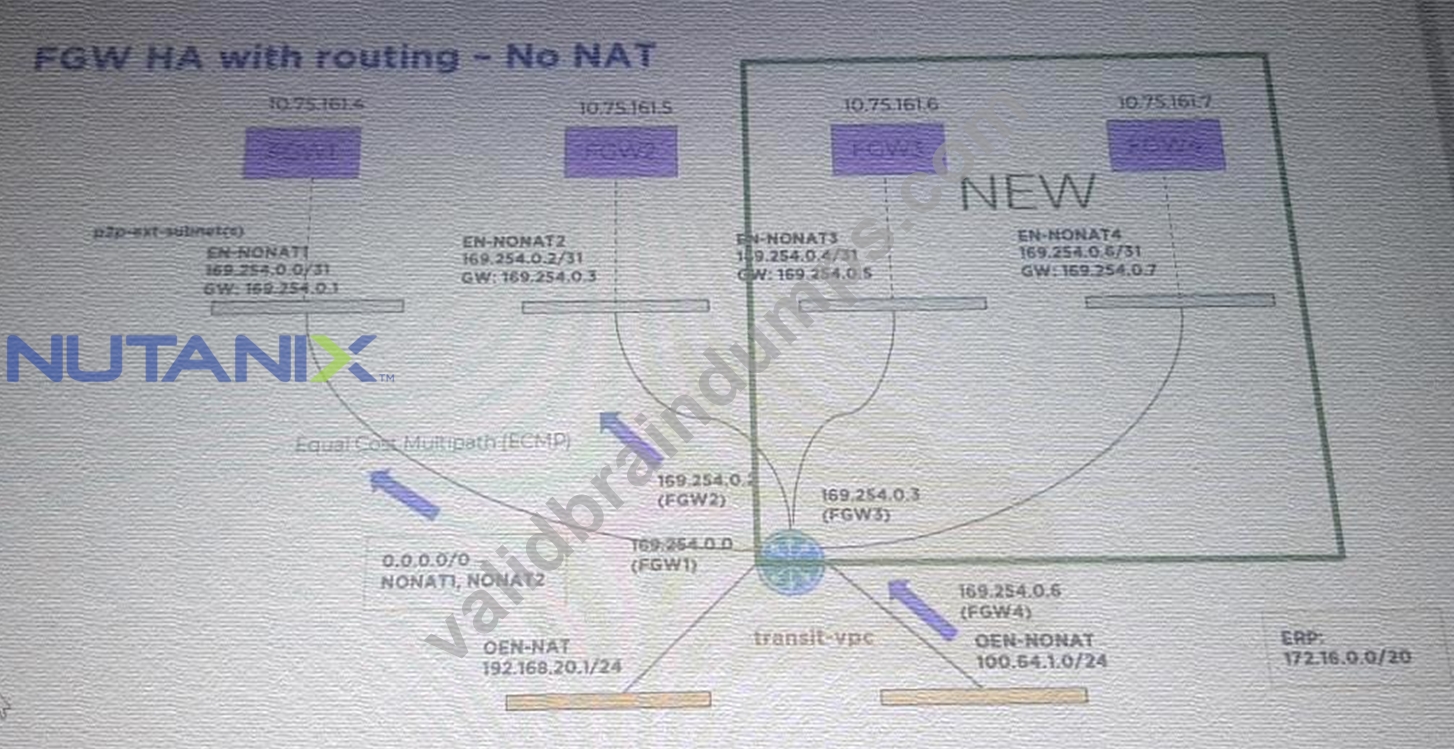
AN NC2 on Azure Cluster was deployed with two Flow gateways in HA (FGW1 and FGW2). After a week of use. Four bare-metal nodes, were added to the NC2 cluster and additional workloads were added.
It was determined that additional bandwidth for north/South traffic would be needed. Two additional Flow gateways were added (FGW3 and FGW4) from the NC2 portal configuration menu.
The existing workloads prior to expansion on the NC2 cluster will be able to use which Flow Gateways using the No-Nat (routed) traffic path?
- A. All Flow Gateways can be used after the existing workloads reboot.
- B. FGW1&FGW2 only, new workloads can use FGW3 & FGW4.
- C. Only the Flow Gateway that each workload was originally using.
- D. All Flow Gateways can be used.
Answer: D
Explanation:
In the scenario presented, the NC2 cluster was initially deployed with two Flow Gateways (FGW1 and FGW2) in HA. After adding four bare-metal nodes and additional workloads, two more Flow Gateways (FGW3 and FGW4) were added to handle the increased bandwidth for north/south traffic. Given the configuration, the existing workloads can utilize all available Flow Gateways (FGW1, FGW2, FGW3, and FGW4) for No-NAT (routed) traffic paths. This setup allows for Equal Cost Multipath (ECMP) routing, distributing traffic load across all Flow Gateways.
References
* Nutanix Flow Networking
NEW QUESTION # 37
A company is extending asubnet from their on-premises environment to an NC2cluster on Azure. The company is considering using either a Virtual Tunnel End Point (VTEP) or a layer 2 subnet Extension over VPN.
In which two scenarios would it be advantageous to use VTEP for this requirement? (Choose two.)
- A. Connectivity between sites already provides encryption.
- B. Multiple remote Availability Zones exist to add to the same VTEP-based extended Layer 2 subnet.
- C. Connectivity between sites already does not provided encryption.
- D. Only one remote Availability Zone exists that needs the subnet extended.
Answer: A,B
Explanation:
* Scenario Analysis:
* A. Connectivity between sites already provides encryption: Using VTEP in this scenario is advantageous because VTEP does not inherently provide encryption. If encryption is already provided, VTEP can be effectively used without additional security concerns.
* D. Multiple remote Availability Zones exist to add to the same VTEP-based extended Layer 2 subnet: VTEP is well-suited for scenarios where multiple remote Availability Zones need to be connected to the same extended Layer 2 subnet. This allows for efficient management and seamless connectivity across different zones.
* Scenarios B and C:
* B. Only one remote Availability Zone exists that needs the subnet extended: This scenario does
* not leverage the strengths of VTEP, as it is better suited for multiple zones.
* C. Connectivity between sites already does not provide encryption: Using VTEP without existing encryption is not ideal as VTEP itself does not encrypt the traffic.
* Conclusion: VTEP is advantageous when encryption is already in place and when multiple remote zones need to be connected to the same extended subnet.
References:
* Nutanix NC2 Networking Guide
* Azure Networking Documentation
NEW QUESTION # 38
......
100% Free Nutanix Certified Professional (NCP) NCP-CI-Azure Dumps PDF Demo Cert Guide Cover: https://www.validbraindumps.com/NCP-CI-Azure-exam-prep.html