

[Nov 12, 2024] AACE-PSP Exam Dumps - AACE International Practice Test Questions
New Real AACE-PSP Exam Dumps Questions
NEW QUESTION # 11
When resource leveling craft labor for a critical path schedule, the scheduler
- A. Need not consider its effects, as it is a theoretical concept with limited application to construction projects.
- B. Can depend on the results of the resource leveling operation to reflect a useful realignment of all schedule activities without 'further analysis.
- C. Must consider breaks in continuity of work for subcontractors, thereby possibly incurring additional subcontractor mobilization and demobilization costs.
- D. Need only consider the non-union crafts persons.
Answer: B
NEW QUESTION # 12
At the end of month one, did the delay to the parking structure foundation delay the project?
- A. Yes, by 9 calendar days.
- B. Yes, by 14 calendar days.
- C. NO.
- D. Yes, by 4 calendar days.
Answer: D
NEW QUESTION # 13
Which activity is drawn in the incorrect position?
- A. Activity E.
- B. Activity D.
- C. Activity C.
- D. Activity G.
Answer: B
NEW QUESTION # 14
Which of the following is NOT true?
- A. Constraints can interfere with the longest path calculation.
- B. A network must contain only one Critical Path.
- C. Multiple calendars can affect the total float calculation.
- D. Remaining durations can exceed original durations.
Answer: D
NEW QUESTION # 15
Assuming conventional finish-to-start relationships, to calculate a schedule retaining the existing logic means that
- A. It is calculated using logic reflecting out-of-sequence progress.
- B. It is calculated using the original logic.
- C. There is no such thing.
- D. An out-of-sequence activity cannot resume until all predecessors are finished.
Answer: B
NEW QUESTION # 16
In order for a claimant to be entitled to an extension of contract time for a delay event (and further to be considered compensable):
- A. The delay must affect the contractor's planned construction schedule.
- B. The delay must not cause monetary harm to the defendant.
- C. The delay must be concurrent with the delay attributable to both parties.
- D. The delay must affect the critical path.
Answer: D
NEW QUESTION # 17
Assuming a total of 30 lifts per crane per day, what is the maximum number of lifts that could be accomplished using 3 small tower cranes over a 5-day period?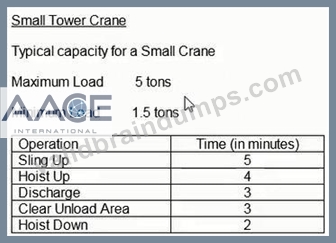
- A. 300 lifts
- B. 150 lifts
- C. 45 lifts
- D. 450 lifts
Answer: D
NEW QUESTION # 18
Based on the stated costs, what percentage of the total cost comes from the 2000 series of activities?
- A. 8.6% (1 : 11.591)
- B. 9.1% (1 : 11.000).
- C. 3.9% (1 : 25.708)
- D. 2.3% (1 : 43.501).
Answer: D
NEW QUESTION # 19
Determine the correct formula and date for the late start for Activity 9001.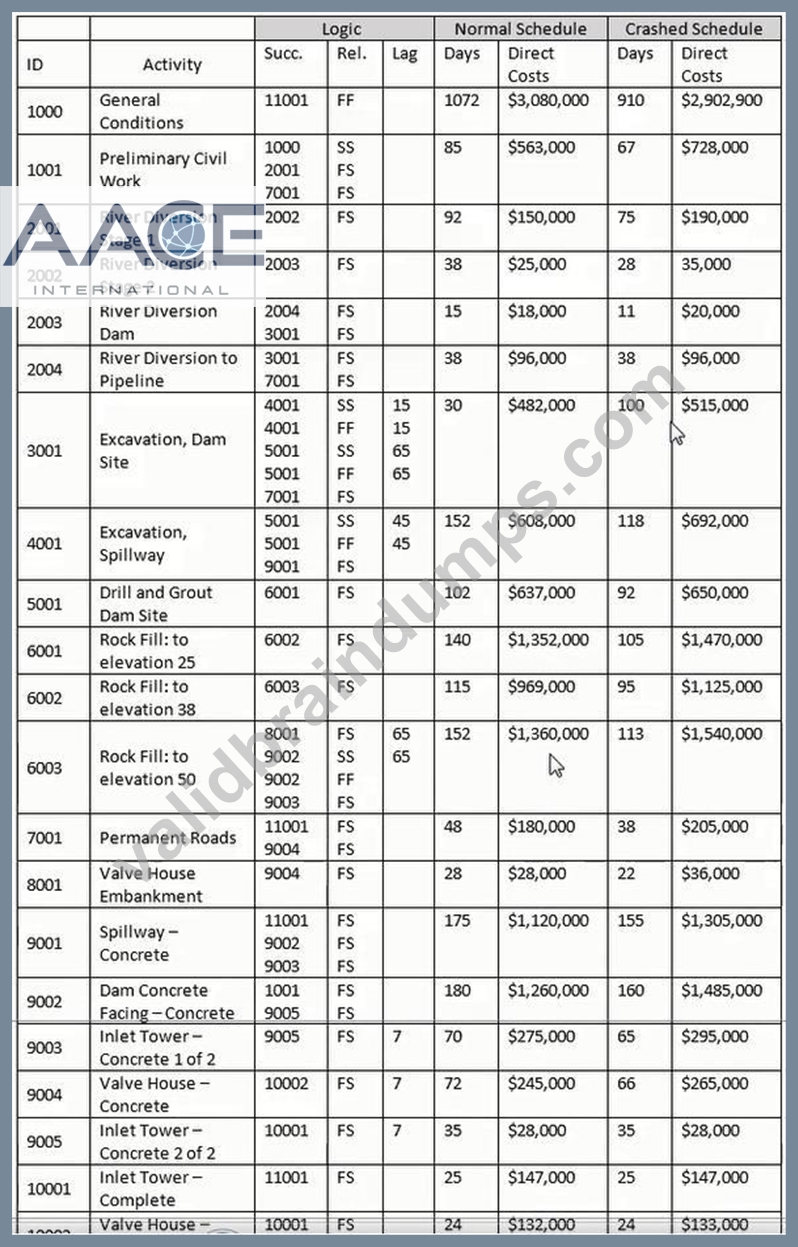
- A. There is insufficient data provided to calculate the answer.
- B. LS.6001 Dur.6001 -> 11-20-02.
- C. LF.9001 Dur.9001 -> 11-20-02.
- D. The early finish is required in order to determine the answer.
Answer: C
NEW QUESTION # 20
There is only enough room for a maximum of 4 cranes to be placed on-site. Assuming that a single crane can perform 35 lifts per day and that a column pour requires 60 lifts, what is the minimum number of tower cranes that should be used for the above described column pours?
- A. 2 cranes
- B. 3 cranes
- C. 4 cranes
- D. 1 crane
Answer: A
NEW QUESTION # 21
Each of the following accurately describes total float in a schedule EXCEPT:
- A. The amount of time an activity can be delayed without delaying the start or occurrence of any other activity or event in the network.
- B. Computed for an activity by subtracting its early finish from its late finish, or its early start from its late start.
- C. Can be positive or negative.
- D. The amount of time an activity can be delayed without delaying the overall project completion time.
Answer: A
NEW QUESTION # 22
For the late finish for Activity 11001, select the most appropriate response for transitioning from the forward pass.
- A. EF.11001.
- B. EF.11001 + 1 day.
- C. LS.11001 + 25 days.
- D. 02-19-04.
Answer: D
NEW QUESTION # 23
Why does activity 11001 not show successor activities?
- A. It is the final activity for the required work for the project
- B. The early finish and late finish are circular
- C. The scheduler forgot to add the successor activities
- D. It is the penultimate work required for the project
Answer: A
NEW QUESTION # 24
If a cost estimate assumes that 240 hours will be expended on a given activity, and the projected crew size expected to perform that activity is 5 personnel working and 8-hour workday, what is the calculated duration for the activity?
- A. 4 days
- B. 6 days
- C. 8 days
- D. 5 days
Answer: B
NEW QUESTION # 25
How could the structural steel drawing delay have been prevented?
- A. Add a time buffer at the end of structural steel activities.
- B. Allow adequate time for review and resubmittal in the baseline schedule.
- C. Release the structural steel for fabrication concurrent with review of structural steel shop drawings.
- D. Switch to post-tensioned concrete construction.
Answer: A
NEW QUESTION # 26
Which of the following documents is most likely to be of the LEAST value to a planner/scheduler when planning a contractor's baseline critical path schedule for the construction of a large high-clearance bridge located very near an airport? The contractor has been awarded the contract.
- A. The project geotechnical report
- B. The project plans and specifications
- C. The government's report on future high-clearance bridge projects
- D. The regulations published by the government aviation agency
Answer: C
NEW QUESTION # 27
Using the "normal" schedule, what is the early finish date of activity 10002 and its total float?
- A. 12-18-03 and 25 days of float
- B. 12-18-03 and 4 days of float
- C. 12-27-03 and 24 days of float
- D. 12-17-03 and 4 days of float
Answer: D
NEW QUESTION # 28
These are the activities on the critical path: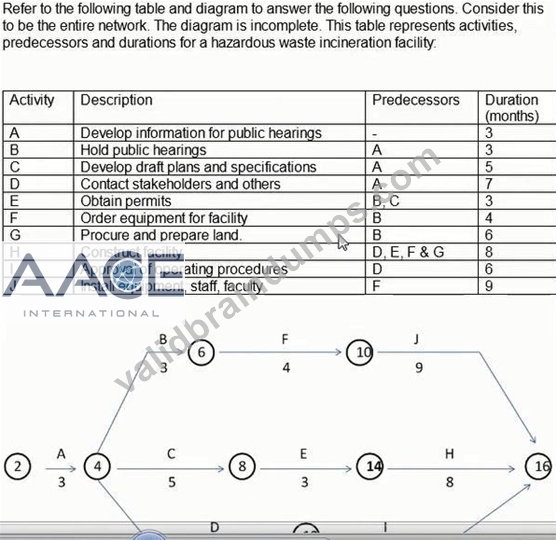
- A. A, B, F, & J
- B. A, B, G, & H.
- C. A, C, E, & H.
- D. A, D, & I.
Answer: B
NEW QUESTION # 29
Which of the following are NOT normally included in the project scope statement, either directly or by reference?
- A. Project objectives in terms of cost, schedule and quality measures
- B. Project deliverables
- C. Project contract between the contractor and owner
- D. Project justification
Answer: D
NEW QUESTION # 30
An early start constraint dictates
- A. The planned start of an activity.
- B. The planned start of a successor activity
- C. The actual start of an activity.
- D. An activity's remaining duration.
Answer: B
NEW QUESTION # 31
What is the primary difference between the arrow diagramming method (ADM) and the precedence diagramming method (PDM)?
- A. ADM is manual CPM calculations, while PDM is computerized.
- B. ADM is limited to finish-to-start logic relationships, while PDM is not.
- C. ADM uses arrows, while PDM uses boxes.
- D. PDM is a bar chart with network logic, while ADM is a pure logic network.
Answer: B
NEW QUESTION # 32
Time-scaled logic diagrams are
- A. Logic networks that are drawn to match the calendar.
- B. The same as a pure-logic diagram.
- C. Used to calculate the most probable activity duration.
- D. Only calculated using a computer.
Answer: A
NEW QUESTION # 33
What is a key first step in developing a critical path method schedule?
- A. Drawing the logic diagram.
- B. Drawing a bar chart of the key phrases of the work.
- C. Defining the execution plan to meet the required scope of work.
- D. Setting out the resource to be used and its limitations.
Answer: A
NEW QUESTION # 34
......
The AACE-PSP certification is recognized globally as a mark of excellence in project planning and scheduling. It is a valuable credential for professionals who work in project management, cost engineering, and related fields. Planning & Scheduling Professional (PSP) Exam certification demonstrates the holder's commitment to the highest standards of professionalism and expertise in project planning and scheduling. The AACE International also offers a range of professional development opportunities for certified professionals, including conferences, workshops, and online courses, to help them stay up-to-date with the latest trends and best practices in their field.
AACE-PSP Certification Exam Dumps Questions in here: https://drive.google.com/open?id=1NUkLEQdf6Fddl1cHG1tdSsJIVU5ZvQSM
Pass Your AACE-PSP Exam Easily with Accurate PDF Questions: https://www.validbraindumps.com/AACE-PSP-exam-prep.html